go-zero
Go microservice framework.
Free
Support platforms
web
What is go-zero
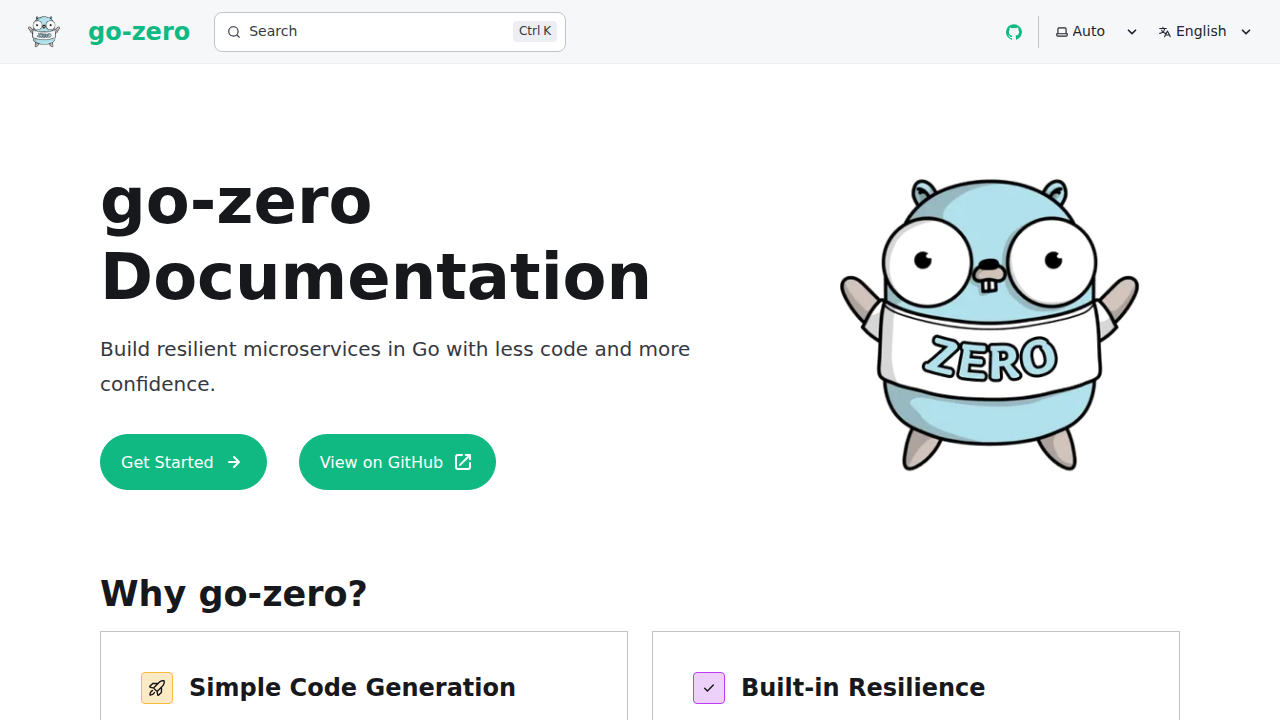
go-zero is a robust, high-performance microservice framework built in Go. It provides a comprehensive set of tools and features to streamline the development of cloud-native applications. go-zero distinguishes itself through its focus on ease of use, high performance, and built-in best practices, such as automatic code generation, service discovery, and circuit breaking. It leverages gRPC for efficient communication and offers features like request tracing and monitoring. Developers benefit from reduced boilerplate, faster development cycles, and improved application reliability. go-zero is ideal for teams building scalable, resilient microservices in Go, offering a production-ready solution out-of-the-box.
go-zero 's Core features
Automatic Code Generation
go-zero's goctl tool automates the generation of boilerplate code for APIs, gRPC services, and other components. This reduces manual coding effort and ensures consistency across your project. It supports generating code from .api files, which define your service's interface, request/response models, and other configurations. This allows developers to focus on business logic rather than infrastructure.
Built-in Service Discovery
Integrates with popular service discovery systems like etcd and Consul, enabling dynamic service registration and discovery. This allows services to locate each other without hardcoded addresses, facilitating scalability and resilience. The framework automatically handles service registration, health checks, and load balancing, simplifying microservice communication.
Circuit Breaker Implementation
Includes a built-in circuit breaker to prevent cascading failures in distributed systems. It monitors service health and automatically trips the circuit when a service becomes unavailable or slow, preventing further requests from overwhelming the failing service. This improves the overall stability and reliability of the system.
Request Tracing and Monitoring
Provides built-in support for request tracing using OpenTelemetry, allowing developers to track requests across multiple services. It integrates with monitoring tools like Prometheus and Grafana, providing metrics and dashboards for performance analysis and troubleshooting. This enables comprehensive visibility into the system's behavior.
High Performance gRPC Support
Leverages gRPC for efficient inter-service communication. gRPC uses Protocol Buffers for data serialization, resulting in smaller payloads and faster transmission compared to JSON-based APIs. go-zero optimizes gRPC usage with connection pooling and other performance enhancements, ensuring low latency and high throughput.
Rich Middleware Ecosystem
Offers a comprehensive set of middleware components for common tasks such as authentication, authorization, logging, and request validation. This allows developers to easily add cross-cutting concerns to their services without writing custom code. The middleware is designed to be modular and extensible, allowing for customization and integration with other tools.
How to use go-zero
- Install Go: Ensure Go version 1.18 or later is installed on your system. Verify with
go version.,2. Install goctl: Use the goctl tool for code generation and project management. Rungo install github.com/zeromicro/go-zero/tools/goctl@latest.,3. Create a new project: Generate a new project structure using goctl. For example:goctl api new my-api.,4. Define API: Define your API using a .api file, specifying endpoints, request/response structures, and other configurations.,5. Generate code: Use goctl to generate the server and client code from your .api file:goctl api go -api my-api.api -dir .,6. Run the server: Build and run your microservice usinggo run my-api.goor deploy it to your preferred environment.
Use cases of go-zero
Building Microservices
Develop a suite of independent, deployable services, each responsible for a specific business function. Teams can use go-zero to quickly build and deploy these services, leveraging its features for service discovery, circuit breaking, and request tracing. This allows for independent scaling and updates of individual services.
API Gateway Implementation
Create an API gateway to aggregate and manage requests to multiple backend microservices. go-zero's features, like routing, authentication, and rate limiting, can be used to build a robust and scalable gateway. This simplifies client interactions and provides a single point of entry for all API requests.
Cloud-Native Application Development
Build applications designed to run in cloud environments, such as Kubernetes or serverless platforms. go-zero's support for service discovery, health checks, and monitoring makes it well-suited for cloud-native deployments. It enables developers to build resilient and scalable applications that can adapt to changing resource demands.
Backend for Mobile Applications
Develop a backend for mobile applications that requires high performance and scalability. go-zero's gRPC support and efficient communication protocols allow for building backends that can handle a large number of concurrent requests. This ensures a responsive and reliable user experience.
Who benefits from go-zero
Go Developers
Experienced Go developers looking to build microservices or cloud-native applications. go-zero provides a framework that simplifies development, reduces boilerplate, and provides production-ready features, allowing developers to focus on business logic.
Backend Engineers
Backend engineers responsible for building and maintaining scalable and resilient systems. go-zero's features, such as service discovery, circuit breaking, and request tracing, help engineers build robust and observable backend services.
Microservices Architects
Architects designing microservice-based architectures. go-zero provides a comprehensive set of tools and features that align with microservices best practices, making it easier to build and manage complex distributed systems.
Cloud-Native Developers
Developers building applications for cloud environments, such as Kubernetes or serverless platforms. go-zero's features, such as service discovery and monitoring, make it well-suited for cloud-native deployments, enabling scalability and resilience.
Pricing of go-zero
Open Source (MIT License). Free to use, no paid tiers.