GORM
Golang ORM: Developer-Friendly
Free
Support platforms
web
What is GORM
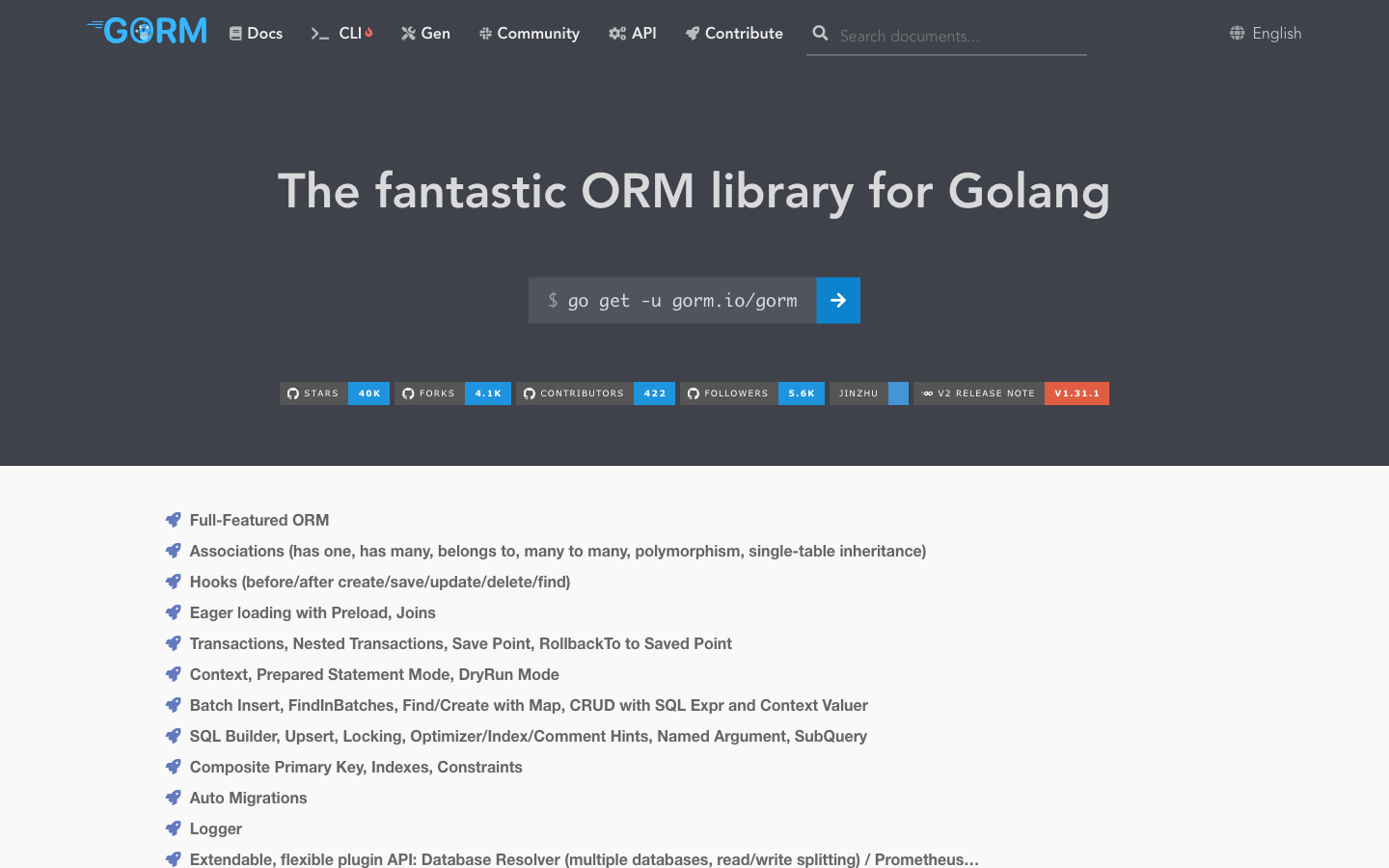
GORM is a full-featured Object-Relational Mapping (ORM) library for the Go programming language, designed to simplify database interactions. Its core value proposition lies in providing a developer-friendly interface for interacting with databases, abstracting away the complexities of raw SQL queries. GORM distinguishes itself through features like associations (one-to-one, one-to-many, many-to-many), hooks for lifecycle events, eager loading, and transaction support. It utilizes a plugin API for extensibility, allowing for database resolver and Prometheus integration. Developers working with Go and needing to manage database interactions efficiently benefit most from GORM, saving time and reducing the risk of SQL-related errors.
GORM 's Core features
Full-Featured Associations
GORM supports various association types, including has one, has many, belongs to, and many-to-many relationships. This simplifies the modeling of complex data structures and reduces the need for manual join queries. For example, you can easily load related data with `Preload` or `Joins`, improving code readability and maintainability. This feature streamlines database interactions for complex data models.
Hooks for Lifecycle Events
GORM provides hooks (before/after create/save/update/delete/find) that allow developers to execute custom logic at various stages of the database interaction lifecycle. This enables tasks such as data validation, data transformation, and logging. For instance, you can automatically hash passwords before saving a user record or update timestamps before saving or updating any record, enhancing data integrity and application behavior.
Eager Loading with Preload
Eager loading with `Preload` and `Joins` optimizes database queries by retrieving related data in a single query, reducing the 'N+1' query problem. This significantly improves performance, especially when dealing with complex relationships. For example, loading a user with their associated posts using `db.Preload("Posts").First(&user, 1)` avoids multiple database round trips.
Transaction Support
GORM supports transactions, nested transactions, save points, and rollback operations, ensuring data consistency and integrity. This is crucial for operations that involve multiple database interactions. For example, you can wrap a series of database operations within a transaction to ensure that either all operations succeed or none do, preventing partial updates.
Extensible Plugin API
GORM's flexible plugin API allows for customization and integration with other tools and services. This includes database resolvers for read/write splitting and Prometheus integration for monitoring. This extensibility allows developers to adapt GORM to their specific needs and integrate it with their existing infrastructure, enhancing its versatility.
How to use GORM
- Install GORM using
go get -u gorm.io/gormin your Go project.,2. Import the necessary packages in your Go file:import ( "gorm.io/gorm", "gorm.io/driver/sqlite" )(or your preferred database driver).,3. Establish a database connection:db, err := gorm.Open(sqlite.Open("test.db"), &gorm.Config{}).,4. Define your data models as Go structs, tagging fields for database mapping (e.g.,gorm:"primaryKey").,5. Use GORM's methods to perform CRUD operations:db.Create(&user),db.First(&user, 1),db.Model(&user).Update("name", "new name").,6. Explore advanced features like associations, hooks, and transactions as needed for your application's requirements.
Use cases of GORM
Web Application Development
Developers building web applications use GORM to manage database interactions, simplifying CRUD operations and handling complex relationships. They can define models, perform queries, and manage transactions, accelerating development and reducing boilerplate code. This is particularly useful for applications with complex data models and frequent database updates.
API Development
API developers utilize GORM to create RESTful APIs that interact with databases. GORM simplifies data retrieval, validation, and persistence, allowing developers to focus on API logic rather than low-level database details. This streamlines the process of building APIs that serve data from relational databases.
Microservices Architecture
In microservices architectures, GORM can be used to manage database interactions within individual services. Each service can have its own database and use GORM to interact with it, ensuring data consistency and facilitating communication between services. This approach promotes modularity and scalability.
Data Migration and Management
GORM's auto-migration feature helps developers manage database schema changes. Developers can define models in Go code, and GORM automatically creates or updates the database schema. This simplifies the process of database migrations and ensures that the database schema is always in sync with the application's data models.
Who benefits from GORM
Go Developers
Go developers who need an ORM to simplify database interactions, reduce boilerplate code, and improve code maintainability. GORM provides a developer-friendly interface and a wide range of features to streamline database operations.
Web Application Developers
Web application developers building applications with Go and needing to manage database interactions efficiently. GORM simplifies CRUD operations, handles complex relationships, and provides features like transactions and hooks, accelerating development.
API Developers
API developers using Go to build RESTful APIs that interact with databases. GORM simplifies data retrieval, validation, and persistence, allowing developers to focus on API logic rather than low-level database details.
Backend Engineers
Backend engineers working on projects that require database interactions and data modeling. GORM provides a powerful and flexible ORM solution that simplifies database operations and improves code quality.
Pricing of GORM
Open Source (MIT License). Free to use.