React
JavaScript library for UI building.
Free
Support platforms
web
What is React
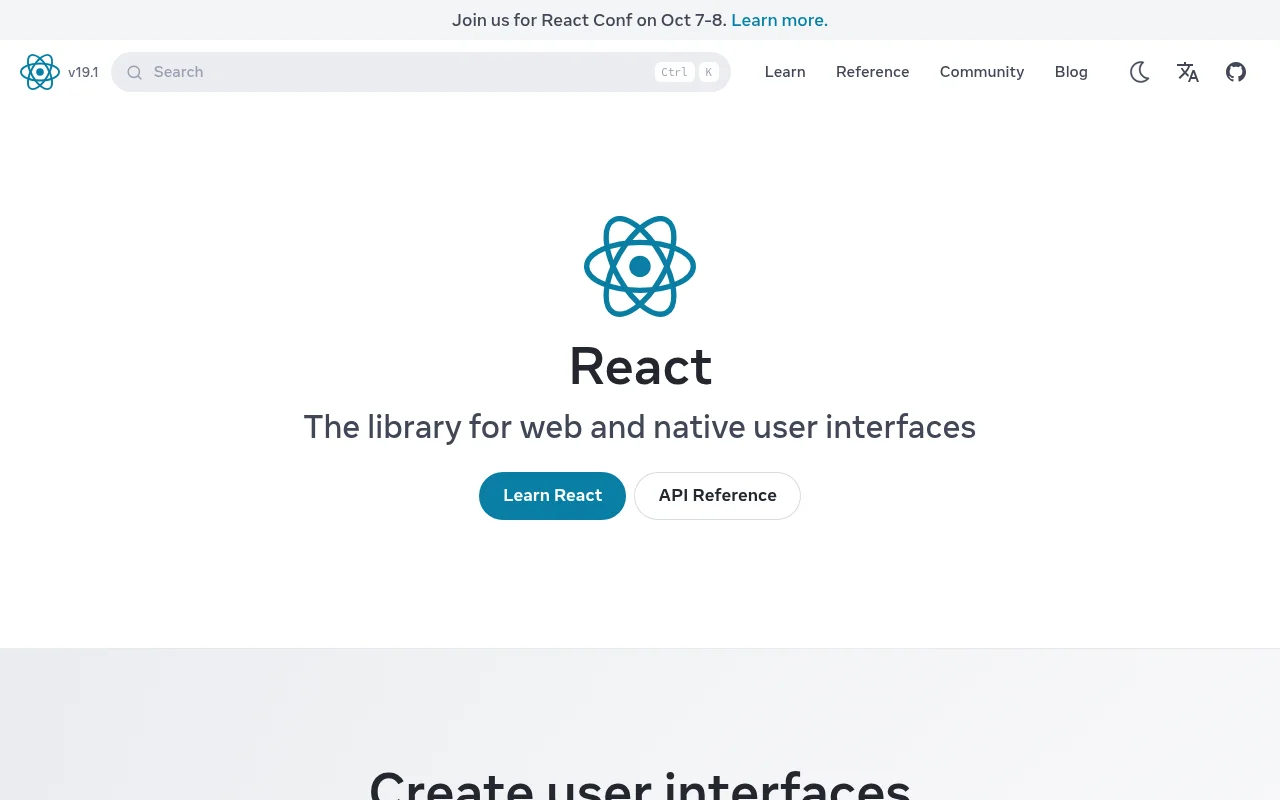
React is a JavaScript library for building user interfaces, focusing on component-based architecture and declarative programming. It allows developers to create reusable UI components that efficiently update the DOM, leading to faster and more maintainable applications. Unlike traditional JavaScript frameworks that manipulate the DOM directly, React uses a virtual DOM to optimize updates, resulting in improved performance. React's component-based approach promotes code reusability and modularity, making it easier to manage complex UIs. It's ideal for building single-page applications, interactive web pages, and mobile apps with a focus on user experience and performance. React's ecosystem offers a wide range of tools and libraries, making it a versatile choice for developers of all skill levels.
React 's Core features
Component-Based Architecture
React's core strength lies in its component-based architecture. Developers build UIs from independent, reusable components. Each component manages its own state and renders a piece of the UI. This modular approach improves code organization, maintainability, and reusability. It allows for easier debugging and collaboration, as changes in one component typically don't affect others, leading to faster development cycles.
Virtual DOM for Efficiency
React uses a virtual DOM to optimize UI updates. When data changes, React first updates the virtual DOM. It then compares the virtual DOM with the actual DOM and only updates the parts of the actual DOM that have changed. This process minimizes direct DOM manipulation, which is a slow operation, resulting in significant performance improvements, especially for complex UIs with frequent updates.
JSX Syntax for UI
React uses JSX, a syntax extension to JavaScript, to describe the UI. JSX allows developers to write HTML-like structures within JavaScript code, making it easier to visualize and build UI components. JSX is compiled into regular JavaScript calls, providing a more intuitive and readable way to define the UI compared to direct DOM manipulation or string concatenation.
Unidirectional Data Flow
React enforces a unidirectional data flow, meaning data flows in one direction: from parent components to child components. This makes it easier to track and manage data changes, reducing the likelihood of unexpected side effects and simplifying debugging. This predictable data flow is a key factor in React's maintainability and scalability, especially in large applications.
Rich Ecosystem and Community
React benefits from a large and active community, providing extensive documentation, tutorials, and a vast ecosystem of libraries and tools. This includes state management libraries (like Redux and Zustand), routing libraries (like React Router), and UI component libraries (like Material UI and Ant Design). This rich ecosystem accelerates development and provides solutions for various UI challenges.
Declarative Programming
React promotes declarative programming, where developers describe what the UI should look like based on the current state, rather than explicitly manipulating the DOM. React handles the actual DOM updates efficiently. This declarative approach makes code easier to understand, maintain, and debug. It also allows React to optimize UI updates automatically.
How to use React
- Set up a new React project using Create React App:
npx create-react-app my-app.,2. Navigate into your project directory:cd my-app.,3. Start the development server:npm start. This will launch your app in a browser athttp://localhost:3000.,4. Create React components by defining JavaScript functions or classes that return JSX (JavaScript XML).,5. Use JSX to describe the UI structure and content within your components.,6. Import and render components within other components to build your application's structure.
Use cases of React
Single-Page Applications (SPAs)
Developers use React to build SPAs, providing a fast and fluid user experience. React's component-based architecture and efficient DOM updates enable smooth transitions and dynamic content loading without full page reloads. This is ideal for applications like social media platforms, dashboards, and interactive web applications where responsiveness is critical.
Interactive UI Components
React is used to create reusable and interactive UI components, such as buttons, forms, and data visualizations. Developers can build these components once and reuse them across multiple projects, saving time and ensuring consistency. React's component-based approach makes it easy to manage the state and behavior of these interactive elements.
Web Application Front-Ends
React is a popular choice for building the front-end of web applications, providing a robust framework for managing UI logic, data fetching, and user interactions. Developers can integrate React with back-end APIs to create dynamic and responsive web experiences. React's performance and scalability make it suitable for applications of all sizes.
Mobile App Development (with React Native)
React Native, built on React, allows developers to build native mobile applications for iOS and Android using JavaScript and React. This enables code reuse between web and mobile platforms, reducing development time and effort. React Native provides access to native device features, creating a seamless user experience.
Who benefits from React
Front-End Developers
Front-end developers benefit from React's component-based architecture, JSX syntax, and efficient DOM updates. It simplifies UI development, improves code organization, and enhances performance, allowing them to build complex and interactive web applications more efficiently.
Full-Stack Developers
Full-stack developers can leverage React for the front-end while using other technologies for the back-end. React's versatility and large ecosystem enable them to build complete web applications, from UI to API integration, with a consistent and maintainable codebase.
UI/UX Designers
UI/UX designers can collaborate effectively with React developers to create user-friendly and visually appealing interfaces. React's component-based approach allows designers to easily understand and contribute to the UI development process, ensuring design consistency and efficient implementation.
Mobile App Developers (with React Native)
Mobile app developers can use React Native to build native mobile applications for iOS and Android. This allows them to leverage their JavaScript and React skills to create cross-platform apps, reducing development time and effort while maintaining native performance.
Pricing of React
React is an open-source JavaScript library, available under the MIT License, and is free to use for any purpose, including commercial projects.