Rust Programming Language
Reliable & Efficient Systems Language
Free
Support platforms
web
What is Rust Programming Language
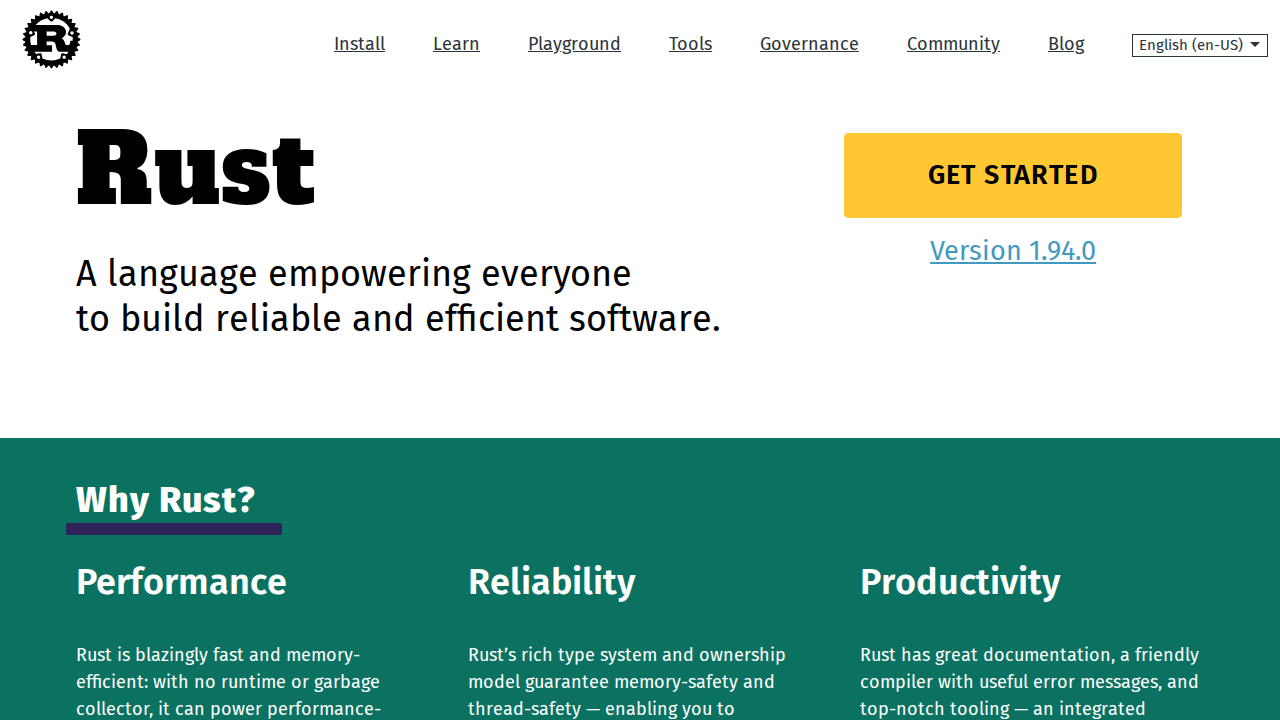
Rust is a systems programming language focused on safety, speed, and concurrency. It addresses the challenges of modern software development by providing memory safety without garbage collection, enabling developers to build reliable and efficient software. Unlike languages with runtime overhead like Java or Python, Rust compiles directly to machine code, delivering performance comparable to C and C++. Its ownership model and rich type system prevent common programming errors such as null pointer dereferences and data races at compile time. Rust's package manager, Cargo, simplifies dependency management and build processes. It's ideal for performance-critical services, embedded systems, and integrating with other languages, offering a robust solution for developers seeking control and efficiency.
Rust Programming Language 's Core features
Memory Safety Without GC
Rust's ownership, borrowing, and lifetime system ensures memory safety at compile time, eliminating runtime errors like dangling pointers and memory leaks. This is achieved without a garbage collector, leading to predictable performance and reduced overhead. This approach contrasts with languages like Java and Python, which rely on garbage collection, potentially introducing pauses and performance variability. Rust's memory management is deterministic and efficient.
Blazing Fast Performance
Rust compiles directly to machine code, resulting in performance comparable to C and C++. Benchmarks consistently show Rust's speed advantage over interpreted languages like Python and JavaScript. This performance is critical for applications requiring low latency and high throughput, such as game engines, operating systems, and network services. Rust's zero-cost abstractions further contribute to its efficiency.
Concurrency Without Data Races
Rust's ownership model and type system enable safe concurrent programming. The compiler prevents data races at compile time, ensuring that multiple threads can access and modify data without conflicts. This is a significant advantage over languages where concurrency errors are often detected at runtime, leading to unpredictable behavior. This safety is achieved through features like `Send` and `Sync` traits.
Rich Type System
Rust's type system is expressive and powerful, allowing developers to catch errors early in the development process. It supports generics, traits, and pattern matching, enabling the creation of robust and maintainable code. The compiler provides helpful error messages, guiding developers toward correct solutions. This contrasts with dynamically typed languages where type-related errors are often discovered during runtime.
Cargo Package Manager
Cargo simplifies dependency management, building, and testing of Rust projects. It automatically downloads and manages dependencies, builds projects, and runs tests. Cargo also integrates with crates.io, the Rust package registry, making it easy to share and reuse code. This streamlined process significantly improves developer productivity and reduces the complexity of managing dependencies.
How to use Rust Programming Language
- Visit the official Rust website (rust-lang.org) and click 'Get Started'.,2. Follow the instructions to install Rust using the rustup installer, which manages Rust versions and toolchains.,3. Open a terminal or command prompt and verify the installation by running
rustc --version.,4. Create a new Rust project using Cargo:cargo new my_project.,5. Navigate into your project directory:cd my_project.,6. Edit thesrc/main.rsfile to write your first Rust program, then build and run it usingcargo run.
Use cases of Rust Programming Language
Network Services
Developers building high-performance network services benefit from Rust's speed, reliability, and low resource footprint. Companies like Cloudflare use Rust for critical infrastructure components, achieving significant performance gains and improved stability compared to other languages. Rust's ability to handle concurrency safely makes it ideal for handling numerous concurrent connections.
Embedded Systems
Engineers working on embedded systems leverage Rust's fine-grained control over hardware and memory. Rust's ability to compile to bare metal and its lack of a runtime or garbage collector make it suitable for resource-constrained devices. This allows developers to build reliable and efficient firmware for IoT devices, microcontrollers, and other embedded applications.
Command-Line Tools
Developers create fast and reliable command-line tools using Rust's robust ecosystem. The language's performance and safety features ensure that tools are efficient and less prone to errors. Cargo simplifies dependency management, making it easy to distribute and maintain command-line applications. This is particularly useful for DevOps and system administration tasks.
WebAssembly (Wasm)
Developers can use Rust to compile code to WebAssembly (Wasm) and run it in web browsers or other Wasm environments. This allows for high-performance web applications and the reuse of existing Rust code on the client-side. This approach is particularly beneficial for computationally intensive tasks like image processing or game development.
Who benefits from Rust Programming Language
Systems Programmers
Systems programmers benefit from Rust's low-level control, memory safety, and performance. They can build operating systems, device drivers, and other system-level software with greater reliability and efficiency, reducing the risk of memory-related bugs that plague C and C++ development.
Backend Developers
Backend developers can use Rust to build high-performance, scalable, and reliable server-side applications. Rust's concurrency features and memory safety make it well-suited for handling a large number of concurrent requests, ensuring optimal performance and resource utilization. This is particularly useful for building network services and APIs.
Embedded Systems Engineers
Embedded systems engineers can leverage Rust's ability to target low-resource devices and its fine-grained control over hardware. Rust's safety features help prevent common errors in embedded programming, leading to more reliable and secure firmware. This is ideal for IoT devices, microcontrollers, and other embedded applications.
WebAssembly Developers
WebAssembly developers can use Rust to write high-performance code that runs in web browsers. Rust's performance and safety features make it an excellent choice for computationally intensive web applications, such as games, simulations, and data visualization tools. This allows developers to bring native-like performance to the web.
Pricing of Rust Programming Language
Rust is free and open-source, licensed under the MIT License and Apache License 2.0. There are no associated costs for using the language, its compiler, or its standard library.