LLaMA
Open-source LLM for research.
Free
Support platforms
web
Tool tags
What is LLaMA
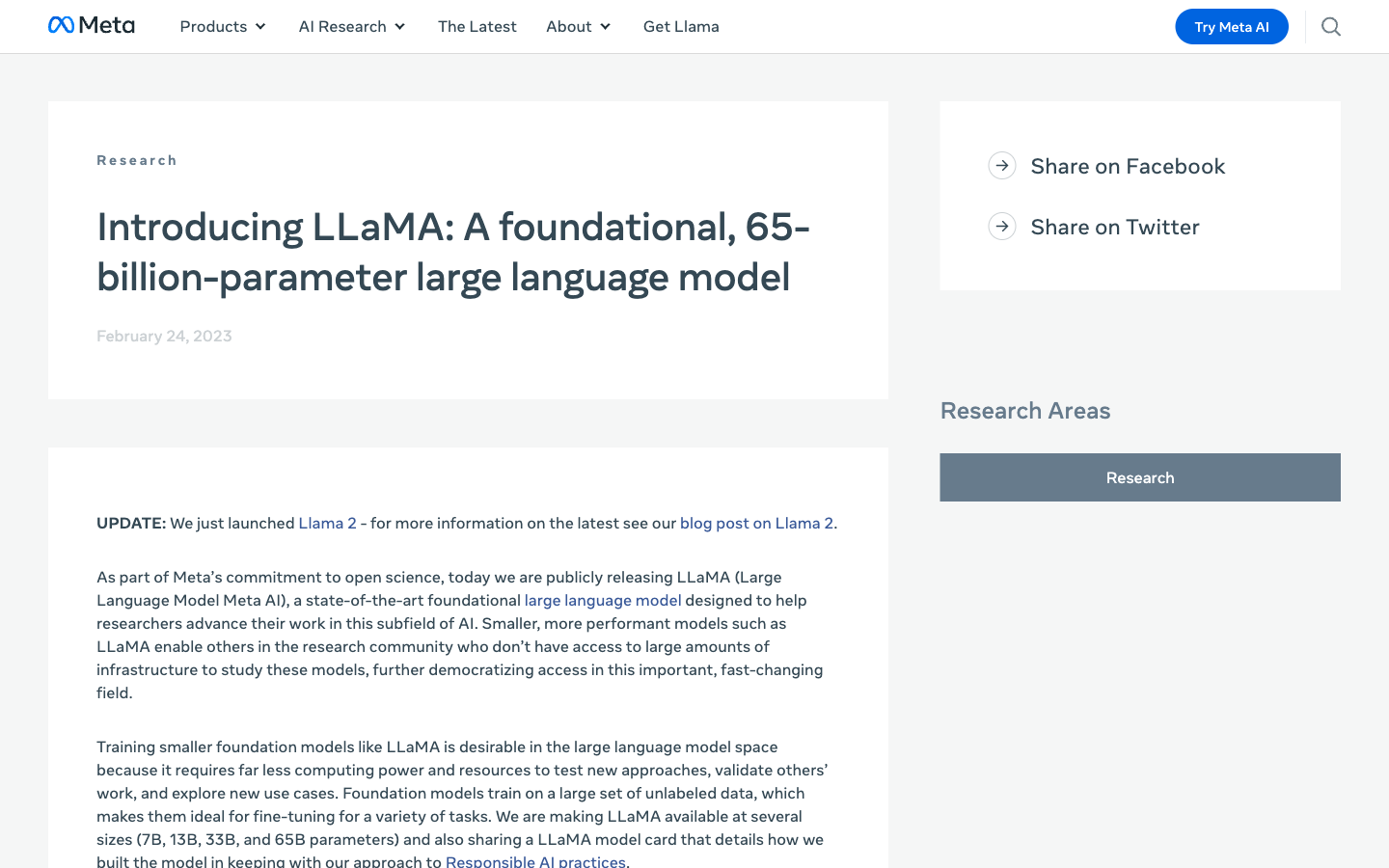
LLaMA (Large Language Model Meta AI) is a foundational language model developed by Meta AI, designed to advance research in the field of large language models. It offers various sizes, including a 65-billion-parameter model, and is intended for use by researchers. LLaMA's key value lies in its open-source nature, enabling researchers to access, study, and build upon its architecture. This contrasts with proprietary models, fostering collaborative development and accelerating progress in areas like natural language understanding, generation, and reasoning. The model's architecture is based on the transformer model, utilizing techniques like improved training data and optimization strategies to achieve high performance with fewer parameters than comparable models. Researchers and developers benefit from LLaMA by gaining a powerful, customizable tool for exploring and pushing the boundaries of AI.
LLaMA 's Core features
Open-Source Availability
LLaMA's open-source nature allows researchers to freely access, modify, and redistribute the model and its code. This promotes transparency, reproducibility, and collaborative research. Unlike closed-source models, LLaMA enables in-depth analysis of its architecture, training data, and performance characteristics, fostering innovation and accelerating advancements in the field of large language models. This open approach allows for community contributions and rapid iteration.
Multiple Model Sizes
LLaMA is available in various sizes, including models with 7B, 13B, 33B, and 65B parameters. This allows researchers to select the model size that best suits their computational resources and research objectives. Smaller models are easier to experiment with and require less computational power, while larger models typically offer improved performance on complex tasks. This flexibility allows for scalability and experimentation.
Transformer Architecture
LLaMA is built upon the transformer architecture, a widely adopted and highly effective neural network design for natural language processing. The transformer architecture utilizes self-attention mechanisms to process input sequences, allowing the model to capture long-range dependencies and contextual relationships within the text. This architecture is crucial for achieving state-of-the-art performance in various NLP tasks.
Optimized Training Data
LLaMA was trained on a massive dataset of text data, carefully curated and optimized to improve model performance. The training data includes a diverse range of sources, such as publicly available datasets, web data, and books. Data preprocessing techniques, such as filtering and cleaning, were applied to ensure data quality and reduce noise, leading to improved model accuracy and generalization capabilities.
Efficient Training Techniques
Meta AI employed efficient training techniques to train LLaMA, enabling the model to achieve high performance with fewer parameters compared to some other models. These techniques include optimized training algorithms, hardware acceleration, and distributed training strategies. This results in a model that is more computationally efficient and requires less resources for training and inference, making it more accessible for research.
How to use LLaMA
- Review the LLaMA research paper and understand its architecture and training methodology. 2. Request access to the model weights through the provided form on the Meta AI website. 3. Download the model weights after access is granted, ensuring compliance with the licensing terms. 4. Choose a compatible inference framework (e.g., PyTorch, Transformers library) to load and run the model. 5. Prepare your input data, such as text prompts, for the model. 6. Run inference using the chosen framework and analyze the model's outputs.
Use cases of LLaMA
NLP Research
Researchers can use LLaMA to explore novel architectures, training methods, and fine-tuning techniques for language models. They can experiment with different datasets, evaluate model performance on various NLP tasks, and contribute to the advancement of the field. This allows for rapid prototyping and experimentation with different model configurations.
Model Benchmarking
LLaMA can be used as a benchmark model to compare the performance of new language models. Researchers can evaluate their models against LLaMA on standard NLP benchmarks, such as question answering, text summarization, and sentiment analysis. This provides a standardized way to assess the progress and effectiveness of different model architectures.
Fine-tuning for Specific Tasks
Developers can fine-tune LLaMA on specific datasets to create specialized language models for various applications. For example, a model can be fine-tuned for customer service chatbots, content generation, or code completion. This allows for customization and adaptation to specific domain requirements, improving performance on targeted tasks.
Educational Purposes
Students and educators can use LLaMA to learn about large language models and experiment with different NLP techniques. They can explore the model's architecture, training process, and capabilities. This provides a hands-on learning experience and fosters a deeper understanding of AI concepts. It also allows for educational projects and research.
Who benefits from LLaMA
AI Researchers
Researchers benefit from LLaMA's open-source nature, allowing them to study, modify, and build upon the model's architecture. They can use it to explore new research directions, benchmark their models, and contribute to the advancement of NLP.
NLP Developers
Developers can leverage LLaMA to build and fine-tune custom language models for various applications. They can integrate LLaMA into their projects, experiment with different configurations, and create specialized solutions for their specific needs.
Students and Educators
Students and educators can use LLaMA for educational purposes, such as learning about large language models and experimenting with NLP techniques. It provides a valuable tool for hands-on learning and research projects in the field of AI.
Pricing of LLaMA
Open source, available for research purposes under a non-commercial license. Access to model weights requires approval.