Tokio
Async runtime for Rust.
Free
Support platforms
web
What is Tokio
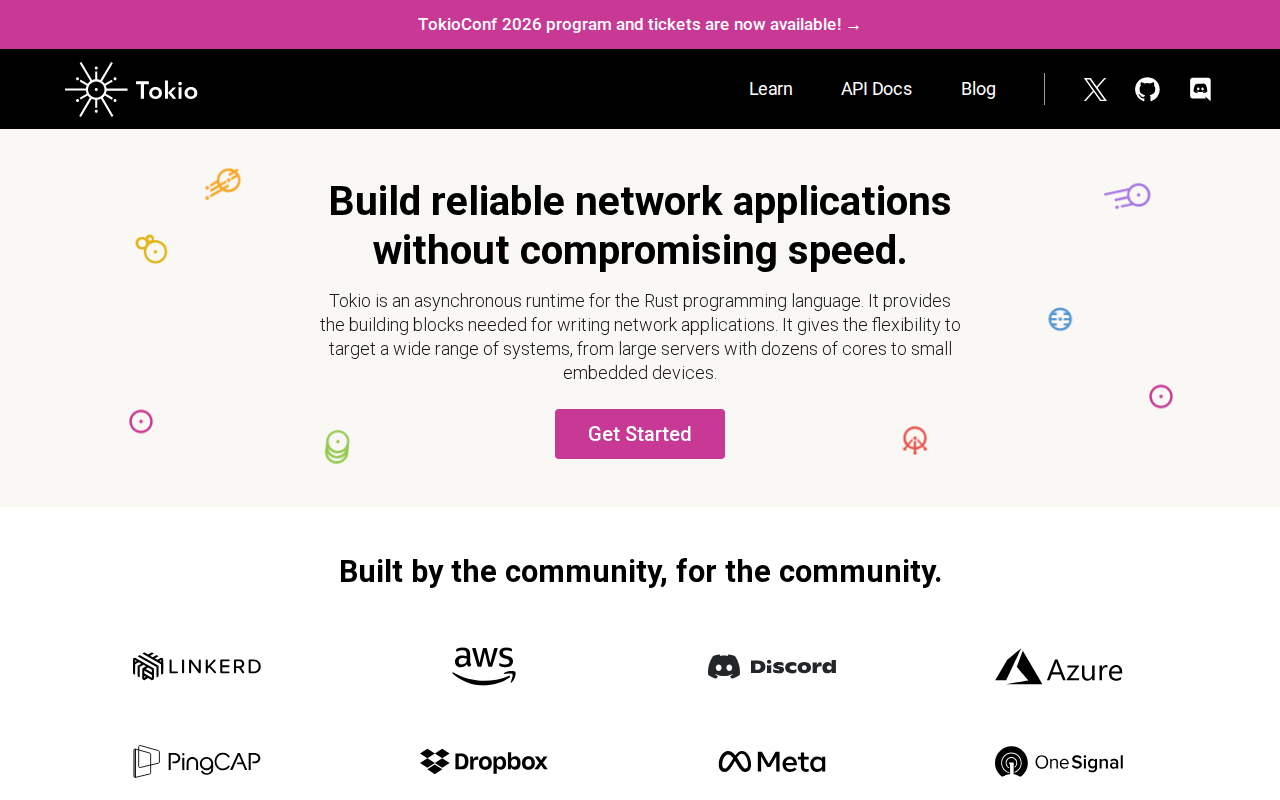
Tokio is an asynchronous runtime for the Rust programming language, providing the foundational building blocks for writing high-performance network applications. It offers a memory-safe, thread-safe, and misuse-resistant environment, mitigating common bugs like unbounded queues and buffer overflows. Unlike traditional threading models, Tokio leverages a multi-threaded, work-stealing scheduler, enabling applications to handle hundreds of thousands of requests per second with minimal overhead. Its async/await syntax simplifies asynchronous programming, and its flexible design allows for customization across various systems, from large servers to embedded devices. Developers building network services, APIs, and embedded systems in Rust will find Tokio invaluable for achieving both performance and reliability.
Tokio 's Core features
Asynchronous Runtime
Tokio provides a complete asynchronous runtime environment for Rust, managing I/O, timers, filesystem operations, synchronization primitives, and scheduling. This allows developers to write concurrent and non-blocking applications, improving resource utilization and responsiveness. The runtime uses a work-stealing scheduler to efficiently distribute tasks across multiple threads, maximizing throughput.
Memory-Safe & Thread-Safe
Tokio leverages Rust's memory safety guarantees to prevent common programming errors such as data races, memory leaks, and buffer overflows. The runtime's design ensures that concurrent operations are handled safely, reducing the risk of unexpected behavior and improving application stability. This is achieved through Rust's ownership and borrowing system.
High Performance
Built on Rust's performance capabilities, Tokio delivers exceptional speed and efficiency. Its multi-threaded, work-stealing scheduler allows applications to process a high volume of requests with minimal overhead. Benchmarks often show Tokio-based applications handling hundreds of thousands of requests per second, outperforming many other asynchronous runtimes.
Async/Await Syntax
Tokio embraces Rust's `async/await` syntax, simplifying the development of asynchronous applications. This syntax makes asynchronous code easier to read, write, and maintain compared to traditional callback-based approaches. It allows developers to write asynchronous code that looks and behaves like synchronous code.
Extensible Ecosystem
Tokio integrates with a rich ecosystem of libraries, including Hyper (HTTP client/server), Tonic (gRPC), Tower (modular components), and Tracing (structured logging). These components provide pre-built solutions for common tasks, accelerating development and improving application functionality. This ecosystem allows developers to build complex applications with ease.
Flexible Configuration
Tokio offers flexibility in configuration to suit various application needs. While it provides sensible defaults, developers can fine-tune the runtime's behavior, such as the number of worker threads, the I/O driver, and the scheduler settings. This allows for optimization for different hardware and workload characteristics.
How to use Tokio
- Add Tokio as a dependency to your Rust project by including
tokio = "1"in yourCargo.tomlfile under the[dependencies]section.,2. Import thetokioprelude in your Rust code:use tokio::prelude::*;oruse tokio::main;for the macro.,3. Use the#[tokio::main]macro above yourmainfunction to automatically initialize the Tokio runtime.,4. Utilizeasyncandawaitkeywords to define asynchronous functions and await their results, enabling non-blocking operations.,5. Use Tokio's provided utilities liketokio::net::TcpListenerandtokio::sync::Mutexto build network applications and manage concurrency.,6. Run your application usingcargo runand observe the asynchronous behavior, such as handling multiple network connections concurrently.
Use cases of Tokio
Network Servers
Developers building high-performance network servers (e.g., web servers, API servers) use Tokio to handle numerous concurrent connections efficiently. They leverage Tokio's asynchronous I/O and concurrency features to minimize latency and maximize throughput, resulting in a responsive and scalable service. Examples include building HTTP servers with Hyper or gRPC servers with Tonic.
Embedded Systems
Tokio is used in embedded systems and IoT devices to manage network communication and handle asynchronous tasks. Developers can build applications that interact with sensors, communicate over networks, and perform background processing without blocking the main thread. This allows for efficient resource utilization in constrained environments.
Command-Line Tools
Developers create command-line tools that perform network operations, such as downloading files, interacting with APIs, or managing cloud resources. Tokio enables these tools to perform asynchronous operations, improving responsiveness and allowing them to handle multiple tasks concurrently without blocking the user interface.
Real-time Applications
Tokio is used in real-time applications, such as chat applications, online games, and financial trading platforms, to handle high volumes of concurrent connections and maintain low latency. The asynchronous nature of Tokio allows these applications to process events and update the user interface in real-time.
Who benefits from Tokio
Rust Developers
Rust developers who need to build high-performance, concurrent, and reliable network applications. Tokio provides the necessary tools and runtime environment to leverage Rust's strengths in memory safety and performance, enabling them to create robust and scalable solutions.
Backend Engineers
Backend engineers building APIs, microservices, and network services. Tokio simplifies the development of asynchronous network applications, allowing them to handle a large number of concurrent requests efficiently, improving the performance and scalability of their backend systems.
Embedded Systems Engineers
Engineers working on embedded systems and IoT devices. Tokio enables them to build network-connected applications with efficient resource utilization, allowing for asynchronous communication and background processing without blocking the main thread.
DevOps Engineers
DevOps engineers who need to optimize the performance and scalability of their applications. Tokio helps them build and deploy efficient network services, reducing resource consumption and improving the overall performance of their infrastructure.
Pricing of Tokio
Open Source (MIT License). Free to use and contribute to. No paid plans or tiers.