rust-analyzer
Rust IDE features via Language Server
Free
Support platforms
web
What is rust-analyzer
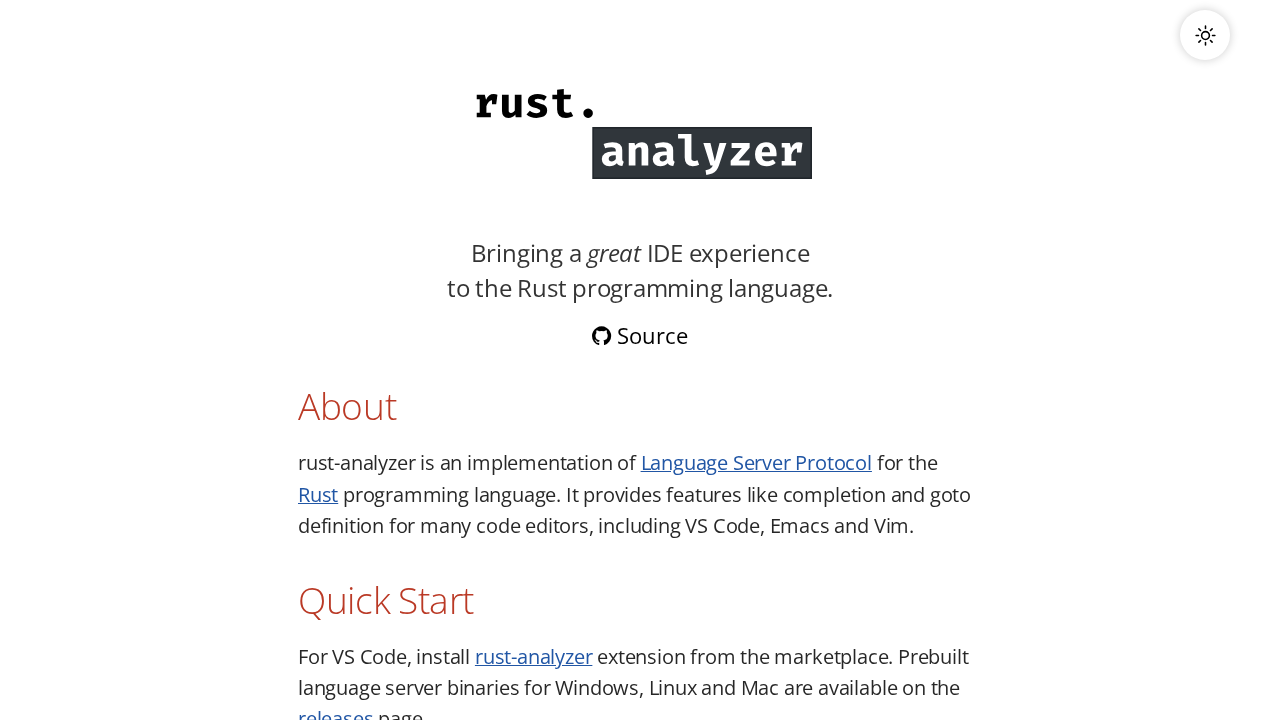
rust-analyzer provides a robust IDE experience for the Rust programming language by implementing the Language Server Protocol (LSP). It offers essential features like code completion, go-to-definition, and error highlighting, enhancing developer productivity. Unlike basic text editors, rust-analyzer integrates deeply with the Rust compiler, providing accurate and context-aware suggestions. Its key advantage lies in its focus on performance and accuracy, offering a responsive and reliable coding environment. Developers using VS Code, Emacs, Vim, and other editors benefit from its seamless integration. The project is open-source, developed by Ferrous Systems, and supported by various contributors, ensuring continuous improvement and community-driven development.
rust-analyzer 's Core features
Intelligent Code Completion
Provides context-aware code completion suggestions as you type, significantly reducing development time. It leverages the Rust compiler's understanding of your code to offer accurate suggestions, including imports, function signatures, and struct members. This feature is more precise than generic completion tools, often predicting the exact code you need, thus minimizing errors and improving code quality. This is achieved by parsing the code and analyzing the Abstract Syntax Tree (AST).
Go-to-Definition & Find References
Enables quick navigation within your codebase. Clicking on a variable or function name will instantly take you to its definition, and 'find references' allows you to see all usages of a symbol. This is crucial for understanding code flow and refactoring. This functionality is powered by the LSP, which analyzes the code's structure and dependencies, providing results in milliseconds, even in large projects, improving developer efficiency.
Real-time Error Diagnostics
Offers immediate feedback on syntax errors, type mismatches, and other issues as you write code. The analyzer highlights errors directly in your editor, providing clear and concise explanations. This proactive approach helps catch errors early in the development cycle, reducing debugging time and improving code quality. The diagnostics are based on the Rust compiler's error messages, ensuring accuracy.
Refactoring Support
Includes refactoring tools like rename, extract function, and inline variable, making code maintenance easier. These tools automatically update all references to a symbol when you rename it, reducing the risk of introducing errors. The refactoring capabilities are built on top of the LSP, which understands the code's structure and dependencies, ensuring safe and accurate transformations.
Integration with Rustfmt & Clippy
Seamlessly integrates with Rustfmt (code formatting) and Clippy (linting) to enforce consistent code style and identify potential issues. Rustfmt automatically formats your code according to the Rust style guidelines, while Clippy provides suggestions for improving code quality and preventing common mistakes. This integration ensures that your code adheres to best practices and is easy to read and maintain.
How to use rust-analyzer
- Ensure you have a supported code editor installed (VS Code, Emacs, Vim are recommended).,2. For VS Code, install the 'rust-analyzer' extension from the VS Code Marketplace.,3. For other editors, consult the rust-analyzer manual for installation instructions specific to your editor.,4. Open your Rust project in your chosen editor.,5. rust-analyzer will automatically start providing features like code completion, error diagnostics, and go-to-definition.,6. Configure rust-analyzer settings in your editor to customize its behavior (e.g., enabling features, setting linting rules).
Use cases of rust-analyzer
Developing Rust Applications
Software engineers use rust-analyzer to write, debug, and maintain Rust applications. They benefit from features like code completion, error diagnostics, and refactoring tools, which accelerate the development process and reduce the likelihood of errors. This leads to faster development cycles and higher-quality code.
Learning Rust
Beginners learning Rust can use rust-analyzer to understand the language better. The real-time error diagnostics and code completion features provide immediate feedback and guidance, helping them learn the language's syntax and best practices. This accelerates the learning curve and makes the process more enjoyable.
Refactoring Large Codebases
Teams working on large Rust projects use rust-analyzer's refactoring tools to safely and efficiently modify their code. Features like rename and find references enable them to make changes without introducing errors, which is critical for maintaining code quality and reducing technical debt.
Contributing to Open Source Rust Projects
Developers contributing to open-source Rust projects use rust-analyzer to understand and modify existing code. The go-to-definition and find references features help them navigate complex codebases, while the real-time error diagnostics ensure that their contributions are correct and adhere to the project's coding standards.
Who benefits from rust-analyzer
Rust Developers
Experienced Rust developers benefit from the advanced features like code completion, refactoring tools, and real-time error diagnostics, which significantly improve their productivity and code quality. It helps them write and maintain complex Rust applications efficiently.
Rust Learners
Individuals learning the Rust programming language find rust-analyzer invaluable. The real-time error diagnostics and code completion features provide immediate feedback and guidance, making it easier to understand the language's syntax and best practices.
Open Source Contributors
Developers contributing to open-source Rust projects rely on rust-analyzer to navigate and understand existing codebases. The go-to-definition and find references features help them quickly grasp the code's structure and dependencies, facilitating contributions.
Teams maintaining large Rust projects
Teams working on large Rust projects use rust-analyzer's refactoring tools to safely and efficiently modify their code. Features like rename and find references enable them to make changes without introducing errors, which is critical for maintaining code quality and reducing technical debt.
Pricing of rust-analyzer
Open Source (MIT License). Free to use and contribute to. Donations accepted via Open Collective.
More similar tools like rust-analyzer

Kimi AI with K2.5
Kimi is an AI-powered chatbot designed to assist users with various inquiries and tasks.


Reply Logo
Windsurf is an intuitive AI coding assistant designed to enhance developer productivity and streamline coding workflows.