Express
Fast, minimalist Node.js framework
Free
Support platforms
web
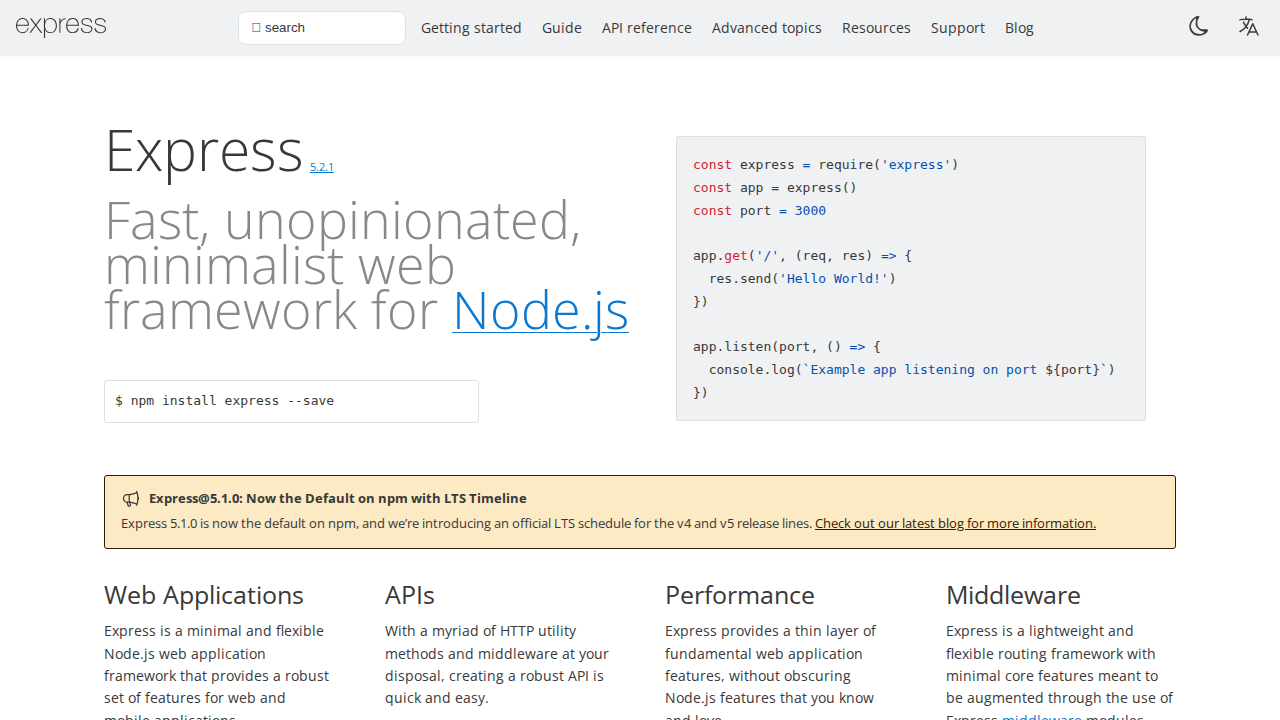
What is Express
Express is a fast, unopinionated, and minimalist web application framework for Node.js. It provides a robust set of features for building web and mobile applications, offering a thin layer of fundamental features without obscuring Node.js's native capabilities. Its core value lies in its flexibility and speed, enabling developers to quickly create APIs and web applications with minimal overhead. Unlike full-fledged frameworks, Express allows developers to choose their own middleware, providing granular control over the application's functionality. This approach, combined with its lightweight design, makes Express ideal for projects requiring performance and customization. Developers building APIs, single-page applications, and real-time applications benefit most from Express's streamlined approach.
Express 's Core features
Minimalist Web Framework
Express provides a lean core, offering essential features for web application development without imposing rigid structures. This minimalist design allows developers to select and integrate middleware modules as needed, promoting flexibility and customization. This contrasts with more opinionated frameworks that may restrict choices, making Express suitable for diverse project requirements and architectural preferences.
Flexible Routing
Express offers a powerful routing system that allows developers to define routes for different HTTP methods (GET, POST, PUT, DELETE, etc.) and URLs. This flexibility enables the creation of complex web applications and APIs. Developers can use route parameters, middleware, and regular expressions to handle various request scenarios, ensuring efficient and organized code.
Middleware Support
Express's middleware architecture allows developers to extend the framework's functionality by adding custom or third-party modules. Middleware functions can intercept and modify requests and responses, enabling features such as authentication, logging, and request parsing. This modular approach promotes code reusability and simplifies the integration of various functionalities.
Template Engine Integration
Express seamlessly integrates with various template engines (e.g., Pug, EJS, Handlebars) to simplify the creation of dynamic web pages. Template engines allow developers to separate the presentation logic from the application logic, making it easier to manage and maintain the user interface. This integration streamlines the development of server-side rendered applications.
Fast Performance
Express is designed for speed and efficiency. Its lightweight core and minimal overhead contribute to fast response times and efficient resource utilization. This performance is crucial for handling a large number of concurrent requests, making Express suitable for building high-traffic web applications and APIs. Benchmarks often show Express performing well compared to other Node.js frameworks.
How to use Express
- Install Node.js and npm (Node Package Manager) on your system.,2. Create a project directory and navigate into it using the command line.,3. Initialize a new Node.js project by running
npm init -yin your project directory.,4. Install Express using npm:npm install express --save.,5. Create a file (e.g.,index.js) and import Express:const express = require('express');.,6. Define routes and middleware to handle HTTP requests and responses. For example:app.get('/', (req, res) => { res.send('Hello World!'); });.,7. Start the server by runningnode index.jsand accessing your application in a web browser (e.g.,http://localhost:3000).
Use cases of Express
Building REST APIs
Developers use Express to create robust and scalable RESTful APIs. They define routes, handle HTTP methods, and integrate middleware for tasks like authentication and data validation. This allows them to build backend services that can be consumed by various client applications, such as mobile apps and single-page web applications.
Developing Single-Page Applications (SPAs)
Frontend developers use Express to build the backend for SPAs. They create API endpoints to serve data to the frontend, handle user authentication, and manage server-side logic. This allows them to create dynamic and interactive web applications with a clean separation between the frontend and backend.
Creating Real-time Applications
Express is used to build real-time applications such as chat applications and collaborative tools. Developers integrate WebSockets or Server-Sent Events (SSE) to enable real-time communication between the server and clients. This allows for instant updates and interactive user experiences.
Prototyping and Rapid Development
Developers leverage Express for rapid prototyping and quick development cycles. Its minimalist design and ease of use allow them to quickly build and test web applications and APIs. This is particularly useful for validating ideas and iterating on designs before committing to a more complex framework.
Who benefits from Express
Backend Developers
Backend developers benefit from Express's flexibility and ease of use when building APIs and server-side logic. They can quickly create and deploy web applications with minimal overhead, focusing on core functionality rather than framework complexities.
Full-Stack Developers
Full-stack developers utilize Express to build both the frontend and backend of web applications. They can leverage their existing JavaScript knowledge to create complete web solutions, from API endpoints to user interfaces.
API Developers
API developers use Express to build RESTful APIs that serve data to various client applications. The framework's routing capabilities and middleware support make it easy to create scalable and maintainable APIs.
JavaScript Developers
JavaScript developers find Express easy to learn and use, as it leverages their existing knowledge of JavaScript and Node.js. This allows them to quickly build web applications and APIs without having to learn a new language or framework.
Pricing of Express
Open Source (MIT License). Free to use, modify, and distribute. No associated costs or subscription fees.