Protocol Buffers Documentation
Language-neutral data serialization.
Free
Support platforms
web
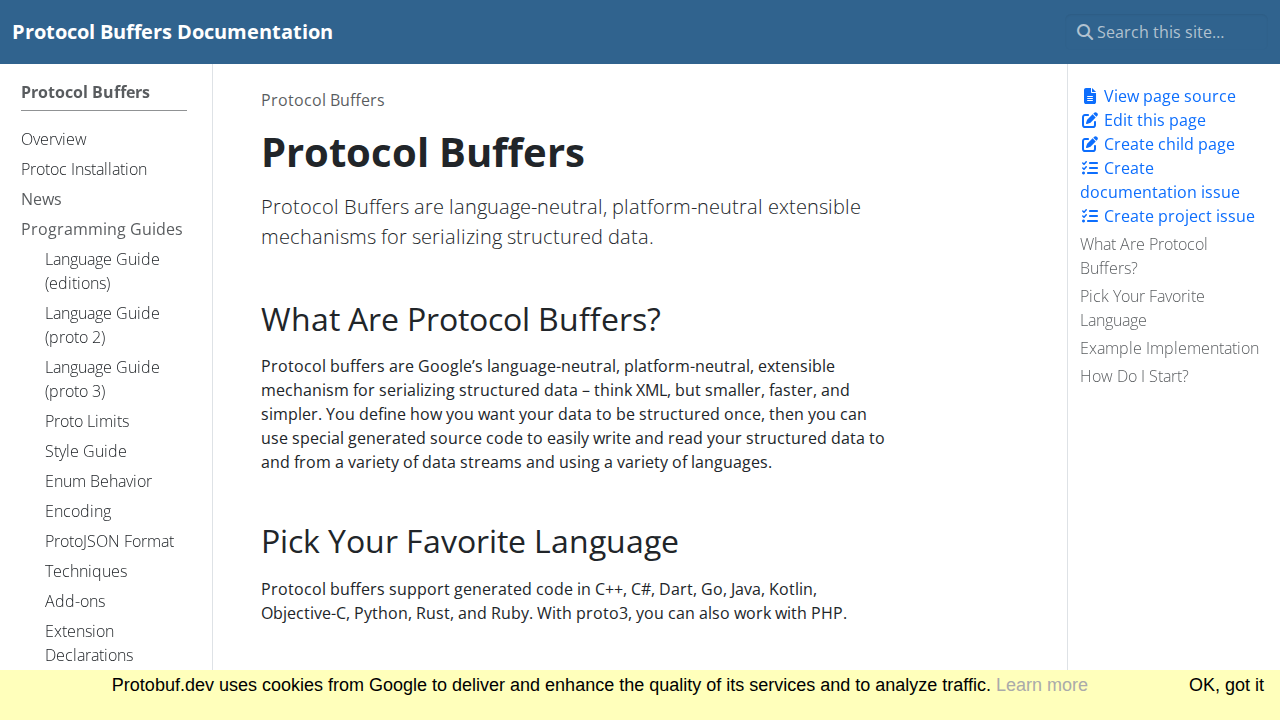
What is Protocol Buffers Documentation
Protocol Buffers (Protobuf) is Google's open-source mechanism for serializing structured data. It offers a language-neutral and platform-neutral approach, making it ideal for data exchange across diverse systems and programming languages. Unlike XML, Protobuf is designed to be smaller, faster, and simpler, resulting in reduced bandwidth usage and improved performance. Developers define data structures once and then use generated code to easily write and read data in various languages like C++, Java, Python, and Go. This approach streamlines data handling, reduces boilerplate code, and enhances efficiency in data-intensive applications. Protobuf is particularly beneficial for microservices, data storage, and communication protocols, providing a robust and efficient alternative to traditional serialization methods.
Protocol Buffers Documentation 's Core features
Language-Neutral Data Format
Protobuf supports code generation for multiple programming languages, including C++, Java, Python, Go, and more. This cross-language compatibility allows seamless data exchange between different systems and applications, regardless of their underlying technology stack. This is achieved through a standardized binary format and compiler plugins that generate language-specific code for serialization and deserialization, ensuring data consistency and interoperability.
Efficient Serialization
Protobuf employs a binary format that is significantly more compact than text-based formats like JSON or XML. This results in reduced data size, leading to lower bandwidth consumption and faster data transfer speeds. Benchmarks often show Protobuf serializations being 3-10x faster and smaller than equivalent JSON representations, making it ideal for high-performance applications and network communication.
Schema Evolution
Protobuf supports forward and backward compatibility through its versioning system. You can add new fields to your data structures without breaking existing code that uses older versions of the schema. This is achieved through field numbers, which allow the Protobuf runtime to correctly parse data even if it contains fields unknown to the receiving application. This feature is critical for long-lived systems that evolve over time.
Strong Typing
Protobuf enforces strong typing through its schema definition, which helps prevent data corruption and ensures data integrity. The schema defines the data types, field names, and other constraints, which are validated during serialization and deserialization. This reduces the risk of runtime errors and makes it easier to debug and maintain your code. The compiler also provides type checking at compile time.
Extensibility
Protobuf allows for easy extension of data structures without requiring changes to existing code. This is achieved through the use of field numbers, which allow new fields to be added to a message without breaking compatibility. This feature is particularly useful for evolving APIs and data models. Extensions can be added without modifying existing code, ensuring backward compatibility.
Code Generation
Protobuf provides code generation capabilities for various programming languages. The `protoc` compiler generates code that handles serialization, deserialization, and data access, reducing manual coding efforts and minimizing the risk of errors. This automation streamlines the development process and ensures consistency across different language implementations. The generated code provides a convenient API for working with your data structures.
How to use Protocol Buffers Documentation
- Define your data structures in a
.protofile using the Protobuf language. 2. Install the Protobuf compiler (protoc) and the appropriate language plugins for your target languages (e.g.,protoc-gen-cppfor C++). 3. Compile your.protofile usingprotoc --cpp_out=. your_file.proto(example for C++). This generates source code for your chosen language. 4. Include the generated code in your project. 5. Use the generated classes/structures to serialize and deserialize your data. 6. Implement the necessary logic for data transmission and reception within your application.
Use cases of Protocol Buffers Documentation
Microservices Communication
Microservices can use Protobuf to communicate with each other efficiently. Each service defines its data contracts in `.proto` files, which are then compiled into language-specific code. This allows services written in different languages (e.g., Go, Java, Python) to exchange data seamlessly and with minimal overhead, improving overall system performance and reducing latency.
Data Storage and Retrieval
Protobuf can be used to store data in databases or files. The binary format is more compact than text-based formats, reducing storage space and improving read/write performance. For example, a game developer might use Protobuf to store player profiles, game state, and other data, optimizing storage efficiency and retrieval speed.
API Development
Protobuf is an excellent choice for defining APIs, especially for gRPC-based services. The `.proto` files serve as the contract for the API, ensuring consistency and facilitating the generation of client and server stubs. This approach simplifies API development, reduces boilerplate code, and improves performance compared to REST APIs using JSON.
Configuration Files
Protobuf can be used to define and manage configuration files. The structured format and strong typing ensure data integrity and make it easier to validate configurations. This is particularly useful in large-scale deployments where configuration management is critical. The binary format also provides a more compact representation compared to XML or JSON.
Who benefits from Protocol Buffers Documentation
Backend Developers
Backend developers benefit from Protobuf's efficiency and cross-language compatibility when building APIs, microservices, and data processing pipelines. They can define data structures once and generate code for various languages, streamlining development and improving performance.
Data Engineers
Data engineers can use Protobuf to efficiently store and transmit large datasets. The compact binary format reduces storage costs and improves data transfer speeds. Protobuf's schema evolution capabilities also simplify managing evolving data models.
API Developers
API developers can leverage Protobuf to define robust and efficient APIs, especially when using gRPC. The `.proto` files serve as the API contract, ensuring consistency and facilitating the generation of client and server stubs, leading to faster development cycles and improved API performance.
Mobile App Developers
Mobile app developers can use Protobuf to optimize data transfer between their apps and backend servers. The smaller data size and faster parsing speeds result in improved app performance and reduced data usage, leading to a better user experience.
Pricing of Protocol Buffers Documentation
Open Source (Apache 2.0 License). Free to use.