Lodash
JavaScript utility library.
Free
Support platforms
web
What is Lodash
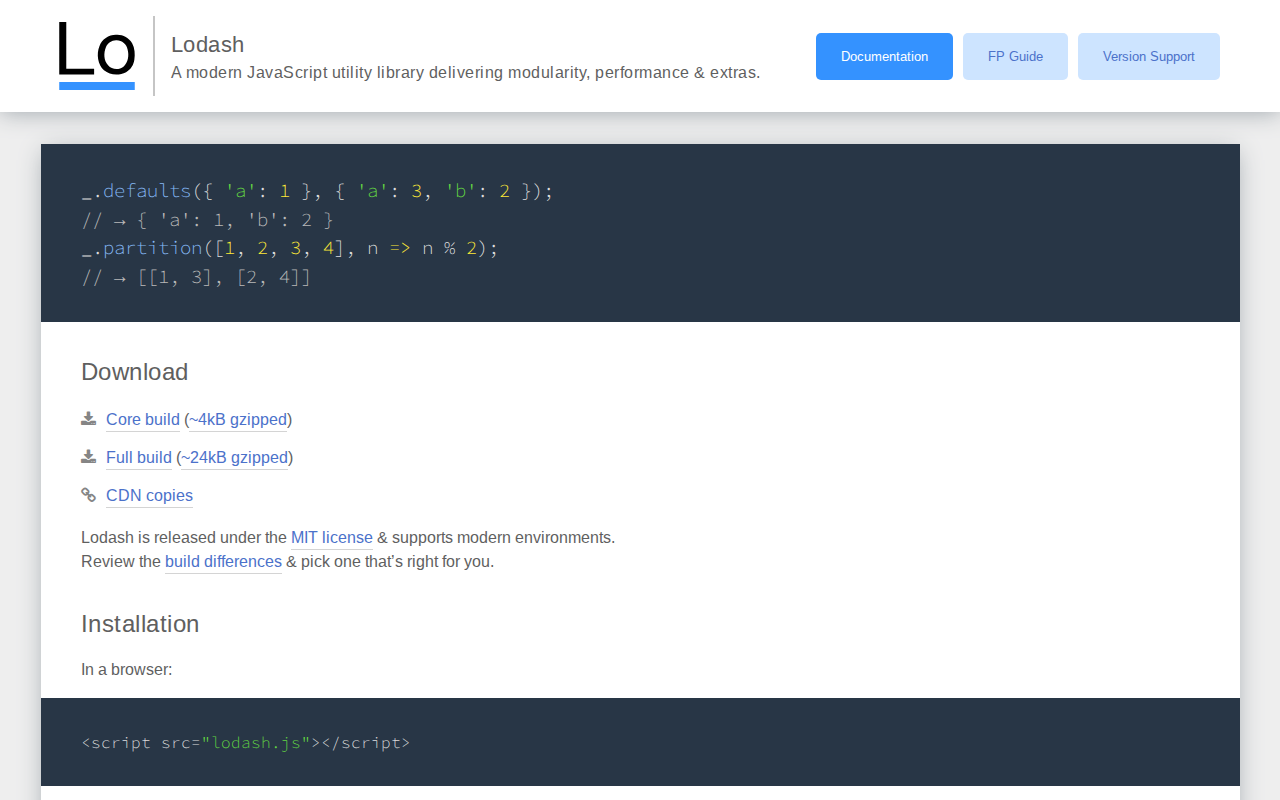
Lodash is a modern JavaScript utility library designed to enhance JavaScript programming with modularity, performance, and extra features. It simplifies common programming tasks by providing a collection of methods for working with arrays, numbers, objects, strings, and more. Unlike native JavaScript, Lodash offers optimized and consistent cross-browser behavior, reducing the need for manual workarounds. It stands out with its functional programming support (lodash/fp), allowing for immutable data manipulation and currying. Developers benefit from its ease of use, performance optimizations, and extensive documentation, making it a valuable tool for both beginners and experienced JavaScript developers. It's particularly useful for those seeking to write cleaner, more maintainable, and efficient code.
Lodash 's Core features
Modular Design
Lodash is built with a modular architecture, allowing developers to import only the specific methods they need. This reduces the overall bundle size and improves performance. For example, you can cherry-pick methods like `_.at` or `_.curryN` to minimize the impact on your application's loading time. This is especially beneficial for front-end development where bundle size directly affects user experience.
Functional Programming Support
The `lodash/fp` build provides immutable, auto-curried, and iteratee-first/data-last methods. This promotes functional programming paradigms, making code more predictable and easier to test. For instance, `fp.map` automatically curries, allowing you to partially apply arguments. This contrasts with the standard Lodash methods, which require a different approach to functional composition.
Performance Optimization
Lodash is highly optimized for performance, with methods designed to be efficient across different JavaScript environments. It offers optimized implementations for common operations like array iteration, object manipulation, and string processing. Benchmarks often show Lodash methods outperforming native JavaScript implementations in specific scenarios, especially in older browsers or when dealing with large datasets.
Extensive Method Library
Lodash offers a comprehensive set of methods covering a wide range of tasks, from array manipulation and object iteration to string formatting and number operations. This extensive library reduces the need to write custom utility functions, saving development time and effort. The library includes methods for tasks like debouncing, throttling, and deep cloning, which are not readily available in standard JavaScript.
Cross-Browser Compatibility
Lodash ensures consistent behavior across different browsers and JavaScript environments. It handles browser inconsistencies and provides polyfills for missing features. This is crucial for ensuring that your application functions correctly across various platforms, including older browsers like IE11, which may lack support for modern JavaScript features.
Community Support & Documentation
Lodash has a large and active community, providing extensive documentation, examples, and support. The documentation is well-structured and includes detailed explanations of each method, along with usage examples. This makes it easy for developers to learn and use Lodash effectively. The community also contributes to the library's development, ensuring its continued relevance and improvement.
How to use Lodash
- Include Lodash in your project using npm:
npm install --save lodash.,2. Import the full build in Node.js:require('lodash')or import specific methods for smaller bundles, e.g.,require('lodash/array').,3. In a browser, include the script tag:<script src="lodash.js"></script>.,4. Utilize Lodash methods directly in your JavaScript code, e.g.,_.map([1, 2, 3], function(n) { return n * 3; });.,5. For functional programming, use the FP build:require('lodash/fp')and access methods likefp.map.,6. Explore the extensive documentation at lodash.com for a comprehensive understanding of available methods and their usage.
Use cases of Lodash
Data Transformation
Developers use Lodash to transform data structures, such as mapping, filtering, and reducing arrays or objects. For example, a developer might use `_.map` to transform an array of user objects into an array of user names, simplifying data processing and presentation in a web application.
Functional Programming
Developers leverage Lodash's functional programming features, like currying and partial application, to create reusable and composable functions. A developer could use `_.curry` to create a function that, when partially applied, returns a new function ready to receive the remaining arguments, enhancing code modularity.
Frontend Development
Frontend developers use Lodash to simplify common tasks like DOM manipulation, event handling, and data binding. A developer might use `_.debounce` to limit the frequency of function calls in response to user events, improving performance and user experience.
Backend Development
Backend developers utilize Lodash for tasks such as data validation, object manipulation, and utility functions. For example, a backend developer might use `_.isObject` to validate the type of incoming data before processing it, preventing errors and ensuring data integrity.
Who benefits from Lodash
Frontend Developers
Frontend developers benefit from Lodash's utility methods for simplifying DOM manipulation, event handling, and data transformation. It streamlines common tasks, reduces boilerplate code, and improves code readability, leading to faster development cycles and better user experiences.
Backend Developers
Backend developers use Lodash to handle data validation, object manipulation, and create reusable utility functions. It helps ensure data integrity, simplifies complex operations, and improves code maintainability, which is crucial for building robust and scalable server-side applications.
JavaScript Beginners
Beginners find Lodash helpful because it simplifies common JavaScript tasks, making the language easier to learn and use. The library provides a gentle introduction to functional programming concepts and offers well-documented methods, allowing beginners to write cleaner and more efficient code.
Experienced JavaScript Developers
Experienced developers use Lodash to improve code efficiency, reduce boilerplate, and enhance code maintainability. The library's optimized methods and functional programming support help them write cleaner, more readable, and performant code, leading to faster development and easier collaboration.
Pricing of Lodash
Lodash is released under the MIT license, making it free to use for personal and commercial projects. No paid plans or subscriptions are offered.