Hyperbrowser
Web Infra for AI Agents & Apps
Paid
Support platforms
web
Tool tags
What is Hyperbrowser
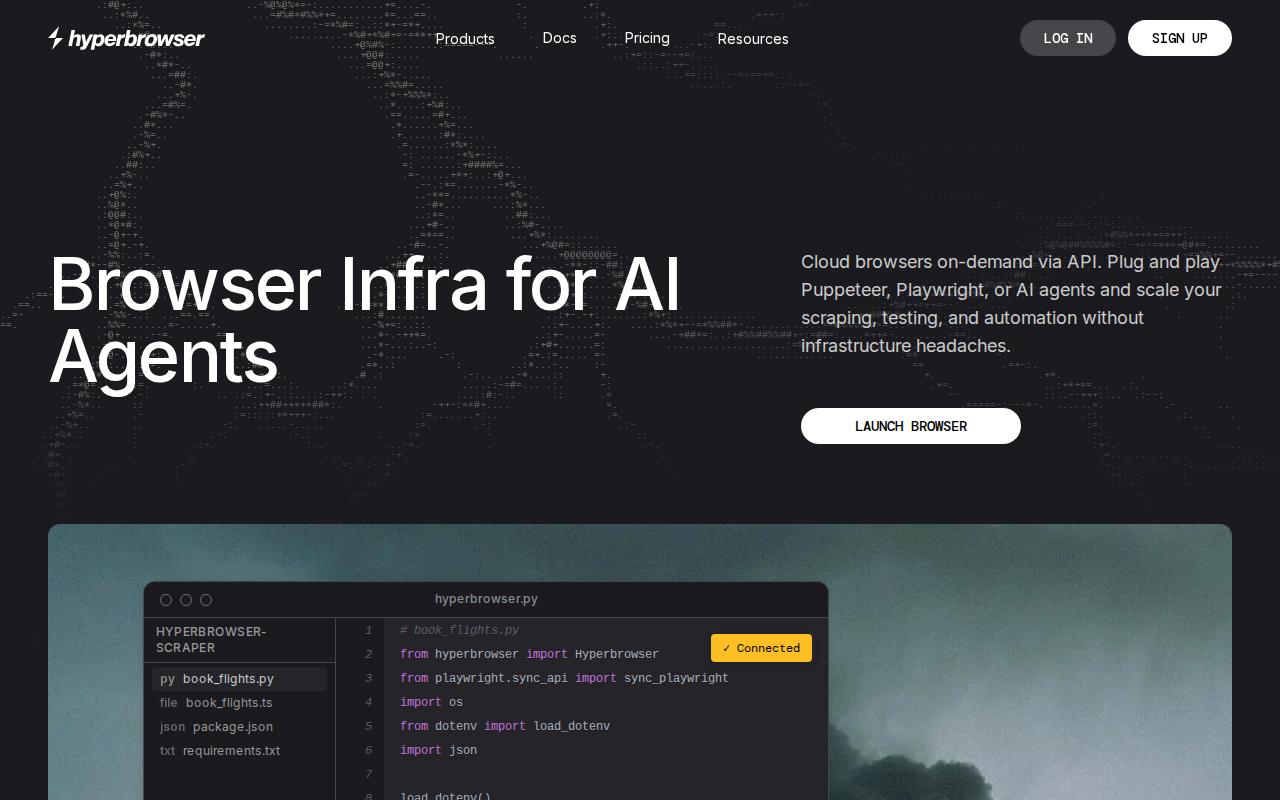
Hyperbrowser provides a browser-as-a-service, specifically designed for AI agents and applications that require web interaction. It offers a robust infrastructure for automating web tasks, scraping data, and interacting with web applications programmatically. Unlike traditional headless browsers, Hyperbrowser is optimized for speed and efficiency, reducing latency and resource consumption. Its unique architecture allows for rapid scaling and integration, making it ideal for developers building AI-powered tools that rely on web access. This service benefits developers, researchers, and businesses automating web interactions, extracting data, or building AI agents that require web browsing capabilities.
Hyperbrowser 's Core features
Headless Browser API
Provides a programmatic interface to control a web browser, allowing developers to automate tasks such as form filling, data extraction, and website navigation. This API supports various actions like clicking elements, scrolling, and injecting JavaScript, enabling complex web interactions. The API is designed for ease of use and integrates seamlessly with popular programming languages, reducing development time.
Scalable Infrastructure
Built on a scalable infrastructure, Hyperbrowser can handle a large volume of requests concurrently. This ensures that your web automation tasks can run efficiently, even during peak loads. The infrastructure automatically scales resources based on demand, providing consistent performance and reliability. This is crucial for applications that require high availability and responsiveness.
Real-time Rendering
Renders web pages in real-time, ensuring that AI agents and applications interact with the web as a human user would. This feature is essential for tasks that require accurate rendering of dynamic content, such as JavaScript-heavy websites. Real-time rendering supports modern web technologies, including JavaScript, CSS, and HTML5, guaranteeing compatibility with a wide range of websites.
Proxy Management
Offers built-in proxy management, allowing users to route their web requests through different IP addresses. This is useful for bypassing geo-restrictions, avoiding IP bans, and simulating different user locations. The proxy management feature supports various proxy types, including HTTP, HTTPS, and SOCKS5, providing flexibility and control over web requests.
User Agent Control
Allows users to specify the user agent string for their web requests, enabling them to simulate different browsers and devices. This is crucial for testing website compatibility and ensuring that web applications render correctly on various platforms. User agent control provides flexibility in simulating different user environments, improving the accuracy of web automation tasks.
How to use Hyperbrowser
- Sign up for a Hyperbrowser account at their website.,2. Obtain your API key from your account dashboard.,3. Install the Hyperbrowser client library for your preferred programming language (e.g., Python, Node.js).,4. Authenticate with your API key in your code.,5. Specify the URL you want to interact with and the actions (e.g., click, scroll, input) you want to perform.,6. Run your script to execute the web automation tasks.
Use cases of Hyperbrowser
AI-powered Web Scraping
Developers can use Hyperbrowser to build AI agents that extract data from websites. For example, an agent could automatically scrape product information from e-commerce sites, monitor prices, and update a database. This automates the data collection process, saving time and resources compared to manual data entry.
Automated Testing of Web Applications
QA engineers can use Hyperbrowser to automate the testing of web applications. They can create scripts that simulate user interactions, verify functionality, and detect bugs. This helps ensure the quality and reliability of web applications by automating repetitive testing tasks and improving test coverage.
Content Aggregation and Monitoring
Content creators and marketers can use Hyperbrowser to aggregate content from multiple websites and monitor changes. For example, they can track news articles, social media updates, and competitor activities. This helps them stay informed about industry trends and manage their online presence efficiently.
Web Automation for Chatbots
Developers can integrate Hyperbrowser into chatbots to enable them to interact with web applications. For example, a chatbot could automatically fill out forms, retrieve information from websites, and perform other web-based tasks. This enhances the chatbot's capabilities and provides a more interactive user experience.
Who benefits from Hyperbrowser
AI Developers
AI developers need Hyperbrowser to enable their AI agents to interact with the web. It provides a reliable and scalable infrastructure for web automation, allowing them to build intelligent applications that can access and process information from the internet.
Web Scraping Professionals
Web scraping professionals require Hyperbrowser to automate data extraction from websites. It offers advanced features like proxy management and user agent control, which are essential for bypassing anti-scraping measures and collecting data efficiently.
QA Engineers
QA engineers benefit from Hyperbrowser by automating web application testing. It enables them to create scripts that simulate user interactions, verify functionality, and detect bugs, improving the quality and reliability of web applications.
Data Scientists
Data scientists can use Hyperbrowser to collect and preprocess web data for machine learning models. It provides a convenient way to extract data from various sources, making it easier to build and train data-driven applications.
Pricing of Hyperbrowser
Pricing not available on the website. Contact them for details.