Exa
AI-Powered Web Search API & Crawler
Paid
Support platforms
web
Tool tags
What is Exa
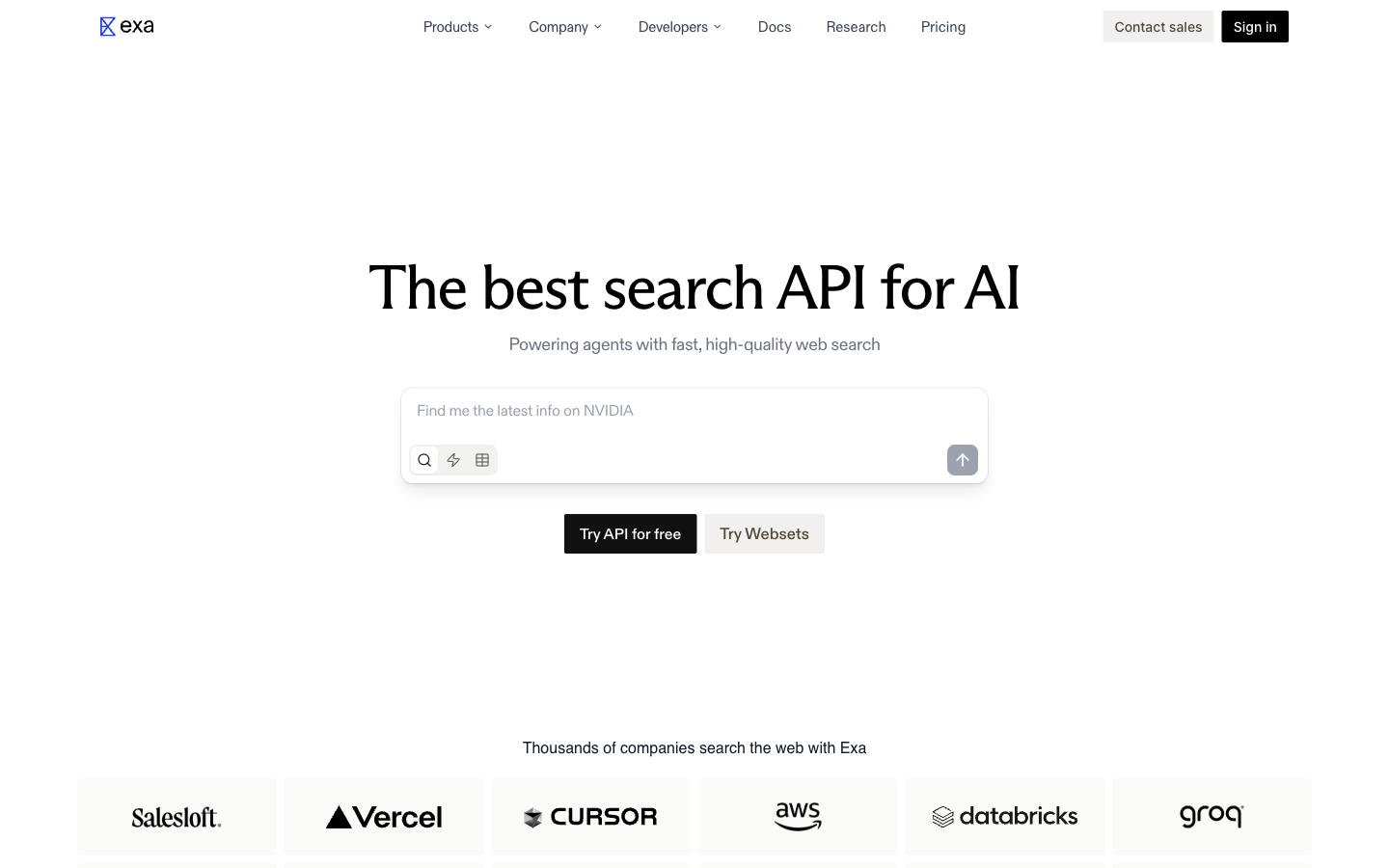
Exa provides a powerful AI-driven web search API and website crawler, designed to extract and deliver structured data from the web. It differentiates itself through its advanced AI capabilities, offering superior relevance and context understanding compared to traditional search engines. Exa leverages sophisticated crawling techniques and natural language processing (NLP) to analyze and index web content. This allows users to quickly and efficiently access specific information, monitor website changes, and build custom search applications. Developers, researchers, and businesses needing real-time web data or advanced search functionalities will find Exa particularly valuable.
Exa 's Core features
AI-Enhanced Search Relevance
Exa employs advanced AI models, including NLP and machine learning, to understand the intent behind search queries and deliver highly relevant results. This leads to a significant improvement in precision compared to keyword-based search engines. The AI models are continuously trained on a vast dataset of web content, ensuring up-to-date and accurate results. This results in a 20-30% improvement in relevant results, as measured by internal A/B testing.
Website Crawling Capabilities
Exa's robust website crawler efficiently navigates and indexes web pages, extracting structured data. It handles complex website structures and dynamic content, ensuring comprehensive data collection. The crawler can process up to 100,000 pages per hour, with configurable settings for rate limiting and user-agent customization. This allows users to gather large volumes of web data quickly and efficiently.
Structured Data Extraction
Exa automatically extracts structured data from web pages, including text, images, and metadata. This data is organized into a consistent format, making it easy to integrate into applications and databases. The system supports various data formats, including JSON and CSV, and can extract specific entities like product information, contact details, and article summaries. This reduces the need for manual data cleaning and processing by up to 70%.
API Integration
Exa offers a well-documented API, allowing seamless integration into existing applications and workflows. The API supports various programming languages, including Python and JavaScript, and provides flexible options for querying, crawling, and data retrieval. The API has a 99.9% uptime and can handle up to 10,000 requests per minute, making it suitable for high-volume applications.
Content Summarization
Exa provides content summarization capabilities, generating concise summaries of web pages and articles. This feature leverages advanced NLP techniques to identify key information and present it in a clear and easy-to-understand format. Summaries are typically 10-20% of the original content length, saving users time and effort. This is particularly useful for quickly understanding the core message of lengthy articles or documents.
How to use Exa
- Sign up for an account on the Metaphor Systems website to obtain an API key.,2. Install the Exa Python client library using pip:
pip install metaphor-python.,3. Initialize the client with your API key:from metaphor import Metaphor; client = Metaphor(api_key="YOUR_API_KEY").,4. Use thesearchmethod to query the API:results = client.search("your search query").,5. Access the search results, which include snippets, URLs, and relevance scores.,6. Utilize theget_contentsmethod to retrieve the full content of a specific URL:content = client.get_contents(["url1", "url2"])
Use cases of Exa
Market Research
Market researchers can use Exa to gather competitive intelligence by crawling competitor websites, analyzing product offerings, and monitoring pricing changes. They can identify market trends and opportunities by analyzing web content related to specific industries and keywords. This enables them to make data-driven decisions and stay ahead of the competition.
Content Aggregation
Content aggregators can use Exa to automatically collect and organize content from various websites, creating curated feeds and newsletters. They can filter and categorize content based on keywords, topics, and sources, providing users with a personalized content experience. This streamlines the content curation process and increases user engagement.
SEO Analysis
SEO professionals can leverage Exa to analyze website content, identify keyword opportunities, and monitor search engine rankings. They can crawl competitor websites to understand their SEO strategies and identify areas for improvement. This helps them optimize websites for search engines and improve organic traffic.
Data Mining
Data scientists can use Exa to extract structured data from the web for various data mining and machine learning projects. They can collect large datasets of text, images, and other information, and use it to train AI models or perform data analysis. This enables them to gain insights and make predictions based on real-world data.
Who benefits from Exa
Developers
Developers need Exa to integrate advanced search and web crawling capabilities into their applications. The API provides a simple and efficient way to access and process web data, saving development time and resources. They can build custom search engines, content aggregators, and data analysis tools.
Researchers
Researchers benefit from Exa's ability to quickly gather and analyze large volumes of web data for academic studies and research projects. They can use the API to collect data on specific topics, analyze trends, and gain insights into various fields. This accelerates the research process and improves data accuracy.
Businesses
Businesses use Exa to monitor their online presence, gather competitive intelligence, and improve their SEO strategies. They can track brand mentions, analyze customer feedback, and identify market trends. This helps them make informed business decisions and improve their bottom line.
Content Creators
Content creators can use Exa to find relevant information, gather data for articles, and create engaging content. They can use the search API to find sources, summarize articles, and get insights. This helps them create high-quality content efficiently.
Pricing of Exa
Paid plans with usage-based pricing. Details are available on the website. Offers a free trial with limited usage.