Llama
Open-source LLMs for research
Free
Support platforms
web
What is Llama
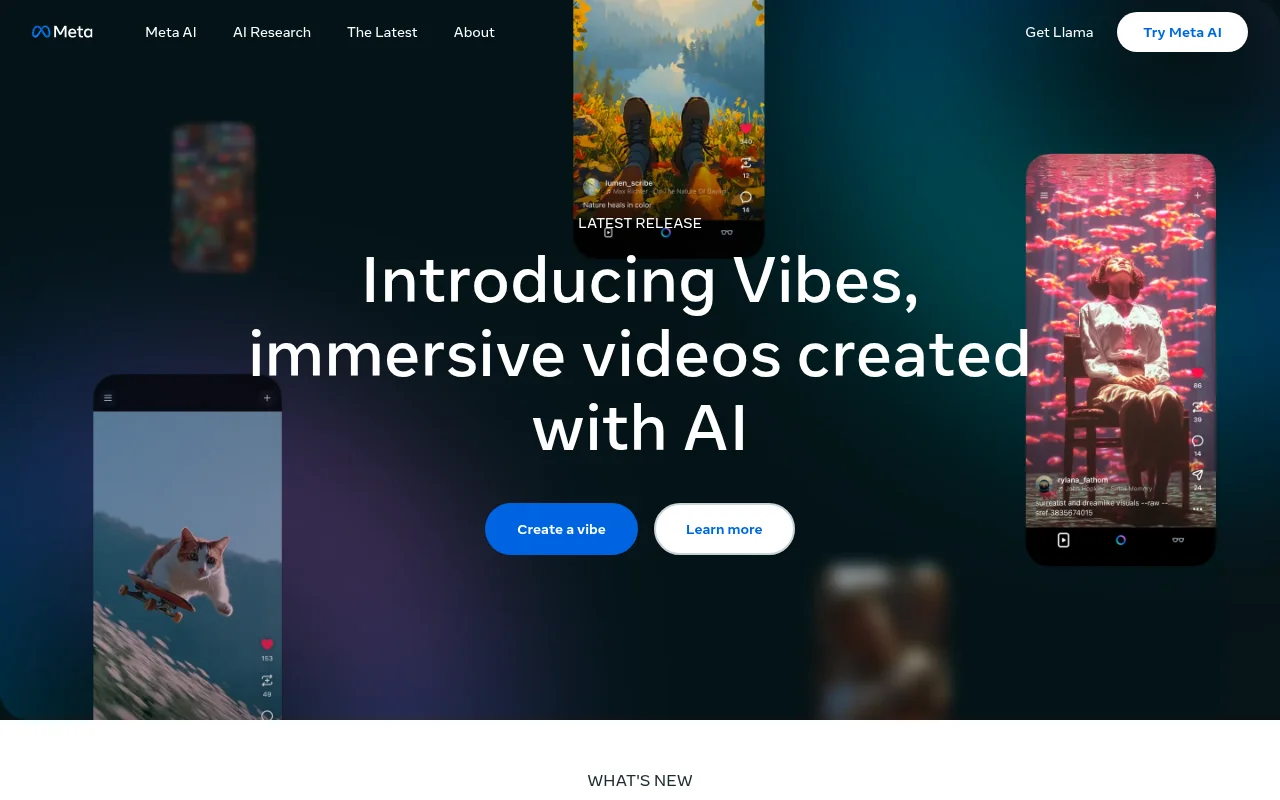
Llama is a family of open-source large language models (LLMs) developed by Meta AI, designed for research and commercial use. It offers various model sizes, from 7 billion to 70 billion parameters, providing flexibility for different computational resources and performance needs. Llama models are trained on vast datasets of text and code, enabling them to generate human-quality text, translate languages, write different kinds of creative content, and answer your questions in an informative way. Unlike some proprietary models, Llama's open-source nature allows researchers and developers to freely access, modify, and build upon the models, fostering innovation and collaboration within the AI community. This open approach provides transparency and control, empowering users to tailor the models to their specific requirements and applications. Llama distinguishes itself through its performance-to-size ratio, offering competitive results with smaller model sizes, making it more accessible and efficient for various use cases.
Llama 's Core features
Multiple Model Sizes
Llama offers models with 7B, 13B, 34B, and 70B parameters. This allows users to select a model that balances performance and resource requirements. For example, the 7B model can run on a single GPU, while the 70B model delivers state-of-the-art results but requires more powerful hardware. This flexibility caters to diverse hardware setups and application needs.
Open-Source License
Llama is released under a non-commercial license, enabling researchers and developers to freely use, study, and adapt the models for research purposes. This open approach fosters transparency and collaboration, facilitating advancements in the field of LLMs. The license allows for commercial use with specific conditions, promoting broader adoption and innovation.
High Performance
Llama models are designed to achieve competitive performance compared to larger, closed-source models. For instance, the Llama 2 70B model has demonstrated performance comparable to or better than models with significantly more parameters in various benchmarks. This efficiency makes Llama a cost-effective solution for many applications.
Pre-trained and Fine-tunable
Llama models are pre-trained on massive datasets, providing a strong foundation for various NLP tasks. Users can fine-tune these models on their specific datasets to improve performance for particular applications. This allows for customization and adaptation to specialized domains, such as medical or legal text.
Support for Various Tasks
Llama models can perform a wide range of NLP tasks, including text generation, translation, question answering, and code generation. Their versatility makes them suitable for diverse applications, from chatbots and content creation tools to research projects and software development assistance. The models' capabilities are constantly being expanded through community contributions.
How to use Llama
- Visit the Meta AI website and review the Llama model license and acceptable use policy. 2. Request access to the Llama models via the provided form, agreeing to the terms. 3. Once access is granted, download the model weights from the designated repository (e.g., Hugging Face). 4. Choose a compatible framework or library (e.g., PyTorch, Transformers) to load and run the model. 5. Set up your environment with the necessary dependencies, including Python and the chosen framework. 6. Use the provided example scripts or documentation to generate text, translate, or perform other tasks with the Llama model.
Use cases of Llama
Research and Development
Researchers can use Llama to explore new architectures, training techniques, and applications of LLMs. They can fine-tune the models on specific datasets to study their behavior and performance. This allows for rapid prototyping and experimentation in the field of AI, accelerating innovation and discovery.
Education and Training
Students and educators can use Llama to learn about LLMs and experiment with different configurations. They can build educational tools and projects that leverage the models' capabilities. This provides hands-on experience and promotes a deeper understanding of AI concepts and technologies.
Content Creation
Content creators can use Llama to generate text, write articles, and create other forms of content. They can leverage the models' ability to produce creative and informative text. This can streamline the content creation process and enhance productivity.
Software Development
Developers can use Llama to build AI-powered applications, such as chatbots, code completion tools, and language translation services. They can integrate the models into their projects to add intelligent features and improve user experiences. This can lead to more innovative and user-friendly software.
Who benefits from Llama
AI Researchers
Researchers benefit from Llama's open-source nature, allowing them to study, modify, and experiment with state-of-the-art LLMs. They can use Llama to advance the field of AI, develop new algorithms, and publish their findings.
Developers
Developers can integrate Llama into their applications to add AI-powered features, such as chatbots, content generation, and code completion. They can leverage the models' capabilities to create innovative and user-friendly software.
Educators and Students
Educators and students can use Llama to learn about LLMs and experiment with different configurations. They can build educational tools and projects that leverage the models' capabilities, fostering a deeper understanding of AI.
Businesses
Businesses can leverage Llama to enhance their products and services, improve customer interactions, and automate tasks. They can use the models to create chatbots, generate content, and analyze data, leading to increased efficiency and innovation.
Pricing of Llama
Free to use for research and commercial purposes, subject to the Llama 2 license. Access requires agreeing to the terms of use.