Servo
Embeddable, memory-safe web engine
Free
Support platforms
web
What is Servo
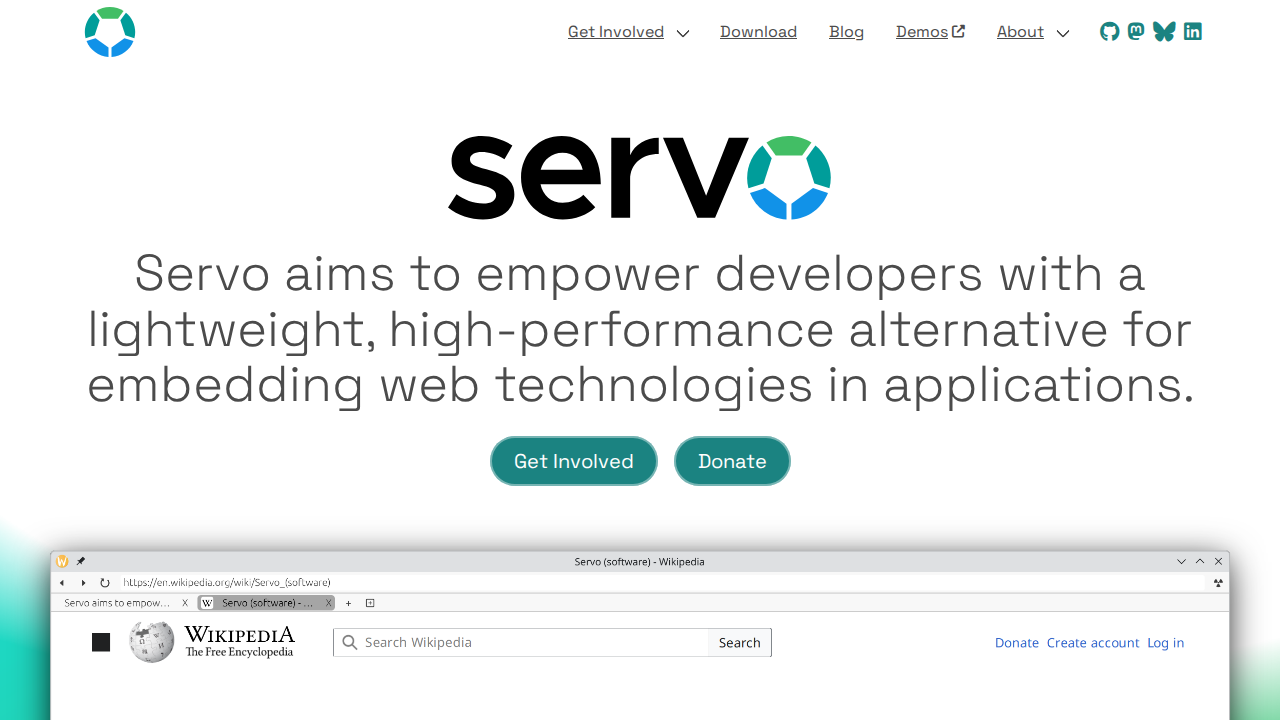
Servo is a high-performance, embeddable web browser engine written in Rust. Its core value proposition is to provide developers with a lightweight and adaptable alternative for integrating web technologies into their applications. Unlike traditional browser engines, Servo leverages Rust's memory safety features, reducing vulnerabilities and improving security. It features WebGL and WebGPU support, and is designed for cross-platform compatibility, including desktop, mobile, and embedded systems. Servo's modular architecture allows for customization, and its use of concurrency and parallelism optimizes rendering speed and energy efficiency. Developers building applications that require web content rendering, such as embedded systems, custom browsers, or UI components, will find Servo particularly beneficial.
Servo 's Core features
Memory-Safe Rendering
Servo is written in Rust, which guarantees memory safety. This eliminates common vulnerabilities like buffer overflows and use-after-free errors, which are prevalent in C/C++-based browser engines. This results in a more secure and stable rendering engine, reducing the risk of crashes and security exploits. This is a key differentiator from engines like Chromium, which are known to have significant security vulnerabilities.
Cross-Platform Compatibility
Servo supports multiple platforms, including Windows, macOS, Linux, Android, and OpenHarmony. This broad compatibility allows developers to embed Servo in a wide range of applications, from desktop software to mobile apps and embedded devices. The portability is achieved through careful design and the use of platform-agnostic libraries where possible.
Modular Architecture
Servo's modular design allows developers to customize and adapt the engine to their specific needs. This modularity is achieved through the use of Rust crates and a well-defined architecture. Developers can selectively include or exclude components, optimizing the engine for their target use case and reducing the overall footprint. This is in contrast to monolithic engines like WebKit.
Parallel Rendering
Servo utilizes concurrency and parallelism to accelerate the rendering of web content on multi-core devices. This means that different parts of the rendering process, such as layout, painting, and compositing, can be executed simultaneously. This leads to faster page load times and a more responsive user experience, especially on modern multi-core processors. Benchmarks show significant performance gains compared to single-threaded rendering engines.
WebGPU and WebGL Support
Servo supports both WebGPU and WebGL, enabling hardware-accelerated graphics rendering. This allows for the display of complex 2D and 3D graphics, animations, and interactive content with high performance. WebGPU provides a modern, low-overhead graphics API, offering significant performance improvements over WebGL, especially on modern GPUs. This is crucial for applications that rely on rich visual experiences.
How to use Servo
- Get the Source Code: Clone the Servo repository from GitHub using
git clone https://github.com/servo/servo.git. - Install Rust: Ensure you have the Rust toolchain installed. Use
rustup updateto update to the latest version. - Build Servo: Navigate to the Servo directory and build the project using
cargo build --release. This will compile Servo's core components. - Run Servo: Execute the compiled binary. The specific command depends on your target platform and desired functionality (e.g.,
target/release/servo --url https://www.example.com). - Explore the API: Investigate the available APIs for embedding Servo in your applications. This typically involves using a WebView API.
- Contribute: Review the contribution guidelines on the Servo website and consider contributing to the project.
Use cases of Servo
Embedded Systems
Manufacturers of embedded devices (e.g., smart appliances, industrial control panels) can use Servo to render web-based user interfaces. This allows them to leverage web technologies (HTML, CSS, JavaScript) for UI development, simplifying development and enabling remote updates. Servo's lightweight nature makes it suitable for resource-constrained environments.
Custom Browser Development
Developers building custom web browsers can use Servo as a rendering engine. Servo's modularity and embeddability allow them to create browsers tailored to specific needs, such as privacy-focused browsers or browsers optimized for specific content types. This provides a flexible alternative to using existing, feature-rich browser engines.
UI Component Integration
Software developers can embed Servo within their applications to render web content as UI components. This is useful for displaying rich text, interactive elements, or web-based dashboards within native applications. Servo's WebView API simplifies the integration process, allowing developers to seamlessly incorporate web content into their existing workflows.
Mobile Application Development
Mobile app developers can leverage Servo to create cross-platform mobile applications with web technologies. Servo's support for Android and other mobile platforms enables developers to build performant and feature-rich mobile apps using familiar web development tools. This reduces the need for platform-specific code and accelerates development cycles.
Who benefits from Servo
Embedded Systems Engineers
Engineers building embedded systems require a lightweight, efficient rendering engine to display web-based user interfaces. Servo's small footprint, cross-platform support, and memory safety make it ideal for resource-constrained devices, ensuring stability and security in critical applications.
Browser Developers
Developers creating custom web browsers need a flexible and customizable rendering engine. Servo's modular architecture and embeddability allow them to build browsers tailored to specific needs, such as privacy-focused browsers or browsers optimized for specific content types, providing a powerful alternative to existing engines.
UI/UX Designers and Developers
UI/UX designers and developers can integrate web content into native applications using Servo's WebView API. This enables them to create rich, interactive user interfaces with web technologies, simplifying development and ensuring a consistent user experience across platforms.
Mobile App Developers
Mobile app developers can use Servo to build cross-platform mobile apps with web technologies. Servo's support for Android and other mobile platforms allows for the creation of performant and feature-rich mobile apps using familiar web development tools, reducing the need for platform-specific code.
Pricing of Servo
Open Source (MPL-2.0). Donations accepted via Open Collective, GitHub Sponsors, and other channels. No commercial licensing fees.