Magika
AI-powered file type detection
Free
Support platforms
web
What is Magika
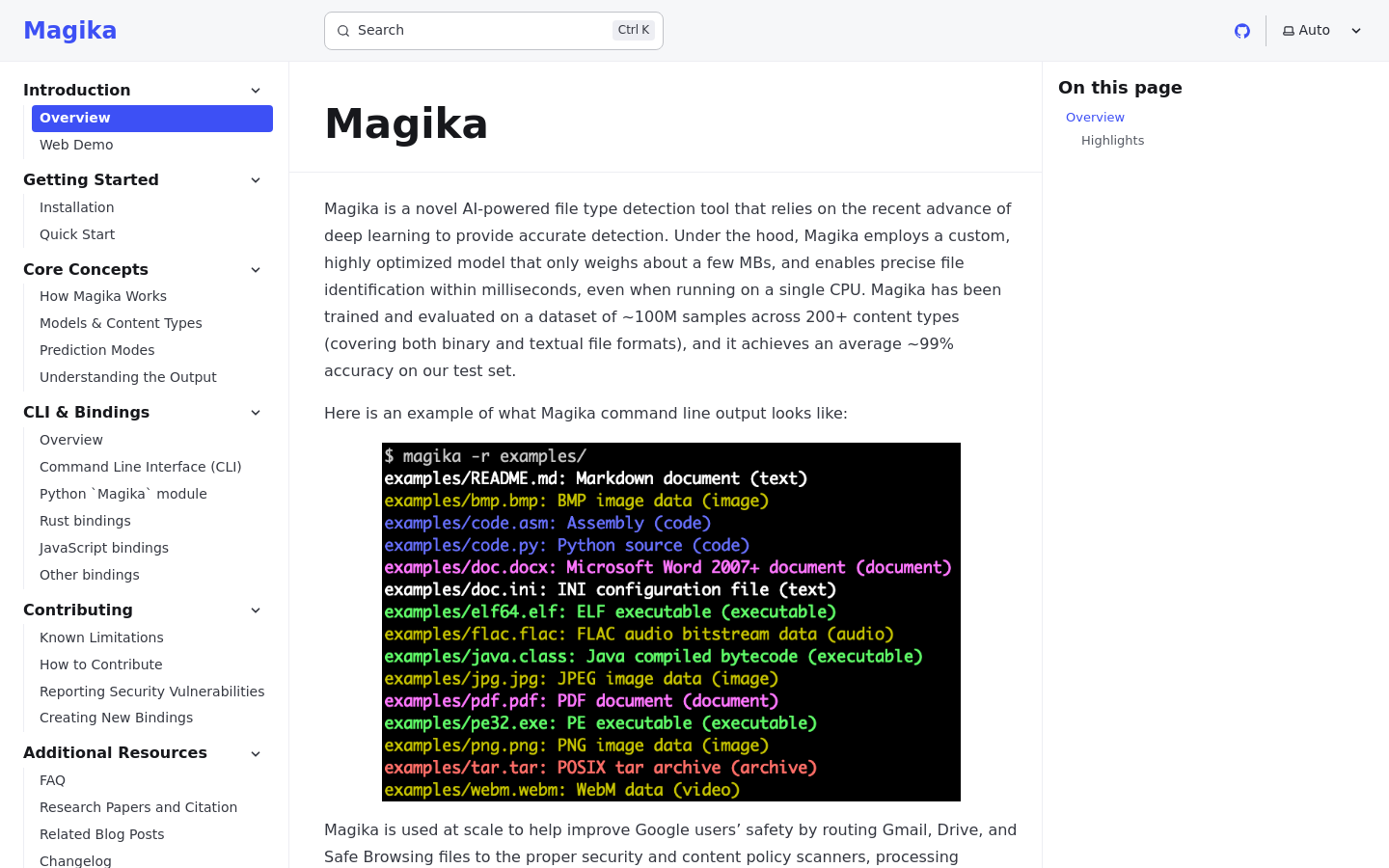
Magika is a high-performance file type identification tool developed by Google, leveraging a custom deep learning model to classify files with extreme accuracy. Unlike traditional tools like 'libmagic' that rely on rigid, manually curated byte-pattern matching, Magika uses a lightweight neural network to analyze file content. This approach significantly reduces misclassification rates for complex formats and code files. It is designed for high-throughput environments, offering a Python-based CLI and API that integrates seamlessly into security pipelines, content management systems, and data processing workflows where precise file identification is critical for security and routing.
Magika 's Core features
Deep Learning Classification
Magika utilizes a highly optimized neural network model to identify file types based on content patterns rather than just magic numbers. This allows it to distinguish between similar file formats—such as different versions of JavaScript or configuration files—that traditional heuristic-based tools often misidentify, resulting in significantly higher precision for complex file sets.
High-Performance Inference
The model is architected for speed, capable of processing thousands of files per second on standard hardware. By utilizing a compact model architecture, it minimizes CPU overhead, making it suitable for integration into high-traffic web servers or large-scale data ingestion pipelines where latency is a primary concern.
Extensive Format Support
Magika supports over 100 distinct file types, ranging from common media formats to obscure programming languages and binary structures. The model is trained on a massive, diverse dataset, ensuring that it remains robust against variations in file headers and obfuscation techniques often encountered in security research.
Seamless CLI Integration
Designed for DevOps and security engineers, the CLI supports standard Unix-style piping and recursive directory scanning. It provides structured output (JSON/JSONL), allowing users to pipe results directly into other security tools like SIEMs, threat intelligence platforms, or automated malware analysis sandboxes.
Low Memory Footprint
Despite the power of deep learning, the model is optimized for minimal memory consumption. It avoids the heavy dependencies of larger frameworks, allowing it to run in resource-constrained environments like Docker containers or serverless functions without requiring significant RAM allocation.
How to use Magika
Install the package via pip using 'pip install magika'.,Run the CLI tool against a single file with 'magika path/to/file'.,Process entire directories recursively using 'magika -r path/to/directory'.,Integrate into Python scripts by importing the Magika class and calling 'm.identify_bytes(data)'.,Output results in JSON format for automated pipeline consumption using the '--json' flag.
Use cases of Magika
Malware Analysis Pipelines
Security researchers use Magika to pre-filter incoming file streams. By accurately identifying file types before passing them to expensive sandbox environments, teams save compute resources and ensure that malicious files are correctly routed to the appropriate analysis engine.
Content Upload Filtering
Web developers implement Magika in file upload services to prevent users from bypassing security filters by renaming malicious files. It ensures that the file content matches the expected MIME type, effectively mitigating risks associated with arbitrary file uploads.
Data Lake Classification
Data engineers use Magika to scan and categorize massive, unstructured data lakes. By identifying file types at scale, they can automate data indexing and ensure that downstream ETL processes only ingest valid, expected file formats.
Who benefits from Magika
Security Engineers
Need to accurately identify file types to detect malicious payloads and enforce security policies. Magika provides the precision required to reduce false positives in automated threat detection systems.
DevOps & SREs
Require high-performance, low-latency tools for managing file processing pipelines. Magika's CLI and API allow for easy integration into CI/CD workflows and automated infrastructure.
Data Scientists
Need to clean and classify large datasets for machine learning. Magika helps in automating the identification of file formats, ensuring data integrity before training models.
Pricing of Magika
Open source project released under the Apache License 2.0. Completely free to use, modify, and integrate into commercial or private projects.