CowAgent
Autonomous AI Agent Framework
Free
Support platforms
web
What is CowAgent
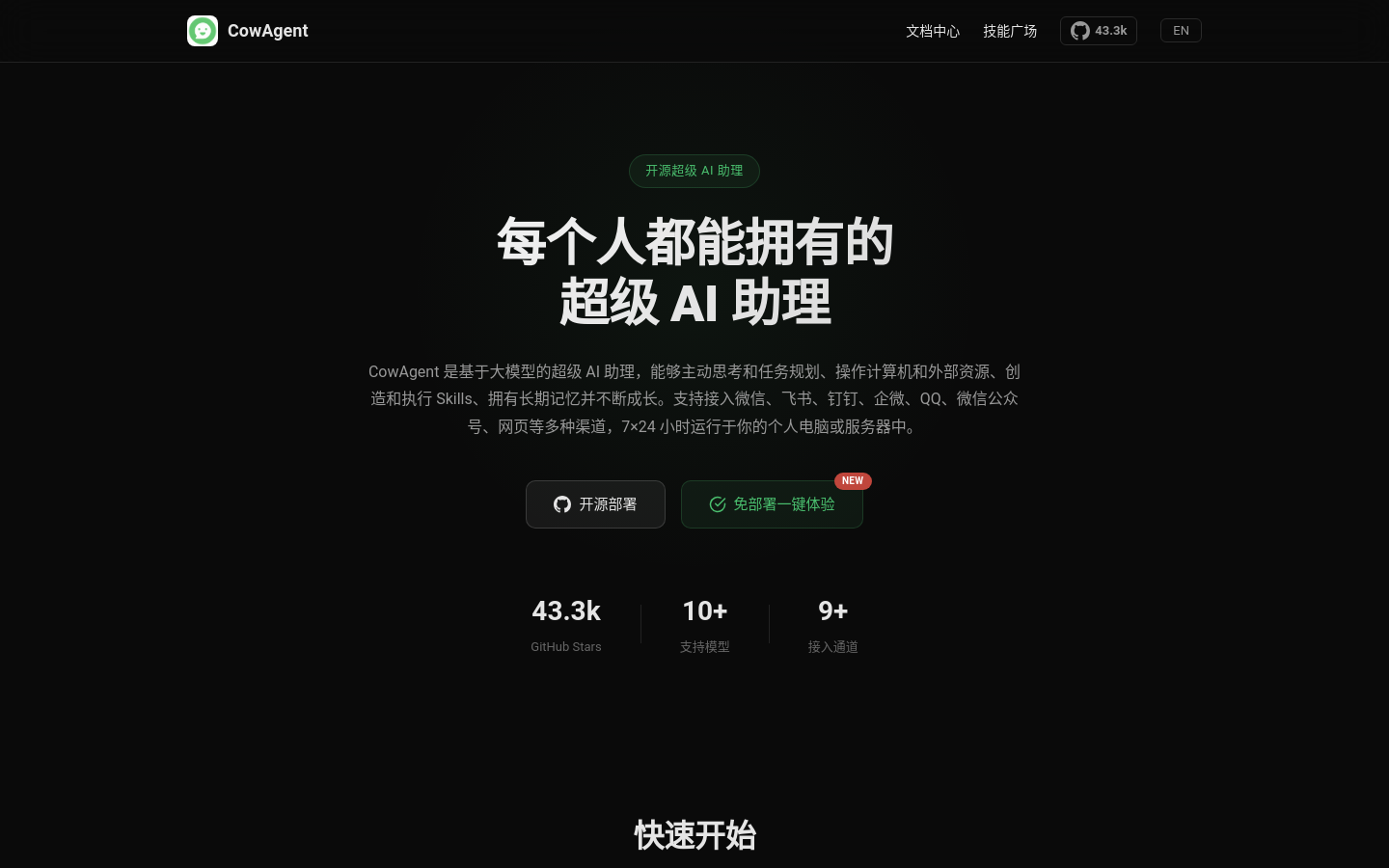
CowAgent is an open-source, autonomous AI agent framework designed to bridge the gap between LLMs and real-world task execution. Unlike standard chatbot wrappers, CowAgent functions as a headless agent capable of autonomous task planning, long-term memory management, and multi-tool orchestration. It operates locally or on private servers, providing deep integration with communication platforms like WeChat, DingTalk, and Lark. By leveraging a modular skill system and persistent vector-based memory, it allows developers to build agents that can execute shell commands, browse the web, and manage files, effectively turning an LLM into a persistent, 24/7 digital worker.
CowAgent 's Core features
Autonomous Task Planning
CowAgent utilizes a recursive reasoning loop that breaks down high-level user goals into granular, actionable sub-tasks. It dynamically evaluates progress after each step, adjusting its strategy if a tool call fails or if the environment state changes, ensuring complex multi-step objectives are completed without constant human intervention.
Persistent Memory Architecture
The system implements a dual-layer memory architecture: global long-term memory and daily context memory. By persisting data to local files and vector databases, the agent maintains continuity across sessions. This allows the agent to recall specific user preferences or past task results, significantly reducing the need for redundant context injection in subsequent prompts.
Extensible Skill System
The framework features a modular 'Skill Hub' that allows users to install pre-built capabilities or define custom ones using natural language. This abstraction layer enables the agent to interact with external APIs, execute Python scripts, or perform file system operations, effectively decoupling the agent's core logic from its functional capabilities.
Multi-Channel Integration
CowAgent provides native support for enterprise and personal communication platforms, including WeChat, DingTalk, Lark, and QQ. By abstracting the communication layer, it allows the agent to act as a unified interface across different messaging apps, enabling users to trigger complex workflows directly from their mobile devices.
Model-Agnostic Backend
The architecture supports a wide range of LLM backends including OpenAI, Claude, DeepSeek, and local models via Qwen or GLM. This flexibility allows users to optimize for cost, latency, or privacy by switching models based on the complexity of the task, ensuring the agent remains performant regardless of the underlying infrastructure.
How to use CowAgent
- Open your terminal on Linux, macOS, or Windows (PowerShell).,2. Execute the installation script: 'bash <(curl -fsSL https://cdn.link-ai.tech/code/cow/run.sh)' or the PowerShell equivalent.,3. Configure your preferred LLM API keys (OpenAI, DeepSeek, Claude, etc.) in the generated configuration file.,4. Install desired capabilities from the Skill Hub using the built-in CLI command.,5. Connect your preferred messaging channel (e.g., WeChat or Web) by updating the channel configuration.,6. Start the agent process to enable autonomous task execution and monitoring.
Use cases of CowAgent
Automated DevOps Monitoring
A DevOps engineer can deploy CowAgent to monitor server logs and error reports. When an anomaly is detected, the agent autonomously investigates the system, summarizes the issue, and sends a detailed report with potential remediation steps to the team's DingTalk group.
Personalized Research Assistant
Researchers can task CowAgent with monitoring specific news sources or web pages. The agent periodically scrapes data, stores relevant findings in its vector database, and compiles a daily summary, saving the user hours of manual information gathering.
Unified Workflow Automation
Business users can trigger complex workflows—such as file processing, data entry, and email drafting—by sending natural language commands via WeChat. The agent executes these tasks across local files and web tools, providing status updates directly in the chat interface.
Who benefits from CowAgent
Software Developers
Developers need a robust, extensible framework to build custom AI agents that interact with local environments and APIs without relying on restrictive, closed-source SaaS platforms.
DevOps & System Admins
These professionals require autonomous tools to handle routine maintenance, log analysis, and incident alerting, allowing them to focus on high-level architectural improvements.
Power Users
Individuals looking to automate personal workflows across multiple platforms (WeChat, Web, local files) who want a private, self-hosted solution that maintains long-term memory.
Pricing of CowAgent
Open source under the MIT License. The software is free to deploy on your own infrastructure or local machine. No mandatory subscription fees.