Model Context Protocol
Standardized AI Model Context
Free
Support platforms
web
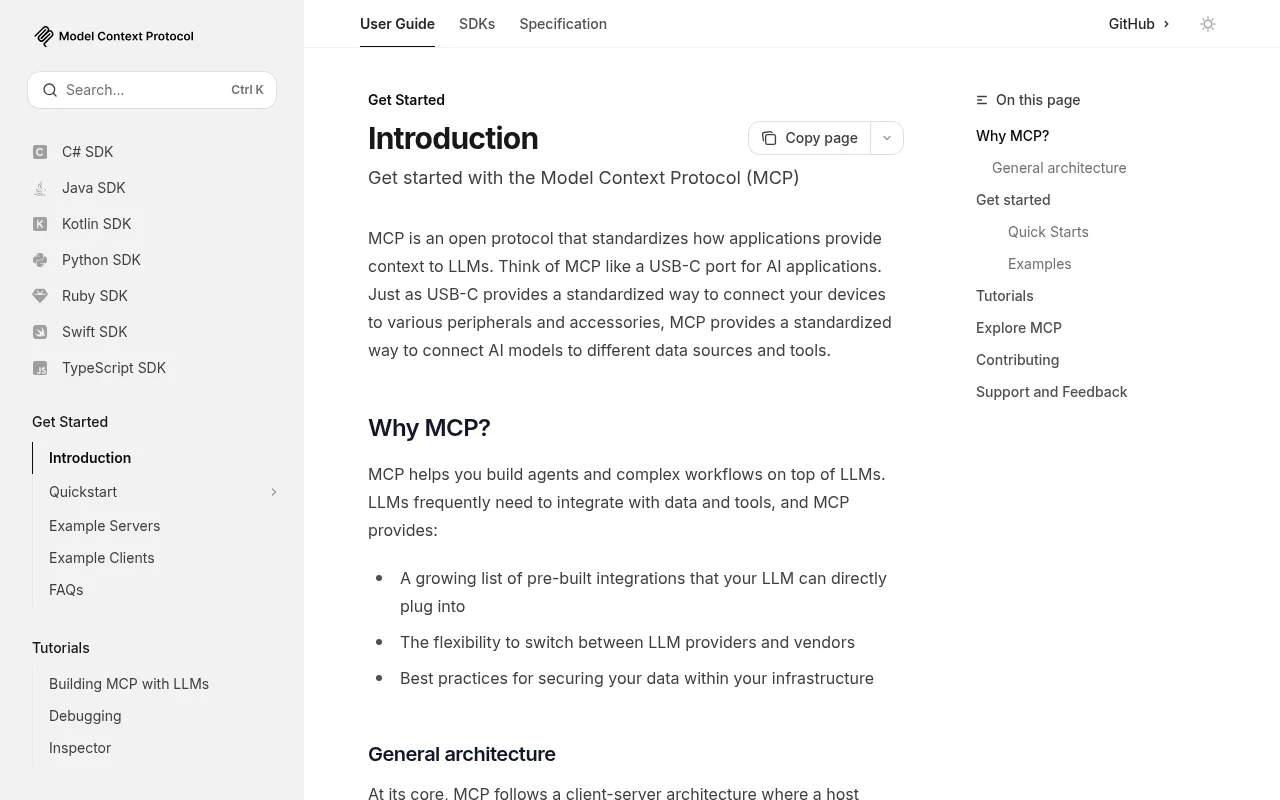
What is Model Context Protocol
Model Context Protocol (MCP) aims to standardize how AI models access and utilize context. It provides a framework for managing and sharing contextual information, such as prompts, data, and configurations, across different AI applications and services. This protocol facilitates interoperability and consistency in how models interpret and respond to inputs. Unlike ad-hoc context management, MCP offers a structured approach, reducing errors and improving model performance. It leverages a declarative approach, allowing developers to define context requirements explicitly. This benefits developers by simplifying the integration of AI models and ensuring consistent behavior across diverse applications, leading to improved accuracy and efficiency in AI-driven solutions.
Model Context Protocol 's Core features
Standardized Context Format
MCP defines a standardized format for representing and exchanging context data. This ensures that different AI models and applications can seamlessly share and understand contextual information. The format supports various data types and structures, allowing for flexibility in representing complex context elements. This standardization reduces the need for custom integrations and simplifies the development process, promoting interoperability across AI systems.
Context Versioning
The protocol includes mechanisms for versioning context data, allowing developers to track changes and maintain compatibility. This is crucial for managing evolving context requirements and ensuring that AI models use the correct version of the context. Versioning helps prevent errors and inconsistencies that can arise from outdated or incompatible context information. It supports rollback capabilities, allowing for the restoration of previous context states if necessary.
Context Sharing Mechanisms
MCP provides mechanisms for sharing context data across different AI applications and services. This includes support for various communication protocols and data storage options. The sharing mechanisms enable developers to build collaborative AI systems where multiple models can access and utilize the same context information. This promotes efficiency and reduces redundancy by centralizing context management.
Security and Access Control
The protocol incorporates security features to protect context data from unauthorized access. This includes support for authentication, authorization, and encryption. Access control mechanisms allow developers to define who can access and modify specific context elements. These security features ensure the confidentiality and integrity of sensitive information used by AI models, protecting against potential vulnerabilities.
Extensibility and Customization
MCP is designed to be extensible, allowing developers to customize it to meet specific needs. This includes the ability to define custom context elements and extend the protocol's functionality. The extensibility features enable developers to adapt the protocol to various use cases and integrate it with existing systems. This flexibility ensures that MCP can be used in a wide range of AI applications.
How to use Model Context Protocol
- Review the Model Context Protocol documentation and understand its core concepts and components.,2. Identify the specific context elements required by your AI model (e.g., prompts, data sources, configuration settings).,3. Implement the MCP interfaces within your AI application to manage and provide the necessary context.,4. Define the context structure using the protocol's standardized format, ensuring compatibility with other MCP-compliant systems.,5. Test the integration to verify that the AI model correctly accesses and utilizes the provided context.,6. Deploy your application, ensuring that the context is consistently available and updated as needed.
Use cases of Model Context Protocol
Multi-Model AI Applications
Developers building applications that use multiple AI models can use MCP to ensure that each model receives the correct context. For example, a chatbot could use MCP to provide context about the user's history and preferences to different models responsible for understanding intent, generating responses, and personalizing the interaction. This ensures consistency and improves the overall user experience.
Contextual Data Management
Data scientists can use MCP to manage the context associated with datasets used for training and inference. They can define the context, such as data sources, preprocessing steps, and feature engineering techniques, and share it with different models. This ensures reproducibility and consistency in model training and evaluation, leading to more reliable results and easier collaboration.
AI Model Deployment
ML engineers can use MCP to simplify the deployment of AI models across different environments. By packaging the model and its context together, they can ensure that the model behaves consistently regardless of where it is deployed. This reduces the risk of errors and simplifies the maintenance of AI systems, leading to faster deployment cycles and improved operational efficiency.
AI-Powered Automation
Businesses can use MCP to automate tasks that require AI models to understand context. For example, a customer service system could use MCP to provide context about the customer's account and past interactions to a model that handles support requests. This enables the system to provide more personalized and efficient support, improving customer satisfaction and reducing operational costs.
Who benefits from Model Context Protocol
AI Developers
AI developers benefit from MCP by simplifying the integration of AI models and ensuring consistent behavior across applications. The standardized format and context management features reduce development time and effort, allowing developers to focus on building and improving their AI models. It also promotes interoperability and collaboration.
Data Scientists
Data scientists can use MCP to manage and share the context associated with datasets used for training and inference. This ensures reproducibility, consistency, and collaboration in model development. It simplifies the process of tracking and managing the data and configurations used by AI models, leading to more reliable results.
ML Engineers
ML engineers benefit from MCP by simplifying the deployment and management of AI models. The protocol helps package models with their context, ensuring consistent behavior across different environments. This reduces deployment complexity, streamlines maintenance, and improves operational efficiency, leading to faster deployment cycles.
Pricing of Model Context Protocol
Open Source (License not specified). Details not available on the website.