Voicebox
Local Open-Source Voice Studio
Free
Support platforms
web
What is Voicebox
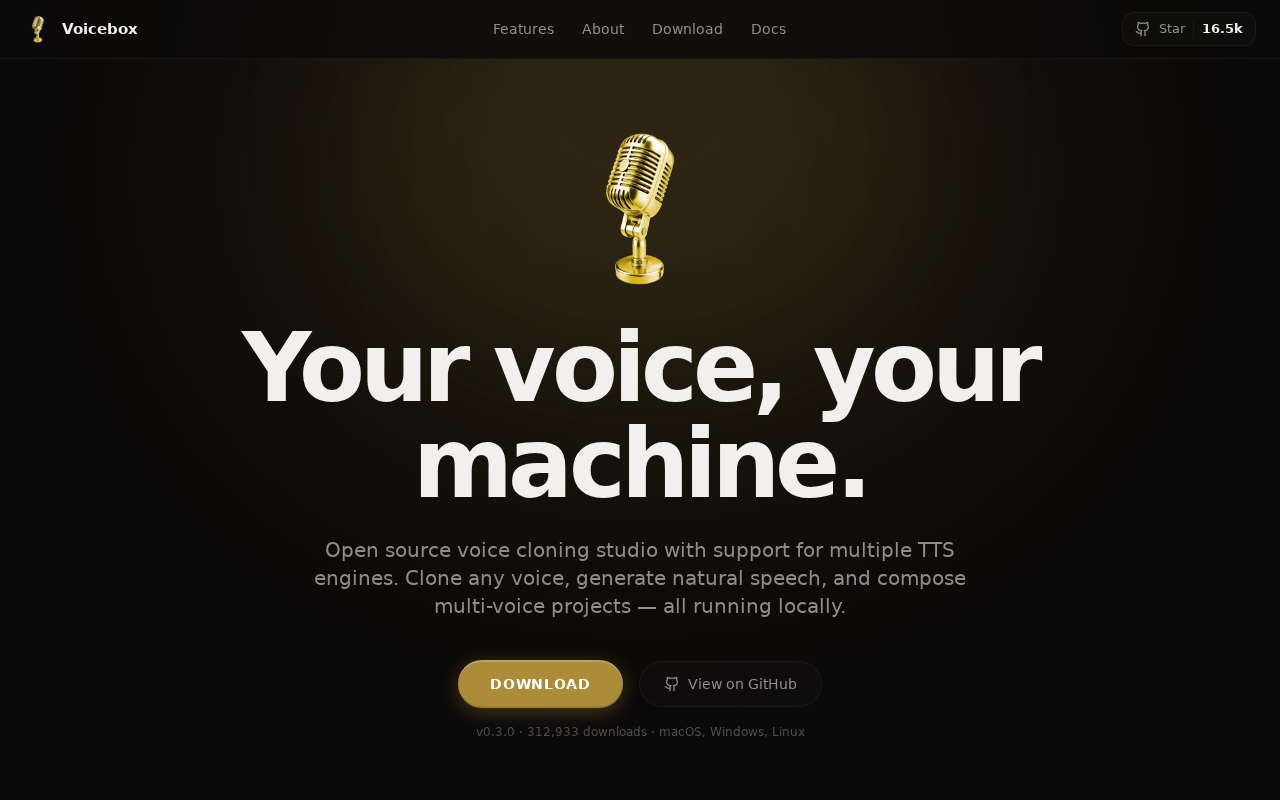
Voicebox is a desktop-native application designed for high-fidelity voice cloning and multi-voice speech synthesis. Unlike cloud-based SaaS alternatives that require API subscriptions and data transmission, Voicebox executes all inference locally, ensuring complete data privacy and zero latency costs. It supports multiple TTS engines, allowing users to switch between models like Qwen and Chatterbox for different acoustic profiles. By leveraging local compute, it enables creators to build complex, multi-voice projects without the constraints of rate limits or content moderation filters, making it an essential tool for developers and content creators prioritizing sovereignty and performance.
Voicebox 's Core features
100% Local Inference
By running exclusively on the user's hardware, Voicebox eliminates the need for cloud API calls. This architecture ensures that sensitive voice data never leaves the local machine, providing a significant privacy advantage over competitors like ElevenLabs. It also removes dependency on internet connectivity and eliminates recurring subscription costs associated with cloud-based inference tokens.
Multi-Engine TTS Support
Voicebox integrates multiple TTS engines, including Qwen 1.7B and Chatterbox, allowing users to choose the best model for their specific use case. This flexibility enables users to balance between high-fidelity, resource-intensive models and faster, lightweight models depending on their local GPU/CPU capabilities, ensuring optimal performance across various hardware configurations.
Multi-Voice Project Composition
The application features a robust project editor that supports multi-voice sequencing. Users can assign different cloned voices to specific text blocks within a single timeline. This is critical for creating dialogue-heavy content, such as audiobooks or podcasts, where distinct character voices must interact seamlessly within a single production workflow.
Low-Latency Local Generation
By utilizing local GPU acceleration, Voicebox achieves near-instantaneous speech synthesis. Unlike cloud services that suffer from network jitter and server-side queuing, local inference provides consistent performance. This allows for rapid iteration and real-time adjustments to prosody and cadence, which is essential for professional-grade voice production.
Zero-Constraint Voice Cloning
Voicebox operates without the restrictive content moderation filters found in commercial, cloud-hosted AI platforms. Users retain full control over the voices they clone and the content they generate, making it ideal for creative projects that require specific character portrayals or experimental audio synthesis that might otherwise be flagged by restrictive cloud-based safety filters.
How to use Voicebox
Download the Voicebox installer for your OS (macOS, Windows, or Linux) from the official GitHub repository.,Launch the application and navigate to the 'Create Voice' tab to upload a clean, 30-60 second audio sample of your target voice.,Select your preferred TTS engine (e.g., Qwen 1.7B or Chatterbox) from the engine dropdown menu to optimize for your hardware.,Input your script into the text editor and assign specific voice profiles to different segments for multi-voice composition.,Click 'Generate' to perform local inference and preview the synthesized audio directly within the desktop interface.,Export your final audio project as a high-quality file for use in video production or software development.
Use cases of Voicebox
Content Creation
YouTubers and podcasters use Voicebox to clone their own voices for rapid narration or to create consistent character voices for storytelling, saving hours of manual recording time while maintaining high production quality.
Game Development
Indie game developers utilize Voicebox to generate placeholder or final dialogue for NPCs. By cloning specific voice profiles locally, they can iterate on game scripts without incurring costs for professional voice actors.
Privacy-Focused Research
Researchers working with sensitive or proprietary audio data use Voicebox to perform voice synthesis without the risk of uploading data to third-party servers, ensuring full compliance with internal data security policies.
Who benefits from Voicebox
Content Creators
Need efficient, high-quality voice synthesis for video and audio projects without the recurring costs and privacy risks associated with cloud-based AI platforms.
Indie Game Developers
Require a cost-effective way to generate diverse character voices for game dialogue, allowing for rapid prototyping and iteration of narrative content.
Privacy-Conscious Developers
Prioritize local-first software architectures to ensure that proprietary or sensitive voice data remains entirely under their control, avoiding third-party data harvesting.
Pricing of Voicebox
Open source project. The software is free to download and use locally. No subscription fees or usage-based costs apply.