Supermemory
Memory API for AI applications
Paid
Support platforms
web
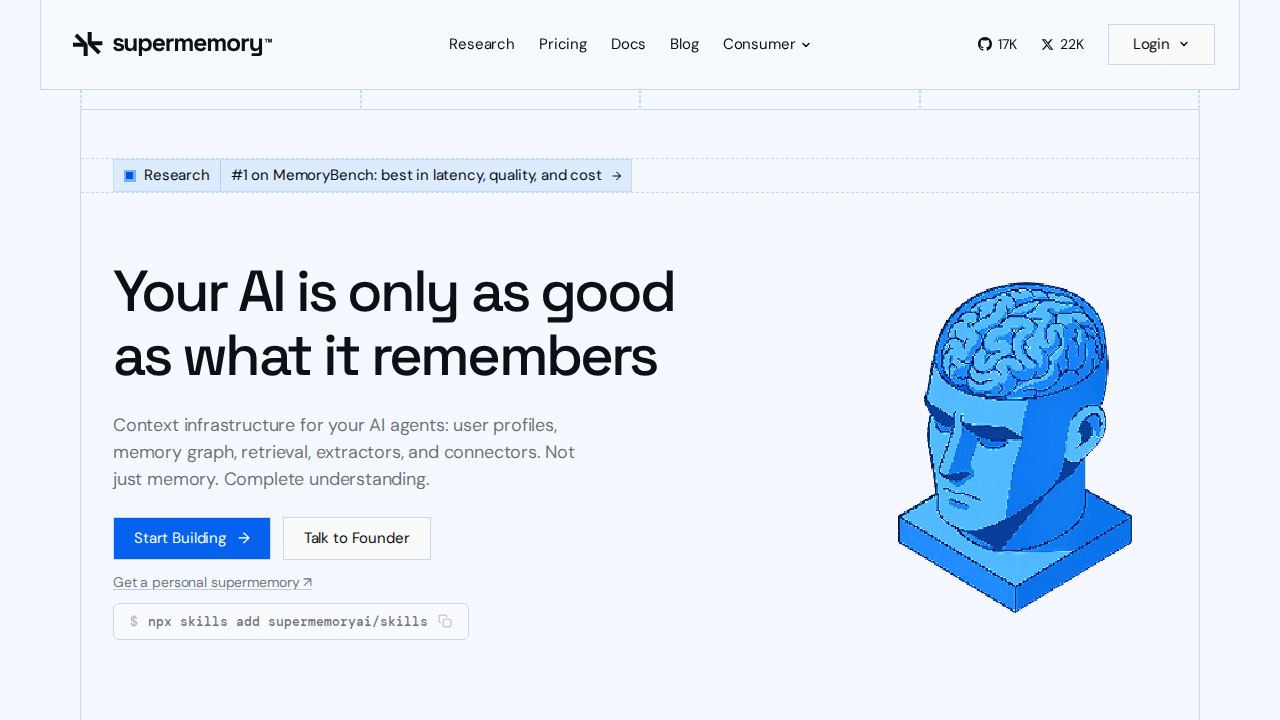
What is Supermemory
Supermemory provides a memory API designed for AI applications, enabling developers to build AI agents that can remember and utilize past interactions. It offers a solution for storing and retrieving information, context, and experiences, crucial for creating intelligent and adaptive AI systems. Unlike traditional databases, Supermemory is optimized for the specific needs of AI, such as handling unstructured data and high-volume, low-latency retrieval. The API allows developers to easily integrate memory capabilities into their AI applications, improving their ability to learn, reason, and make decisions. This is particularly beneficial for applications requiring conversational memory, personalized recommendations, and long-term context retention. Supermemory's unique approach focuses on speed and scalability, ensuring efficient memory management for complex AI tasks.
Supermemory 's Core features
Fast Memory Retrieval
Supermemory is optimized for low-latency retrieval, crucial for real-time AI applications. It utilizes indexing and caching techniques to ensure fast access to stored memories. This allows AI agents to quickly access relevant information, enabling more responsive and efficient interactions. Benchmarks show retrieval times under 100ms for typical queries, significantly faster than traditional database lookups.
Semantic Search Capabilities
Supports semantic search, allowing users to find memories based on meaning rather than exact keyword matches. This is achieved through the use of embeddings and similarity search algorithms. This feature is particularly useful for AI agents that need to understand the context and intent behind user queries, improving the accuracy of information retrieval. It supports various embedding models.
Flexible Data Storage
Supermemory supports storing various data types, including text, embeddings, and metadata. This flexibility allows developers to store diverse information relevant to their AI applications. The API handles unstructured data efficiently, making it suitable for storing conversational history, user preferences, and other complex data structures. It supports JSON and other formats.
Scalable Architecture
Designed to handle large volumes of data and high request loads. The underlying architecture is built for scalability, ensuring consistent performance as the amount of stored data grows. This is achieved through distributed storage and optimized query processing. It can scale to millions of memories and thousands of requests per second.
Contextual Metadata
Allows users to associate metadata with each memory, enabling advanced filtering and organization. This metadata can include timestamps, user IDs, or any other relevant information. This feature is crucial for managing and retrieving memories based on specific criteria, improving the accuracy and relevance of AI agent responses. Metadata can be used for filtering and sorting.
How to use Supermemory
- Sign up for a Supermemory account at supermemory.ai.,2. Obtain your API key from your account dashboard.,3. Install the Supermemory client library for your preferred programming language (e.g., Python, Node.js).,4. Initialize the client with your API key.,5. Use the API to store memories (text, embeddings, etc.) with associated metadata.,6. Query the API to retrieve relevant memories based on keywords, similarity, or other criteria.
Use cases of Supermemory
AI Chatbots
Developers can use Supermemory to build chatbots that remember past conversations and user preferences. The chatbot can recall previous interactions to provide more personalized and relevant responses. This leads to a more engaging and effective user experience, increasing user satisfaction and retention.
Personalized Recommendations
E-commerce platforms can leverage Supermemory to store user browsing history and purchase data. This allows them to provide personalized product recommendations based on past interactions. The AI can analyze user behavior to suggest relevant products, increasing sales and customer loyalty.
Customer Support
Customer support teams can use Supermemory to create AI agents that remember past support interactions. The agent can access previous conversations to provide faster and more accurate solutions. This improves customer satisfaction and reduces support costs by automating common inquiries.
AI-Powered Assistants
Developers can build AI assistants that remember user tasks, preferences, and goals. The assistant can use this memory to proactively offer assistance and automate tasks. This leads to increased productivity and a more seamless user experience.
Who benefits from Supermemory
AI Developers
AI developers need Supermemory to easily integrate memory capabilities into their applications. It simplifies the process of storing, retrieving, and managing information, allowing them to focus on building intelligent AI systems. It provides a ready-to-use solution for memory management.
Chatbot Builders
Chatbot builders benefit from Supermemory's ability to store and retrieve conversational history. This enables them to create chatbots that provide personalized and context-aware responses. This leads to improved user engagement and more effective customer service.
E-commerce Businesses
E-commerce businesses can use Supermemory to build personalized recommendation engines. This allows them to suggest relevant products to customers based on their past behavior. This increases sales and improves customer satisfaction.
Customer Support Teams
Customer support teams can leverage Supermemory to create AI agents that remember past support interactions. This allows them to provide faster and more accurate solutions, improving customer satisfaction and reducing support costs.
Pricing of Supermemory
Pricing details are not available in the provided content. Please refer to the official website for details.