Trigger.dev
Real-time backend for AI apps
Freemium
Support platforms
web
What is Trigger.dev
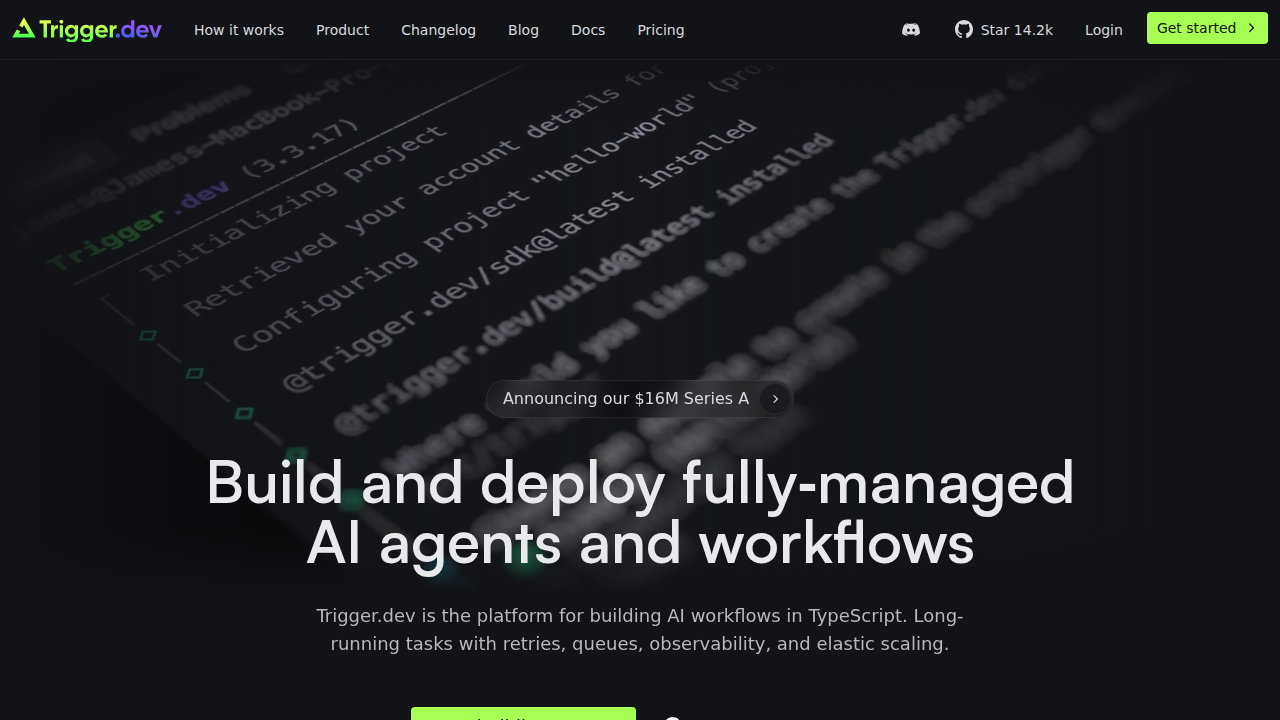
Trigger.dev is a developer platform designed to build and deploy AI agents and backend workflows. It provides a robust infrastructure for connecting frontend applications to tasks, managing concurrency, scheduling tasks, and monitoring their execution in real-time. Unlike traditional task queues, Trigger.dev offers features like durable cron schedules, built-in observability, and integrations with popular services like Vercel. The platform's core technology centers around a real-time task execution engine that simplifies the development and deployment of complex AI-powered applications. Trigger.dev is ideal for developers and teams building applications that require reliable, scalable, and observable backend processes, especially those involving AI agents, scheduled tasks, and integrations with external APIs.
Trigger.dev 's Core features
Real-time Task Execution
Trigger.dev provides a real-time execution engine that allows tasks to run immediately or be scheduled. This ensures that tasks are processed promptly and efficiently, reducing latency and improving the responsiveness of AI applications. The engine supports concurrent task execution and provides mechanisms for handling failures and retries, ensuring reliability.
Durable Cron Schedules
Trigger.dev offers durable cron schedules that are resilient to timeouts and other disruptions. This ensures that scheduled tasks run reliably, even if the underlying infrastructure experiences issues. The system automatically handles retries and provides detailed logging and monitoring to help diagnose and resolve any problems.
Vercel Integration
Seamlessly integrates with Vercel, allowing developers to connect their Vercel projects to Trigger.dev. This integration enables automatic deploys, environment variable synchronization, and atomic deployments, streamlining the development and deployment workflow. This integration reduces manual steps and ensures consistency between the frontend and backend.
Observability & Monitoring
Provides real-time monitoring and tracing of tasks, offering insights into task execution, performance, and errors. The platform includes dashboards for metrics, error tracking, and detailed logs. This allows developers to quickly identify and resolve issues, ensuring the reliability and performance of their applications.
AI Agent Skills
Offers pre-built agent skills to teach AI coding assistants best practices for writing tasks, agents, and workflows. These skills help developers build more robust and efficient AI agents by providing guidance on code structure, error handling, and best practices. This feature accelerates development and improves the quality of AI-powered applications.
How to use Trigger.dev
- Sign up for a Trigger.dev account and create a new project.,2. Install the Trigger.dev CLI using
npm install -g @trigger.dev/cli.,3. Authenticate the CLI with your account usingtrigger loginand follow the prompts.,4. Initialize a new Trigger.dev project in your existing codebase withtrigger init.,5. Define your tasks and workflows using the Trigger.dev SDK, specifying triggers, actions, and dependencies.,6. Deploy your project to Trigger.dev usingtrigger deployto make your tasks live.
Use cases of Trigger.dev
Automated Deployment Workflows
Developers can use Trigger.dev to automate deployment workflows, triggering deployments to Vercel or other platforms based on events like code pushes or scheduled intervals. This streamlines the deployment process, reduces manual effort, and ensures consistent deployments.
Scheduled Data Processing
Data engineers can schedule data processing tasks to run at specific times, such as daily or weekly reports. Trigger.dev's durable cron schedules ensure that these tasks run reliably, even if the system experiences temporary outages, providing consistent data updates.
Real-time Notifications and Alerts
Developers can use Trigger.dev to send real-time notifications and alerts based on events or data changes. For example, they can trigger notifications when a new user signs up or when a critical error occurs, improving user engagement and operational awareness.
AI Agent Orchestration
Developers building AI-powered applications can use Trigger.dev to orchestrate complex workflows involving multiple AI agents. This allows them to chain together different AI models and services, creating sophisticated applications that can perform tasks such as content generation, data analysis, and customer support.
Who benefits from Trigger.dev
Frontend Developers
Frontend developers benefit from Trigger.dev by easily connecting their frontend applications to backend tasks, enabling features like scheduled jobs, background processing, and real-time updates without managing complex infrastructure.
Backend Developers
Backend developers can use Trigger.dev to simplify the creation and management of backend workflows, including scheduled tasks, integrations with external services, and AI agent orchestration, reducing the complexity of backend development.
AI Engineers
AI engineers can leverage Trigger.dev to build and deploy AI agents and workflows, providing a robust platform for managing the execution, monitoring, and scaling of AI-powered applications, including integrations with AI SDKs.
DevOps Engineers
DevOps engineers can use Trigger.dev to automate deployment processes, monitor task execution, and ensure the reliability and scalability of backend systems, improving operational efficiency and reducing manual intervention.
Pricing of Trigger.dev
Free tier available. Paid plans with increased task executions, concurrency, and features. Contact for custom enterprise pricing.