AgentScope
Multi-Agent Orchestration SDK
Free
Support platforms
web
What is AgentScope
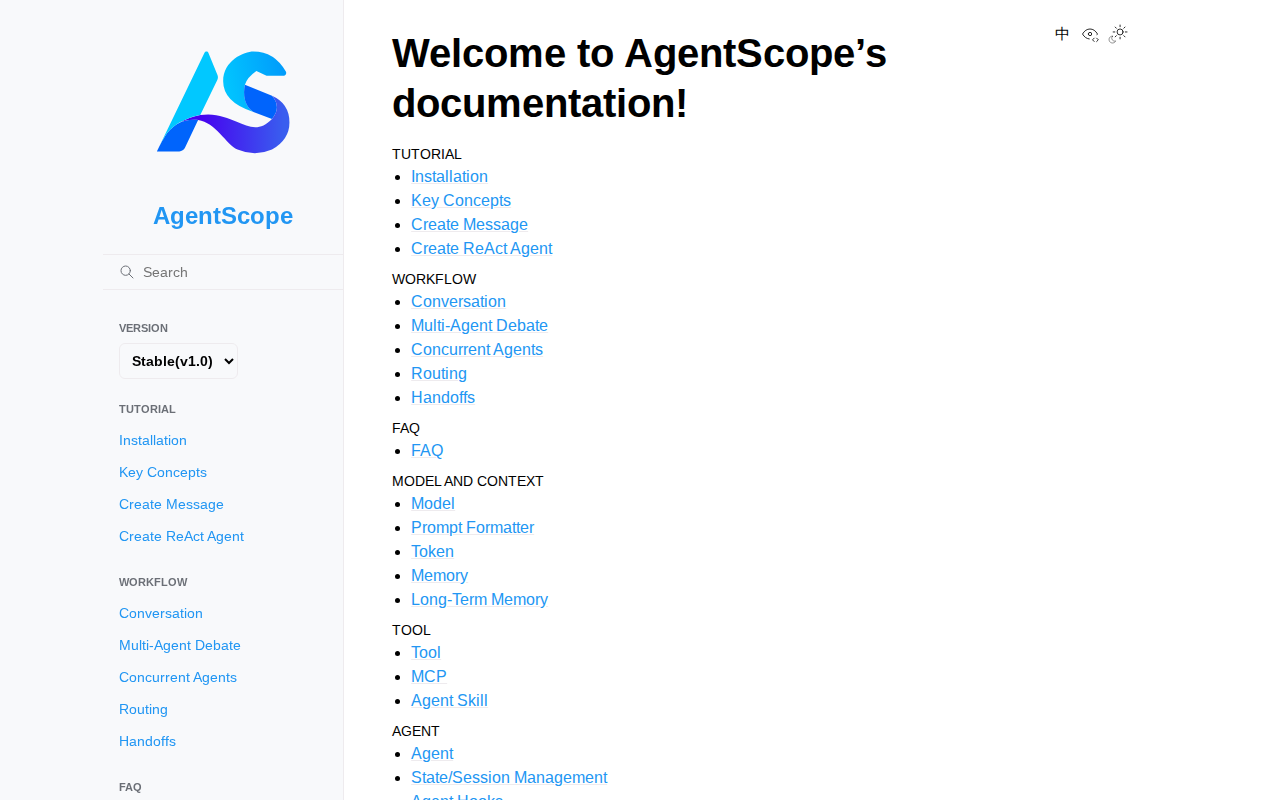
AgentScope is a comprehensive, open-source multi-agent development framework designed by Alibaba. It provides a robust, modular architecture for building, managing, and evaluating complex AI agent systems. Unlike monolithic agent frameworks, AgentScope utilizes a distributed, message-driven design that supports concurrent agent execution, state management, and sophisticated workflow orchestration. It distinguishes itself through its native support for AgentScope Studio, which provides real-time visualization and tracing of agent interactions, and a built-in evaluation suite (OpenJudge) for benchmarking agent performance. It is ideal for developers building autonomous systems that require multi-agent collaboration, long-term memory, and rigorous performance testing.
AgentScope 's Core features
Distributed Multi-Agent Architecture
AgentScope utilizes a message-driven, distributed architecture that allows agents to run across different processes or machines. By decoupling agent logic from the execution environment, it enables horizontal scaling of complex multi-agent systems. This is significantly more flexible than single-process frameworks, allowing developers to handle high-concurrency workloads and integrate specialized agents that may require different hardware or environment configurations.
AgentScope Studio Tracing
The built-in Studio provides a visual interface for real-time monitoring of agent message flows, state changes, and tool usage. It captures granular execution traces, allowing developers to debug complex multi-agent interactions that are otherwise opaque. This visual feedback loop reduces debugging time by providing a clear timeline of inter-agent communication and decision-making processes.
Modular Memory Management
The framework offers sophisticated memory modules including token-based memory and long-term storage solutions. This allows agents to maintain context across sessions and manage token limits effectively. By separating memory from the agent logic, developers can implement custom retrieval strategies, such as RAG or vector-based lookups, ensuring agents remain coherent during long-running, multi-turn conversations.
OpenJudge Evaluation Suite
AgentScope includes OpenJudge, a dedicated evaluation framework for benchmarking agent performance against specific tasks. It allows developers to define automated test cases and metrics to measure agent success rates, response quality, and efficiency. This built-in evaluation capability is critical for iterative development, ensuring that changes to agent prompts or logic do not degrade overall system performance.
Flexible Middleware and Hooks
The framework supports middleware and hooks, enabling developers to inject custom logic into the agent lifecycle, such as logging, rate limiting, or input/output filtering. This modular approach allows for the implementation of cross-cutting concerns without modifying the core agent code. It provides the extensibility needed for production-grade applications where security, observability, and compliance are mandatory requirements.
How to use AgentScope
Install the framework via pip: 'pip install agentscope'.,Initialize your project and configure the model wrapper (e.g., OpenAI, DashScope) in a JSON configuration file.,Define your agents by subclassing the Agent class and assigning specific roles, tools, and memory modules.,Construct a workflow using the Pipeline or direct message-passing API to manage agent interactions.,Launch the AgentScope Studio server to monitor real-time message flow and agent state transitions.,Execute your agent script and analyze the generated traces to optimize performance and logic.
Use cases of AgentScope
Collaborative Software Development
Teams can deploy a swarm of specialized agents—a coder, a reviewer, and a tester—to automate the software development lifecycle. AgentScope orchestrates their communication, ensuring the coder receives feedback from the reviewer before the tester validates the final output.
Complex Task Automation
Enterprises use AgentScope to build autonomous agents that perform multi-step research and data analysis. By using routing and handoffs, the system delegates sub-tasks to specific agents, resulting in a comprehensive, synthesized report generated from disparate data sources.
Agentic Simulation Environments
Researchers use the framework to simulate multi-agent social or economic scenarios. By defining agent states and interaction rules, they can observe emergent behaviors in a controlled, traceable environment, making it ideal for academic and behavioral research.
Who benefits from AgentScope
AI Research Engineers
Need a framework that supports rigorous evaluation and complex multi-agent orchestration for developing and testing novel autonomous system architectures.
Backend Developers
Require a scalable, production-ready SDK to integrate AI agents into existing enterprise applications with robust logging and debugging capabilities.
AI Product Builders
Looking for a modular toolset to rapidly prototype and iterate on multi-agent workflows while maintaining visibility into agent performance and state.
Pricing of AgentScope
Open-source software released under the Apache License 2.0. Free to use, modify, and distribute for commercial and personal projects.