Apache Seata
Distributed Transaction Solution
Free
Support platforms
web
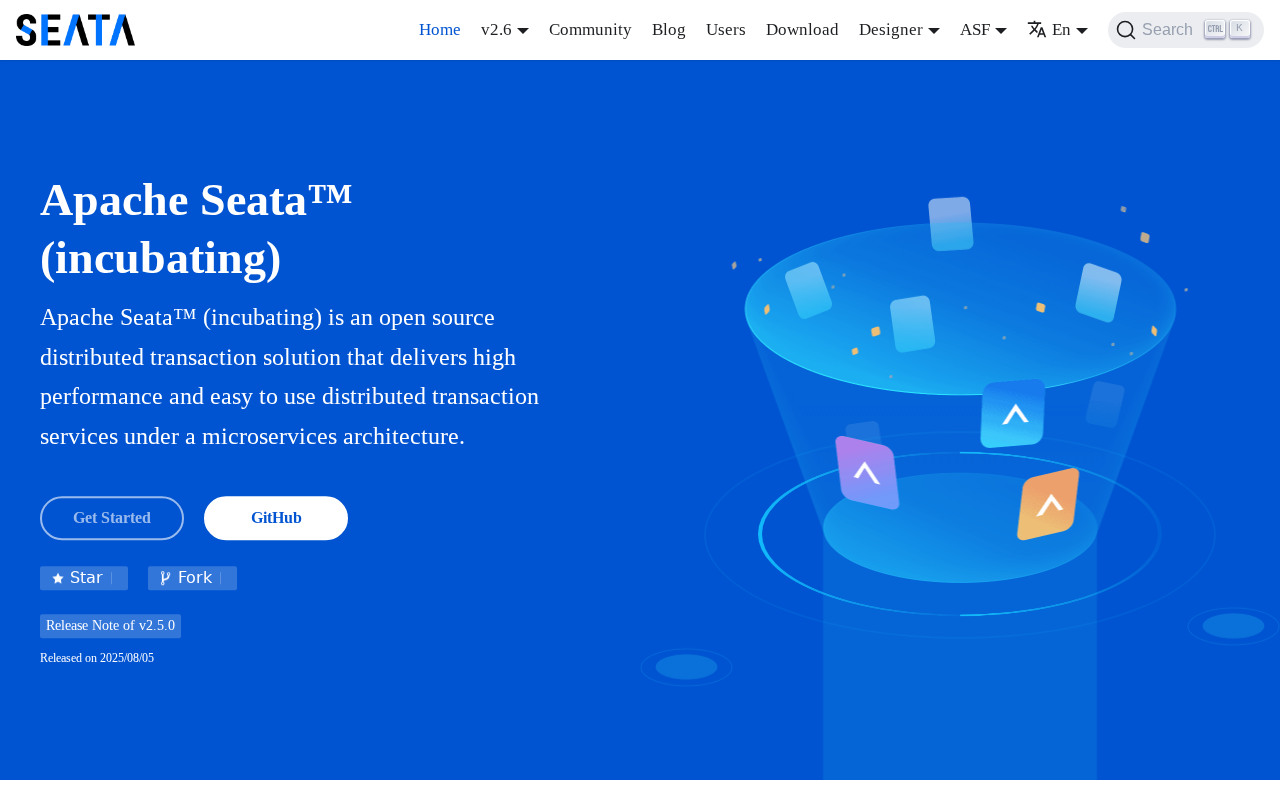
What is Apache Seata
Apache Seata is an open-source distributed transaction solution designed for microservices architectures. It provides high-performance and easy-to-use services to ensure data consistency across multiple services. Unlike traditional monolithic transaction management, Seata offers a flexible approach to handle distributed transactions, supporting various transaction modes like AT, TCC, and SAGA. This allows developers to choose the best fit for their specific needs and application architecture. Seata's unique value lies in its ability to manage transactions across different databases and service boundaries, ensuring data integrity in complex, distributed systems. It's particularly beneficial for applications built on microservices, where maintaining data consistency is a significant challenge.
Apache Seata 's Core features
Multiple Transaction Modes
Seata supports AT (Automatic Transaction), TCC (Try-Confirm-Cancel), and SAGA transaction modes. AT mode provides a simplified approach with automatic resource management. TCC offers more control for complex scenarios, while SAGA is suitable for long-running transactions. This flexibility allows developers to choose the best mode based on their specific needs, improving performance and data consistency.
High Performance
Seata is designed for high performance, minimizing the overhead of distributed transaction management. It achieves this through optimized resource management and efficient communication between transaction participants. Benchmarks show Seata can handle thousands of transactions per second, making it suitable for high-volume applications. The AT mode, in particular, offers good performance due to its simplicity.
Easy Integration
Seata provides client libraries for various programming languages, including Java, Go, and others, making it easy to integrate into existing microservices applications. The integration process typically involves adding dependencies, configuring the Seata client, and annotating transaction methods. This streamlined process reduces the time and effort required to implement distributed transaction management.
Scalability and Reliability
Seata is designed to be scalable and reliable, ensuring that distributed transactions can handle increasing workloads and maintain data consistency even in the face of failures. The Seata Server can be deployed in a cluster to provide high availability, and the client libraries incorporate mechanisms for handling transaction failures and retries. This ensures that transactions are completed successfully.
Cross-Database Support
Seata supports various databases, including MySQL, PostgreSQL, and Oracle. This cross-database support allows developers to use Seata in heterogeneous environments, where different microservices may use different database systems. The AT mode, in particular, provides broad database compatibility, making it easier to manage transactions across diverse data stores.
How to use Apache Seata
- Download and install Seata Server from the official website or Maven repository.,2. Configure the Seata Server with your database connection details and transaction management settings.,3. Integrate the Seata client library into your microservices applications using the appropriate SDK for your programming language (Java, Go, etc.).,4. Annotate your transaction methods with Seata's
@GlobalTransactionalannotation to enable global transaction management.,5. Define your transaction branches using the appropriate transaction mode (AT, TCC, or SAGA) based on your application's requirements.,6. Deploy your microservices and test the distributed transactions to ensure data consistency across all involved services.
Use cases of Apache Seata
E-commerce Order Processing
In an e-commerce platform, when a customer places an order, multiple services are involved (inventory, payment, order creation). Seata ensures that all these operations either succeed together or roll back, preventing issues like insufficient inventory or incomplete payments. This ensures data consistency and a smooth customer experience.
Financial Transactions
For financial applications, Seata can manage transactions across different financial services, such as account transfers, loan applications, and investment transactions. It ensures that funds are debited from one account and credited to another atomically, preventing data inconsistencies and financial losses. This is critical for maintaining the integrity of financial data.
Microservices Data Synchronization
When multiple microservices need to update data related to a single business operation, Seata helps synchronize these updates. For example, updating user profiles across different services (profile service, notification service, etc.). Seata ensures that all services update their data consistently, preventing data discrepancies and ensuring data integrity.
Who benefits from Apache Seata
Microservices Architects
Architects designing microservices-based applications benefit from Seata by simplifying the management of distributed transactions. It provides a robust solution for ensuring data consistency across multiple services, reducing the complexity of building and maintaining distributed systems.
Java Developers
Java developers working on microservices projects can easily integrate Seata using its Java client library. This allows them to implement distributed transactions with minimal code changes, improving the reliability and consistency of their applications. The AT mode is particularly easy to use.
DevOps Engineers
DevOps engineers can leverage Seata to ensure the reliability and scalability of their microservices deployments. Seata's ability to handle transaction failures and its support for clustering contribute to the overall resilience of the system. This helps to maintain high availability and data integrity.
Pricing of Apache Seata
Open Source (Apache 2.0 License). Free to use, with community support and contributions.