Rezonant – Turn Product Vision Into Engineering-Ready Work
AI-Powered Product Development
Freemium
Support platforms
web
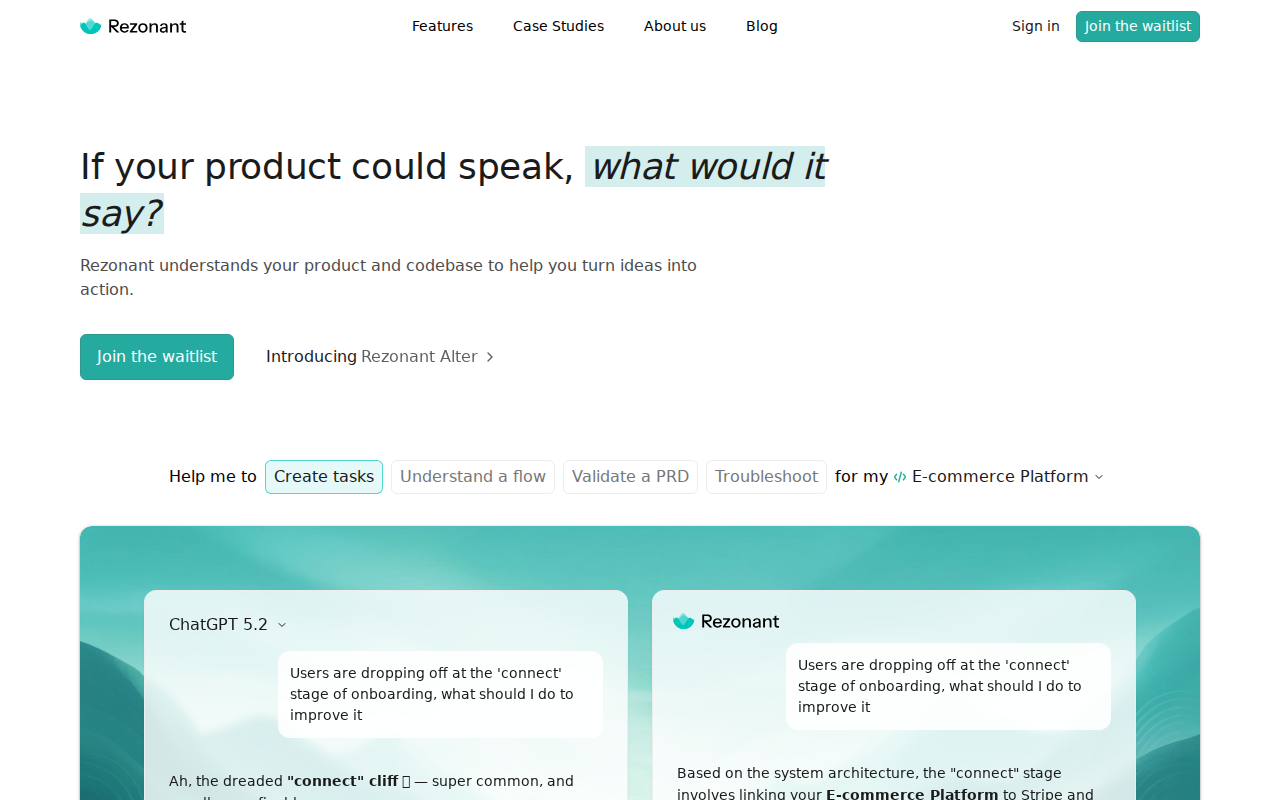
What is Rezonant – Turn Product Vision Into Engineering-Ready Work
Rezonant transforms product vision into actionable engineering tasks. It understands your product's systems and codebase, enabling you to clarify requirements, shape intent into buildable work, and deliver code efficiently. Unlike traditional methods that rely on manual documentation and interpretation, Rezonant leverages AI to automate task creation, flow understanding, and PRD validation. This leads to reduced development time, fewer errors, and improved team alignment. It's ideal for product managers, engineers, and technical leaders seeking to streamline their product development lifecycle and accelerate time-to-market.
Rezonant – Turn Product Vision Into Engineering-Ready Work 's Core features
AI-Driven Task Generation
Rezonant uses advanced AI models to automatically generate engineering tasks from product descriptions. This includes breaking down complex features into smaller, manageable units, estimating effort, and suggesting relevant code changes. This automation reduces manual effort and accelerates the initial planning phase, potentially saving teams up to 30% of their time spent on task creation.
Codebase Understanding
Rezonant integrates with your codebase to provide context-aware task generation. By understanding the existing code structure, dependencies, and architecture, it suggests more accurate and relevant tasks. This reduces the risk of introducing errors or conflicts, leading to a more stable and maintainable codebase. This feature is particularly valuable for large projects with complex dependencies.
Flow Understanding
Rezonant analyzes user flows and system interactions to identify potential bottlenecks and areas for improvement. It can automatically generate diagrams and documentation to visualize these flows, helping teams understand the end-to-end user experience. This feature helps teams to identify and resolve usability issues, leading to a 15-20% improvement in user engagement.
PRD Validation
Rezonant validates Product Requirement Documents (PRDs) against the codebase and user flows to ensure consistency and completeness. It identifies potential gaps or inconsistencies, reducing the risk of miscommunication and rework. This feature helps teams to catch errors early in the development process, saving time and resources.
Integration with Existing Tools
Rezonant integrates with popular project management and development tools, such as Jira, Asana, and GitHub. This allows teams to seamlessly incorporate Rezonant's insights into their existing workflows. This integration streamlines the development process and reduces the need for manual data transfer, improving team efficiency.
How to use Rezonant – Turn Product Vision Into Engineering-Ready Work
- Join the Rezonant waitlist to gain early access to the platform.,2. Describe your product vision or a specific feature you want to build using natural language.,3. Rezonant analyzes your description and codebase (if connected) to generate engineering-ready tasks.,4. Review and refine the generated tasks, adjusting them to fit your specific requirements.,5. Integrate the tasks into your existing project management tools or development workflow.,6. Monitor progress and iterate on the tasks as needed, using Rezonant to stay aligned with your product vision.
Use cases of Rezonant – Turn Product Vision Into Engineering-Ready Work
Feature Prioritization
A product manager uses Rezonant to describe a new feature. Rezonant generates a list of tasks, estimates effort, and identifies potential dependencies. This helps the product manager prioritize the feature based on its impact and feasibility, ensuring resources are allocated effectively.
Codebase Navigation
A developer uses Rezonant to understand the codebase related to a specific feature. Rezonant generates diagrams and documentation that visualize the relevant code structure and dependencies. This helps the developer quickly understand the code and make necessary changes.
Onboarding Optimization
A product team uses Rezonant to analyze the user onboarding flow. Rezonant identifies potential friction points and suggests improvements. This helps the team optimize the onboarding process, increasing user activation and retention rates.
Bug Troubleshooting
An engineer uses Rezonant to troubleshoot a bug. Rezonant analyzes the codebase and user flows to identify the root cause of the bug. This helps the engineer quickly resolve the issue and prevent similar bugs from occurring in the future.
Who benefits from Rezonant – Turn Product Vision Into Engineering-Ready Work
Product Managers
Product managers benefit from Rezonant by gaining clarity on feature requirements, generating actionable tasks, and validating PRDs. This reduces the time spent on planning and documentation, allowing them to focus on strategic product decisions.
Software Engineers
Engineers leverage Rezonant to understand complex codebases, generate tasks, and troubleshoot bugs. This improves code quality, reduces development time, and streamlines the development workflow, leading to faster feature delivery.
Engineering Managers
Engineering managers use Rezonant to improve team efficiency, align development efforts with product vision, and track progress. This leads to better resource allocation, reduced project delays, and improved team performance.
Technical Leaders
Technical leaders use Rezonant to gain a holistic view of the product development process, identify areas for improvement, and make data-driven decisions. This helps them to optimize the development lifecycle and accelerate time-to-market.
Pricing of Rezonant – Turn Product Vision Into Engineering-Ready Work
Join the waitlist for early access. Pricing details are not available on the website, but a freemium model is likely.