RustPython
Python interpreter in Rust
Free
Support platforms
web
Tool tags
What is RustPython
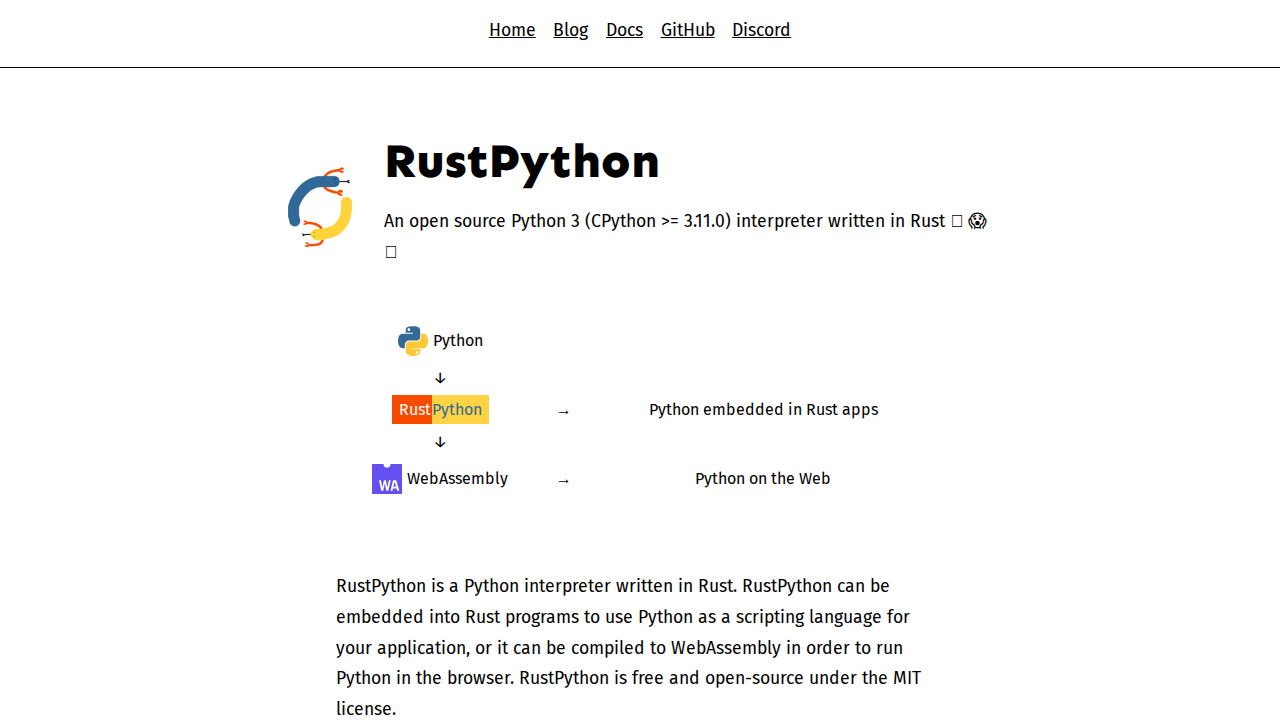
RustPython is an open-source Python 3 interpreter written entirely in Rust. It allows developers to embed Python scripting capabilities directly into Rust applications, offering a unique blend of Python's flexibility and Rust's performance and safety. Unlike CPython, Jython, or IronPython, RustPython is not built on top of another language's runtime, providing a clean and efficient implementation. Furthermore, it can be compiled to WebAssembly, enabling Python code execution in web browsers. This makes it ideal for projects needing scripting, embedded logic, or web-based Python environments. The project is open-source under the MIT license.
RustPython 's Core features
Rust-based Python Interpreter
RustPython is written entirely in Rust, offering memory safety, concurrency, and performance benefits inherent to the Rust language. This contrasts with CPython, which is written in C and can be prone to memory-related vulnerabilities. RustPython's design allows for efficient execution and integration with Rust applications, potentially leading to performance improvements compared to other Python implementations.
WebAssembly Compilation
RustPython can be compiled to WebAssembly (Wasm), enabling Python code to run in web browsers. This opens up possibilities for creating interactive web applications, scripting within web environments, and providing Python-based tools accessible directly in the browser. This is a key differentiator from standard Python interpreters that are not designed for direct web execution.
Embedding in Rust Applications
RustPython allows developers to embed Python as a scripting language within their Rust applications. This enables dynamic behavior and extensibility, allowing users to customize and extend the functionality of a Rust program using Python scripts. This is achieved through a clean API that allows for seamless integration between Rust and Python code.
Open Source and MIT Licensed
RustPython is released under the permissive MIT license, allowing for free use, modification, and distribution, even for commercial purposes. This promotes community contributions, transparency, and flexibility for developers. The open-source nature fosters collaboration and allows for continuous improvement and adaptation to evolving Python standards.
CPython Compatibility Focus
RustPython aims for compatibility with Python 3 (CPython >= 3.11.0). The project actively works towards supporting the Python standard library and language features. This compatibility focus ensures that existing Python code can be ported and executed with minimal modifications, facilitating adoption and integration.
How to use RustPython
- Choose your installation method:
cargo install --git https://github.com/RustPython/RustPythonfor Cargo,rustpython wapm install rustpythonfor WAPM, orconda install rustpython -c conda-forgefor Conda.,2. If building from source, clone the repository and navigate to the project directory.,3. Build the project usingcargo build --releasefor optimized performance.,4. Embed RustPython in your Rust project by addingrustpythonas a dependency in yourCargo.tomlfile.,5. Use the RustPython API to execute Python code within your Rust application or compile to WebAssembly.,6. Refer to the documentation and examples on the GitHub repository for detailed usage instructions and API references.
Use cases of RustPython
Scripting in Embedded Systems
Embedded systems developers can use RustPython to add scripting capabilities to their devices. They can allow users to customize device behavior using Python scripts, providing flexibility and ease of use. This is particularly useful for prototyping and customizing firmware without requiring recompilation.
Web-Based Python Environments
Web developers can leverage RustPython to create in-browser Python environments. Users can write and execute Python code directly in their web browsers, enabling interactive tutorials, educational tools, or web-based IDEs. This eliminates the need for server-side execution or external dependencies.
Extending Rust Applications
Developers building Rust applications can use RustPython to allow users to extend the functionality of their software through Python scripts. This enables a plugin architecture, allowing users to add custom features and integrations without modifying the core Rust code. This enhances the application's versatility and user experience.
Who benefits from RustPython
Rust Developers
Rust developers can benefit from RustPython by embedding Python scripting capabilities into their applications. This allows for dynamic behavior, extensibility, and easier integration with existing Python libraries, all while leveraging Rust's performance and safety.
Web Developers
Web developers can use RustPython to run Python code directly in the browser via WebAssembly. This enables interactive web applications, educational tools, and web-based IDEs, providing a new way to deliver Python-based experiences without server-side dependencies.
Embedded Systems Engineers
Embedded systems engineers can use RustPython to add scripting capabilities to their devices. This allows for flexible customization and easier firmware updates, improving the user experience and reducing development time.
Python Developers
Python developers can explore RustPython as a way to understand the internals of a Python interpreter and to potentially contribute to its development. It offers a unique perspective on Python's implementation and allows them to leverage Rust's strengths.
Pricing of RustPython
Open source under the MIT license. Free to use, modify, and distribute.