Opik
Real-time AI observability platform
Freemium
Support platforms
web
What is Opik
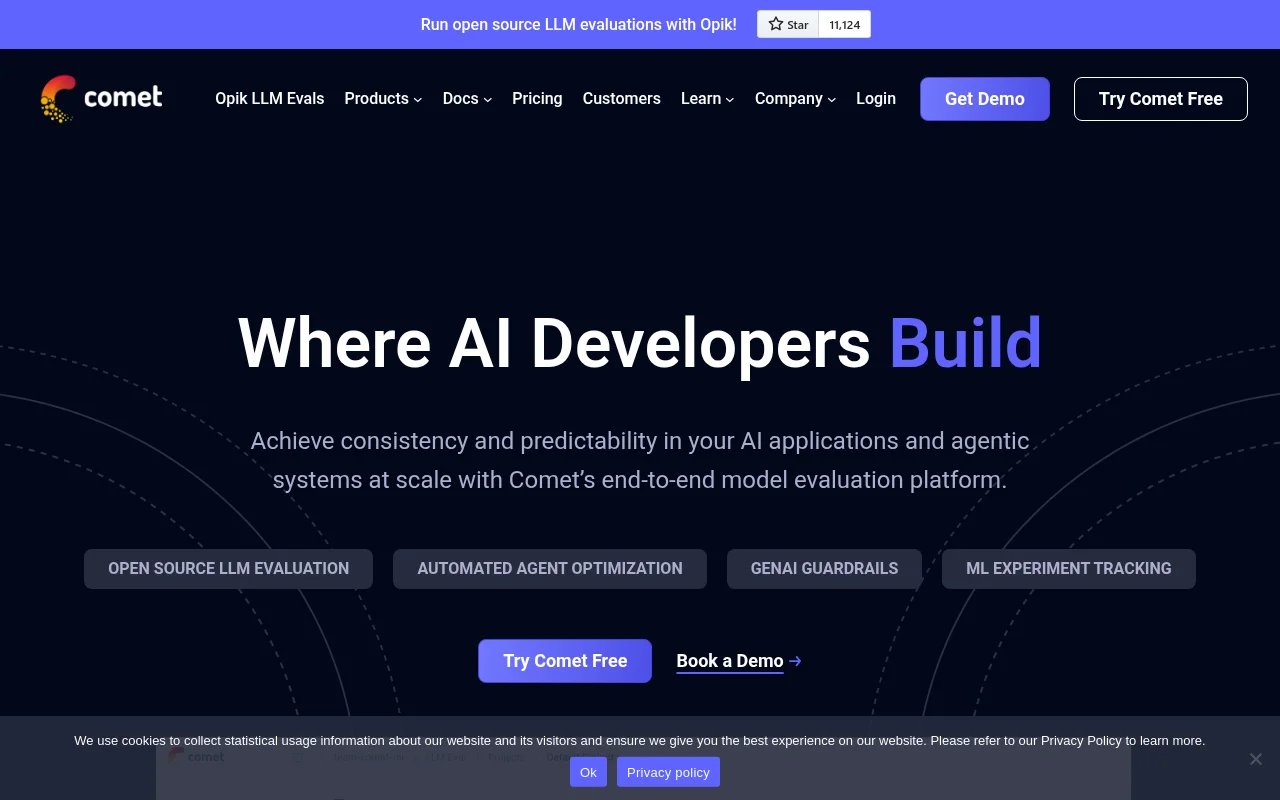
Opik provides a real-time observability platform for AI applications, enabling developers to monitor, debug, and optimize their AI models and pipelines. It offers comprehensive insights into model performance, data quality, and system health. Unlike traditional monitoring solutions, Opik is specifically designed for the unique challenges of AI, such as understanding complex model behavior and identifying data drift. The platform leverages advanced tracing and logging capabilities to capture detailed information about every step of an AI workflow. This allows users to pinpoint performance bottlenecks, diagnose errors, and ensure the reliability of their AI systems. Data scientists, ML engineers, and DevOps teams benefit most from Opik by gaining actionable insights to improve model accuracy, reduce operational costs, and accelerate the development lifecycle.
Opik 's Core features
Real-time Experiment Tracking
Comet tracks every aspect of your AI experiments, including code, hyperparameters, metrics, and datasets. It provides a centralized view of all your experiments, enabling you to easily compare results and identify the best-performing models. This is achieved by automatically logging key information during model training and evaluation, providing a comprehensive audit trail for reproducibility and collaboration. This reduces the time spent on manual tracking and improves the efficiency of model development.
Model Performance Monitoring
Opik provides real-time monitoring of model performance in production. It tracks key metrics such as accuracy, latency, and throughput, and provides alerts when performance degrades. This helps you quickly identify and resolve issues that may impact user experience or business outcomes. The system uses advanced analytics to detect anomalies and trends, providing insights into potential problems before they impact your users. This proactive approach ensures the reliability and stability of your AI applications.
Data Drift Detection
Opik automatically detects data drift, which occurs when the distribution of input data changes over time, potentially degrading model performance. It compares the distribution of incoming data to the data used for training and alerts you when significant changes are detected. This feature helps you maintain model accuracy and prevent unexpected behavior. The system uses statistical methods to quantify data drift, providing actionable insights into the extent and nature of the changes.
Collaboration and Sharing
Comet facilitates collaboration among data scientists and ML engineers by enabling easy sharing of experiments, models, and results. It provides features such as team dashboards, commenting, and version control. This promotes knowledge sharing and accelerates the development process. The platform supports integration with popular collaboration tools, such as Slack and Microsoft Teams, to streamline communication and keep teams informed of progress.
Model Registry and Versioning
Comet includes a model registry that allows you to store, version, and manage your trained models. It provides a centralized repository for all your models, making it easy to track different versions and deploy the best-performing ones. This feature supports model governance and ensures that you are using the most up-to-date and accurate models in production. The registry integrates with popular deployment platforms for seamless model deployment.
How to use Opik
- Sign up for a Comet account at comet.com. 2. Install the Comet Python SDK using pip install comet-ml. 3. Initialize Comet in your Python script by importing comet_ml and setting your API key. 4. Log your model, metrics, and other relevant data using the Comet API. 5. Run your training or inference script. 6. Access the Comet dashboard to visualize your experiments, compare results, and monitor performance in real-time.
Use cases of Opik
Model Training Optimization
Data scientists use Comet to track and compare different model training runs, experimenting with various hyperparameters and datasets. They analyze the results in real-time, identifying the optimal configurations to improve model accuracy and reduce training time. This leads to faster iteration cycles and better model performance.
Production Model Monitoring
ML engineers use Opik to monitor the performance of deployed models in production. They track key metrics such as accuracy, latency, and throughput, and receive alerts when performance degrades. This allows them to quickly identify and resolve issues, ensuring the reliability and stability of the AI applications.
Data Drift Mitigation
Data scientists and ML engineers utilize Opik to detect data drift in production environments. They receive alerts when the distribution of input data changes, allowing them to retrain models with updated data or adjust model parameters to maintain accuracy. This proactive approach prevents model degradation and ensures consistent performance.
Collaboration and Knowledge Sharing
Teams use Comet to share experiment results, models, and insights. They collaborate on model development, discuss findings, and document their work. This fosters knowledge sharing and accelerates the development process, leading to more efficient and effective AI projects.
Who benefits from Opik
Data Scientists
Data scientists need Comet to track, compare, and optimize their machine learning experiments. It helps them iterate faster, improve model accuracy, and collaborate effectively with their teams. The platform provides the necessary tools for experiment tracking, model comparison, and result visualization.
ML Engineers
ML engineers require Opik to monitor and manage deployed models in production. They use it to track performance, detect data drift, and ensure the reliability of AI applications. The platform provides real-time insights and alerts to proactively address issues and maintain model accuracy.
DevOps Engineers
DevOps engineers benefit from Opik by gaining visibility into the performance and health of AI systems. They can use the platform to monitor infrastructure, identify bottlenecks, and optimize resource utilization. This helps them ensure the scalability and reliability of AI deployments.
AI Team Leads
AI team leads use Comet to oversee their team's experiments, track progress, and ensure alignment with project goals. They can monitor the performance of individual team members, identify areas for improvement, and facilitate collaboration. This improves overall team productivity and project success.
Pricing of Opik
Comet offers a free tier with limited features and usage. Paid plans are available with increased limits and advanced features. Pricing details are available on their website, with options for individual users and teams.