OpenAI
OpenAI API: Code generation & more
Paid
Support platforms
web
What is OpenAI
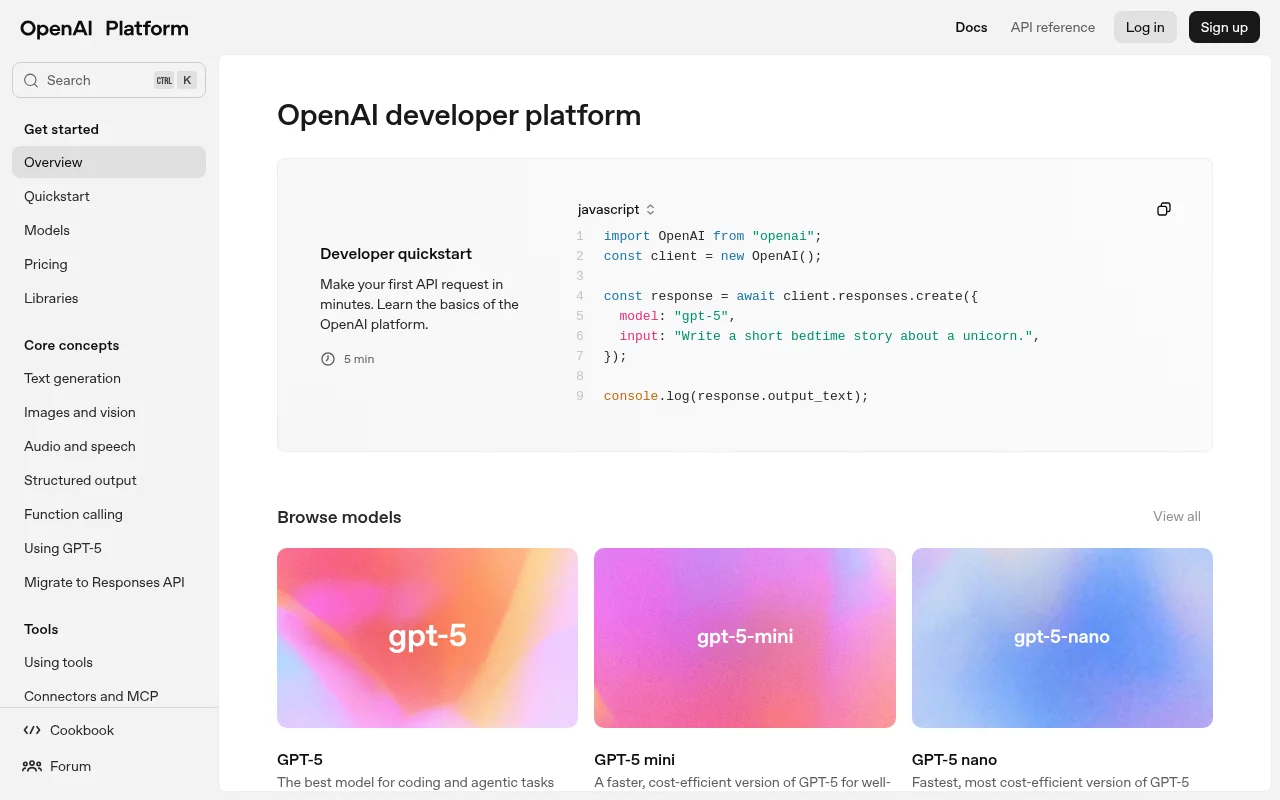
The OpenAI API provides access to a suite of powerful AI models, including those for code generation, text completion, image generation, and more. It allows developers to integrate advanced AI capabilities into their applications through a simple and unified API. Unlike other AI platforms, OpenAI offers a diverse range of models, including specialized code models like Codex, optimized for understanding and generating code in various programming languages. This enables developers to build tools for code completion, debugging, and automated code generation. Developers, researchers, and businesses can leverage the API to build innovative applications, automate tasks, and enhance user experiences. The API's flexibility and scalability make it suitable for projects of all sizes, from individual developers to large enterprises.
OpenAI 's Core features
Code Generation Models
OpenAI offers specialized models like Codex, trained on a massive dataset of code and natural language. These models excel at understanding and generating code in multiple programming languages, including Python, JavaScript, and more. Codex can translate natural language descriptions into code, complete code snippets, and even debug existing code. This feature significantly accelerates the development process and reduces the need for manual coding.
Text Completion Capabilities
Beyond code generation, the API provides powerful text completion capabilities. Developers can use the API to generate human-quality text for various purposes, such as content creation, chatbots, and summarization. The models can generate different creative text formats, like poems, code, scripts, musical pieces, email, letters, etc. This feature is powered by advanced language models, offering high accuracy and fluency.
Image Generation (DALL-E)
The API integrates with DALL-E, allowing users to generate images from text descriptions. This feature enables developers to create visual content dynamically, opening up possibilities for applications in art, design, and content creation. Users can specify the desired image characteristics, style, and content, and the API will generate a corresponding image. The image generation models are trained on a vast dataset of images and text, ensuring high-quality results.
Fine-tuning
The OpenAI API allows users to fine-tune models on their own data. This customization enables developers to tailor the models to specific tasks and datasets, improving performance and accuracy. Fine-tuning involves training the models on a smaller, task-specific dataset, allowing them to learn from the user's data and adapt to specific use cases. This feature is particularly useful for specialized applications and domains.
Scalability and Reliability
The OpenAI API is designed for scalability and reliability, capable of handling high volumes of requests. The API infrastructure is built to ensure consistent performance and uptime, making it suitable for production environments. OpenAI manages the infrastructure, allowing developers to focus on building their applications without worrying about scaling or maintenance. The API also provides rate limits and usage monitoring to help manage costs and prevent abuse.
How to use OpenAI
- Sign up for an OpenAI account and obtain an API key from the OpenAI platform.,2. Install the OpenAI Python library using pip install openai.,3. Authenticate your API requests by setting your API key in your environment variables or directly in your code.,4. Use the API to generate code by sending a request to the code generation endpoint with a prompt describing the desired code.,5. Process the API response, which will contain the generated code.,6. Integrate the generated code into your application or use it for further processing.
Use cases of OpenAI
Automated Code Generation
Software developers can use the API to automate code generation tasks. For example, a developer could provide a natural language description of a function, and the API would generate the corresponding code in the desired programming language. This accelerates development, reduces errors, and improves code quality.
Code Completion and Suggestion
Developers can integrate the API into their IDEs or code editors to provide real-time code completion and suggestion features. As the developer types, the API can predict and suggest the next lines of code, reducing typing and improving coding efficiency. This is particularly useful for complex projects and unfamiliar languages.
Chatbot Development
Businesses can use the API to build chatbots that can understand and respond to user queries in natural language. The API enables the creation of chatbots that can answer questions, provide customer support, and automate various tasks. This improves customer service and reduces operational costs.
Content Creation
Content creators can leverage the API to generate various types of content, such as articles, blog posts, and social media updates. The API can generate text based on prompts, keywords, or topics, saving time and effort in content creation. This enables content creators to produce more content and reach a wider audience.
Who benefits from OpenAI
Software Developers
Developers can use the OpenAI API to automate code generation, improve code completion, and build AI-powered applications. The API simplifies the integration of AI into software projects, accelerating development and enhancing functionality.
Researchers
Researchers can use the API to experiment with and evaluate state-of-the-art AI models. The API provides access to advanced models for various tasks, enabling researchers to explore new possibilities and advance the field of AI.
Businesses
Businesses can use the API to build AI-powered solutions to improve customer service, automate tasks, and generate content. The API enables businesses to integrate AI into their operations, enhancing efficiency and driving innovation.
Content Creators
Content creators can use the API to generate text, images, and other content for their projects. The API helps content creators to produce more content, save time, and reach a wider audience.
Pricing of OpenAI
Pay-as-you-go pricing based on usage. Costs vary depending on the model used and the volume of requests. Free trial available with limited credits. Detailed pricing information is available on the OpenAI website.