Stenography
Automated Code Documentation
Freemium
Support platforms
web
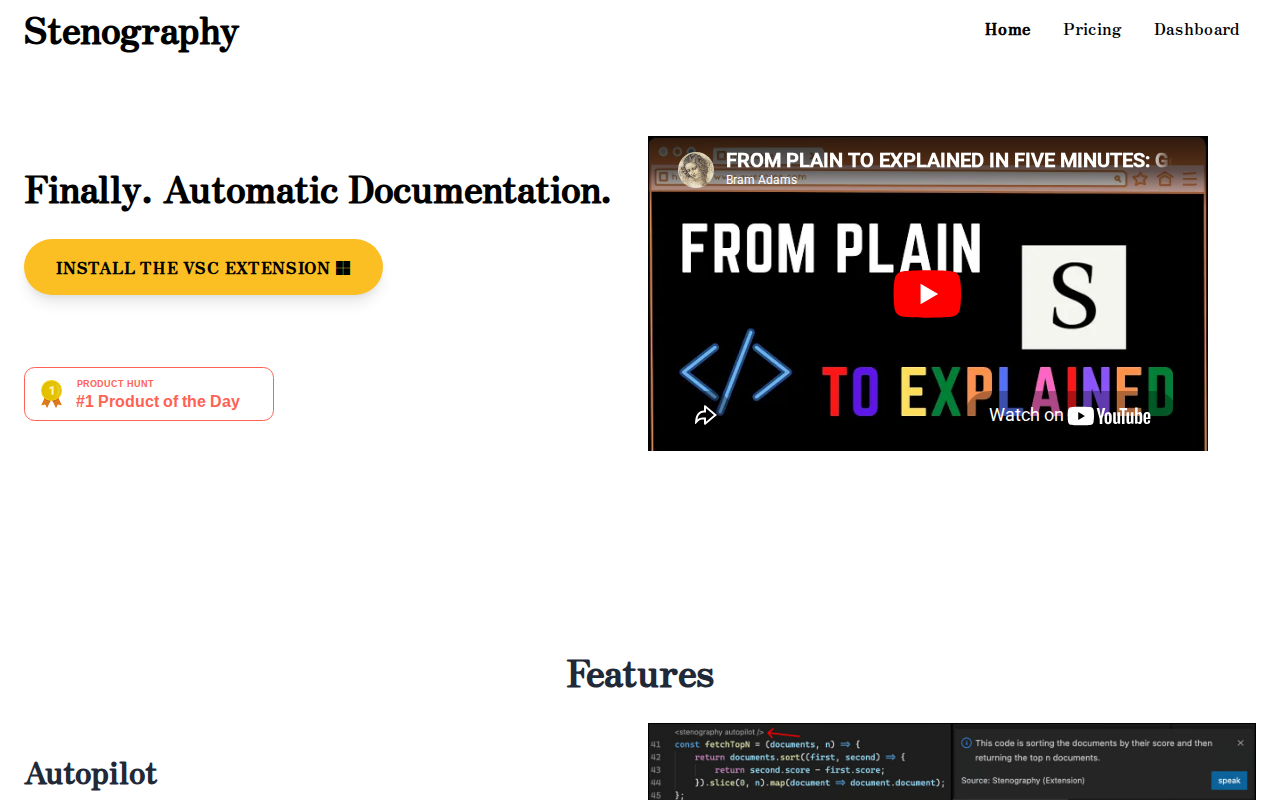
What is Stenography
Stenography is an automated documentation engine designed to bridge the gap between complex source code and human-readable explanations. Unlike traditional static analysis tools that rely on rigid syntax parsing, Stenography utilizes a proprietary AI model trained on vast repositories to generate context-aware documentation. It excels at deciphering legacy codebases, explaining intricate logic flows, and maintaining up-to-date READMEs. By integrating directly into the development lifecycle, it reduces the cognitive load on engineers, ensuring that technical debt is documented in real-time rather than as an afterthought.
Stenography 's Core features
Context-Aware Code Interpretation
Stenography moves beyond simple keyword matching by analyzing the semantic intent of code blocks. It understands the relationship between functions, classes, and modules, allowing it to generate documentation that explains the 'why' behind the logic, not just the 'what'. This is critical for onboarding new developers to large, undocumented legacy systems where traditional tools fail to capture architectural intent.
Automated Pull Request Integration
The platform integrates directly into your CI/CD pipeline, automatically generating documentation updates whenever code changes are pushed. By creating automated Pull Requests, it ensures that your documentation remains synchronized with your codebase, eliminating the 'documentation drift' common in fast-moving agile teams. This reduces manual overhead by approximately 70% compared to manual documentation maintenance.
Multi-Language Support
Stenography supports a wide array of programming languages, including Python, JavaScript, TypeScript, Go, and Rust. It uses language-specific tokenizers to ensure that documentation is syntactically accurate and follows the idiomatic conventions of each language, providing high-quality summaries regardless of the underlying tech stack.
Customizable Documentation Depth
Users can toggle the granularity of the generated documentation, ranging from high-level architectural overviews to line-by-line technical breakdowns. This flexibility allows teams to generate documentation tailored for different stakeholders, such as high-level summaries for product managers and deep-dive technical specs for senior engineers, all derived from the same source code.
Secure Repository Analysis
Stenography prioritizes security by utilizing ephemeral analysis environments. Code is analyzed in memory and not stored permanently, ensuring that sensitive intellectual property remains protected. This approach meets the compliance requirements of enterprise environments that are typically hesitant to use third-party AI tools for proprietary codebase analysis.
How to use Stenography
- Navigate to stenography.dev and authenticate via GitHub to link your repositories.,2. Select the specific repository or individual files you wish to document within the dashboard.,3. Configure the documentation style settings, such as tone, depth, and target audience (e.g., developer vs. stakeholder).,4. Trigger the generation process to allow the AI to parse your code and generate markdown-based explanations.,5. Review the generated output, make manual refinements, and commit the documentation directly to your repository via the integrated PR workflow.
Use cases of Stenography
Legacy Codebase Onboarding
Engineering leads use Stenography to generate documentation for undocumented legacy systems. By automatically mapping out complex logic, new team members can understand the system architecture in hours rather than weeks, significantly reducing the time-to-productivity for new hires.
Automated API Documentation
Backend developers use the tool to generate clear, human-readable documentation for internal APIs. This ensures that frontend teams and external partners have accurate, up-to-date references without the developer needing to manually write and maintain Swagger or OpenAPI files.
Technical Debt Auditing
CTOs and Tech Leads use the tool to scan large repositories to identify undocumented or overly complex functions. By visualizing the documentation coverage, they can prioritize refactoring efforts and identify areas of the code that pose the highest risk to system stability.
Who benefits from Stenography
Engineering Managers
They need to ensure team velocity remains high despite staff turnover. Stenography solves the problem of 'tribal knowledge' by codifying system logic into accessible documentation, ensuring the team is not reliant on a single individual's memory.
Full-Stack Developers
They often struggle to balance feature development with documentation. Stenography automates the tedious task of writing comments and READMEs, allowing them to focus on shipping code while maintaining high standards for code maintainability.
Open Source Maintainers
They need to attract contributors to their projects. High-quality, automated documentation makes it easier for new contributors to understand the codebase, lowering the barrier to entry and increasing the likelihood of high-quality pull requests.
Pricing of Stenography
Freemium model: Free tier for public repositories. Paid Pro plans start at $19/mo for private repositories and advanced features.
More similar tools like Stenography

Kimi AI with K2.5
Kimi is an AI-powered chatbot designed to assist users with various inquiries and tasks.

Reply Logo
Windsurf is an intuitive AI coding assistant designed to enhance developer productivity and streamline coding workflows.