
Memos
Self-hosted, Markdown notes.
Free
Support platforms
web
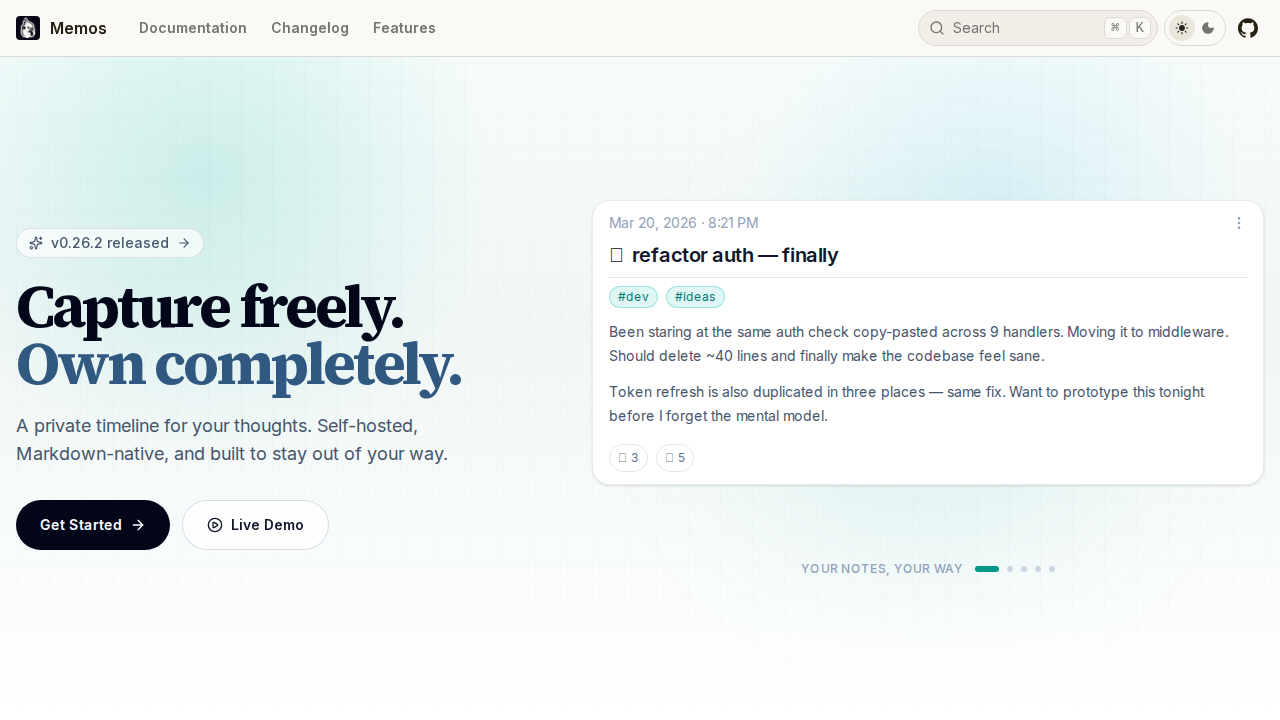
What is Memos
Memos is an open-source, self-hosted note-taking tool designed for instant thought capture and complete data ownership. It allows users to create a private timeline of notes using Markdown, ensuring privacy and control over their data. Unlike cloud-based note-taking apps, Memos is self-hosted, eliminating reliance on third-party servers and offering a privacy-focused experience. It's built with simplicity in mind, deploying in minutes and offering a clean, distraction-free interface. The use of Markdown ensures data portability and ease of use. Memos benefits individuals and teams seeking a private, customizable, and efficient note-taking solution, especially those prioritizing data privacy and control.
Memos 's Core features
Instant Thought Capture
Memos is designed for rapid note-taking. Its interface allows users to quickly jot down ideas and thoughts without complex formatting or navigation. This is achieved through a streamlined input field and a focus on Markdown compatibility, enabling quick and easy note creation. This contrasts with more complex note-taking apps that can slow down the process.
Self-Hosted Deployment
Memos offers self-hosting, giving users complete control over their data. This means the notes are stored on the user's server, not a third-party cloud. This approach enhances privacy and security, as the user is not reliant on external services. Deployment is simplified through Docker, making it accessible to users of varying technical skill levels.
Markdown-Native Storage
Memos uses Markdown for note formatting and storage. This ensures data portability and compatibility with other Markdown editors. Markdown's plain text format makes notes easily readable and editable across different platforms and tools. This also makes it easy to back up and migrate your notes.
Zero Telemetry
Memos is designed with privacy in mind, and it does not collect any telemetry data. This means that the application does not track user activity or send any data back to the developers. This is a key differentiator for users who prioritize privacy and data security, offering a more private note-taking experience.
Open Source and MIT Licensed
Memos is open-source software, licensed under the MIT license. This means the source code is freely available, allowing users to inspect, modify, and redistribute the software. The MIT license grants broad permissions, including commercial use, making it a flexible option for various users and projects.
Easy Deployment
Memos is designed for easy deployment, with a focus on simplicity. The documentation states that it can be deployed in under 5 minutes. This is achieved through Docker support, which simplifies the setup process. This ease of deployment makes Memos accessible to users of varying technical backgrounds.
How to use Memos
- Choose a deployment method: Docker, Docker Compose, or a manual installation.,2. If using Docker, run the provided
docker runcommand to pull and start the Memos container. For Docker Compose, define the service in adocker-compose.ymlfile and rundocker-compose up -d.,3. Access the Memos interface through your server's IP address or domain name on port 5230 (default).,4. Create an account and log in to start creating and organizing your notes.,5. Use Markdown syntax to format your notes, including headings, lists, and links.,6. Explore the settings to customize your Memos instance, including theming and user management.
Use cases of Memos
Personal Knowledge Management
Individuals can use Memos to build a personal knowledge base. They can quickly capture ideas, thoughts, and information using Markdown. This allows them to organize and retrieve information efficiently, improving productivity and learning. The self-hosted nature ensures privacy and control over the data.
Project Note-Taking
Developers and project managers can use Memos to document project progress, track tasks, and share notes with team members. The Markdown format allows for easy formatting and collaboration. The self-hosted nature ensures data security and control, especially for sensitive project information.
Journaling and Daily Reflections
Users can use Memos as a private journal to record daily thoughts, experiences, and reflections. The simple interface and Markdown support make it easy to write and organize entries. The self-hosted nature ensures privacy, allowing users to maintain a secure and personal journal.
Technical Documentation
Technical writers and developers can use Memos to create and maintain technical documentation. The Markdown format is well-suited for writing documentation, and the self-hosted nature ensures that the documentation is accessible and secure. This is particularly useful for internal documentation.
Who benefits from Memos
Privacy-Conscious Individuals
Individuals who prioritize data privacy and security will benefit from Memos' self-hosted nature. They can keep their notes private and avoid reliance on third-party cloud services, ensuring their data remains under their control.
Developers and Tech Enthusiasts
Developers and tech enthusiasts will appreciate Memos' open-source nature, Markdown support, and ease of deployment. They can customize the tool to fit their needs and integrate it into their workflows, while also contributing to the project.
Students and Researchers
Students and researchers can use Memos to take notes, organize research, and create a personal knowledge base. The Markdown format makes it easy to format and cite sources. The self-hosted nature ensures that their notes are secure and accessible.
Teams and Small Businesses
Teams and small businesses can use Memos for internal note-taking, project documentation, and knowledge sharing. The self-hosted nature ensures data security and control, while the Markdown format facilitates collaboration and easy sharing of information.
Pricing of Memos
Free and open-source (MIT License). No paid plans or tiers are mentioned.
More similar tools like Memos

Raycast
Raycast is your ultimate shortcut to everything on your Mac. This powerful launcher and productivity tool empowers you to access and control applications, files, and services with unparalleled speed and efficiency. Forget endless clicking and searching – with Raycast, everything is just a keystroke away. Its intuitive interface and extensive extension library seamlessly integrate with your favorite tools, from project management and design to communication and music. Whether you're a developer, designer, project manager, or simply someone who values productivity, Raycast will transform the way you work. Experience the power of a truly streamlined workflow and reclaim your time. Download Raycast today and unlock a new level of productivity.