什麼是 SGLang
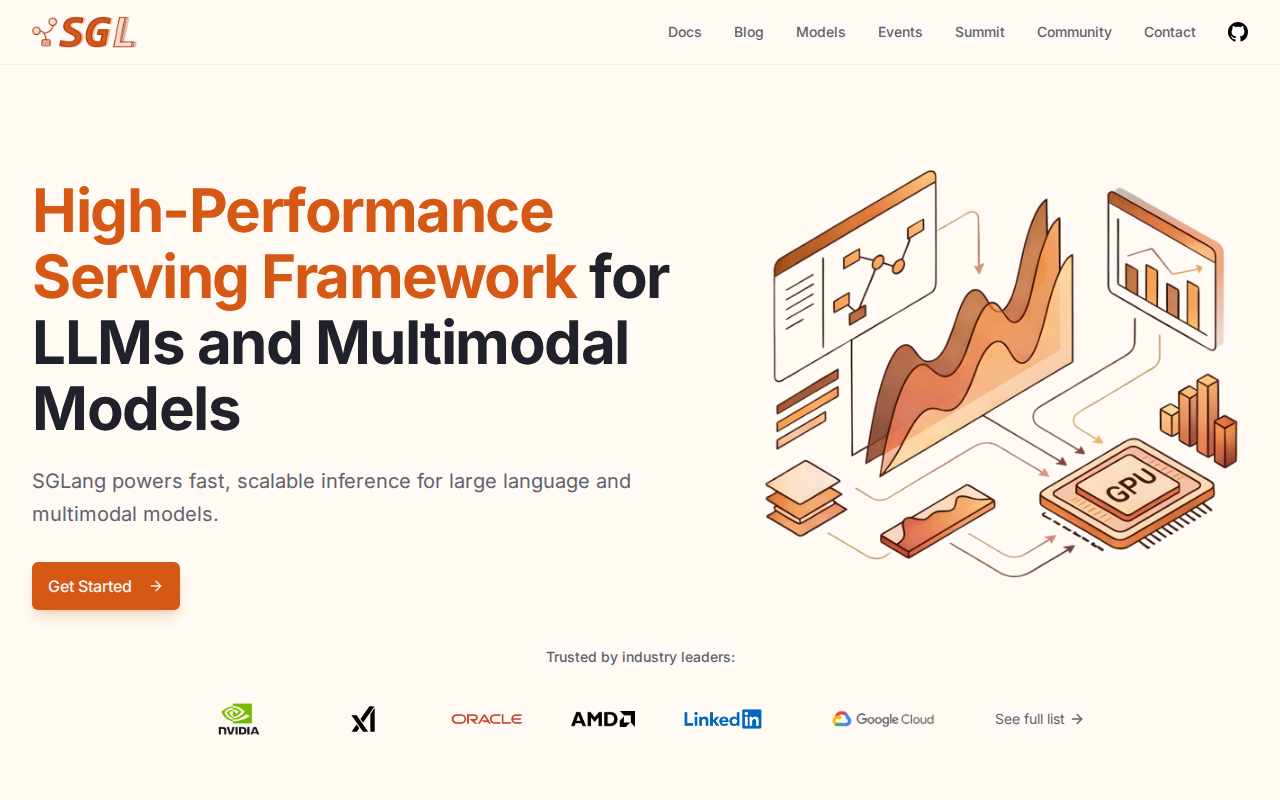
SGLang is a high-performance framework designed for structured generation and efficient serving of Large Language Models (LLMs) and Vision Language Models (VLMs). Unlike standard inference engines, SGLang introduces a domain-specific language that allows developers to interleave prompt templates, control flow, and structured output constraints directly within their code. By utilizing RadixAttention and efficient memory management, it significantly reduces latency and increases throughput for complex multi-turn reasoning tasks. It is the ideal tool for AI engineers building agentic workflows or high-throughput production APIs who need precise control over token generation and KV cache reuse.
SGLang 的核心功能
RadixAttention KV Cache
RadixAttention enables automatic prefix caching across multiple requests. By storing the KV cache in a radix tree, SGLang avoids recomputing common prompt prefixes (like system instructions or few-shot examples). This reduces time-to-first-token (TTFT) by up to 5x in multi-turn conversations compared to standard vLLM implementations, significantly lowering compute costs for agentic workflows.
Structured Output Generation
SGLang provides native support for constrained generation using regex and JSON schemas. By forcing the model to adhere to specific output formats at the token level, it eliminates the need for expensive post-processing or retry loops. This ensures 100% schema compliance for downstream data pipelines, making it highly reliable for extracting structured data from unstructured text.
Integrated Control Flow
The framework allows developers to embed Python-like control flow (if/else, loops) directly into the prompt template. This allows for dynamic prompt construction based on intermediate model outputs without round-tripping to the application server. This reduces network latency and keeps the logic tightly coupled with the generation process.
Multi-Modal Support
SGLang natively supports Vision Language Models (VLMs) like LLaVA and Qwen-VL. It optimizes the processing of image tokens alongside text, ensuring that visual inputs are efficiently cached and processed. This makes it a top-tier choice for building complex vision-based agents that require high-speed inference on combined image-text inputs.
High-Throughput Runtime
Built on a high-performance C++ backend, the SGLang runtime optimizes memory allocation and kernel execution for modern GPUs. It supports continuous batching and PagedAttention, allowing it to handle thousands of concurrent requests with minimal overhead. It consistently outperforms standard HuggingFace Transformers implementations in both throughput and latency metrics.
如何使用 SGLang
- Install the framework via pip:
pip install sglang[all].,2. Launch the SGLang runtime server using the command:python -m sglang.launch_server --model-path <model_id>.,3. Define your generation logic using the SGLang DSL, incorporatinggenandselectfunctions for structured output.,4. Execute your script to interact with the local server, leveraging thesglang.runtimeAPI for asynchronous requests.,5. Monitor performance metrics and KV cache utilization via the built-in dashboard at http://localhost:30000.
SGLang 的使用情境
Agentic Workflow Automation
Developers building autonomous AI agents use SGLang to manage complex reasoning chains. By using RadixAttention to cache system prompts and tool definitions, agents can execute multi-step tasks significantly faster, resulting in more responsive user experiences for complex planning and execution scenarios.
Structured Data Extraction
Data engineers use SGLang to convert massive volumes of unstructured documents into clean JSON. By enforcing strict output schemas during generation, they eliminate parsing errors and reduce the need for manual validation, resulting in reliable, production-ready datasets for downstream analytics.
High-Volume API Serving
Companies serving LLM-based applications at scale use SGLang to maximize GPU utilization. By leveraging its efficient batching and memory management, they can serve more requests per GPU, drastically reducing infrastructure costs while maintaining low latency for end-users.
誰適合使用 SGLang
AI Infrastructure Engineers
They need to optimize inference performance and reduce latency for large-scale production deployments. SGLang provides the low-level control and memory optimization features required to squeeze maximum performance out of expensive GPU clusters.
LLM Application Developers
They build complex agents and data pipelines that require structured outputs. SGLang simplifies their development process by providing a unified DSL for prompt engineering, control flow, and schema enforcement.
SGLang 的價格方案
Open source (Apache 2.0 License). Free to use, modify, and deploy in any environment without licensing fees.