Pulumi
Infrastructure as Code in Code
免费增值
支持平台
web
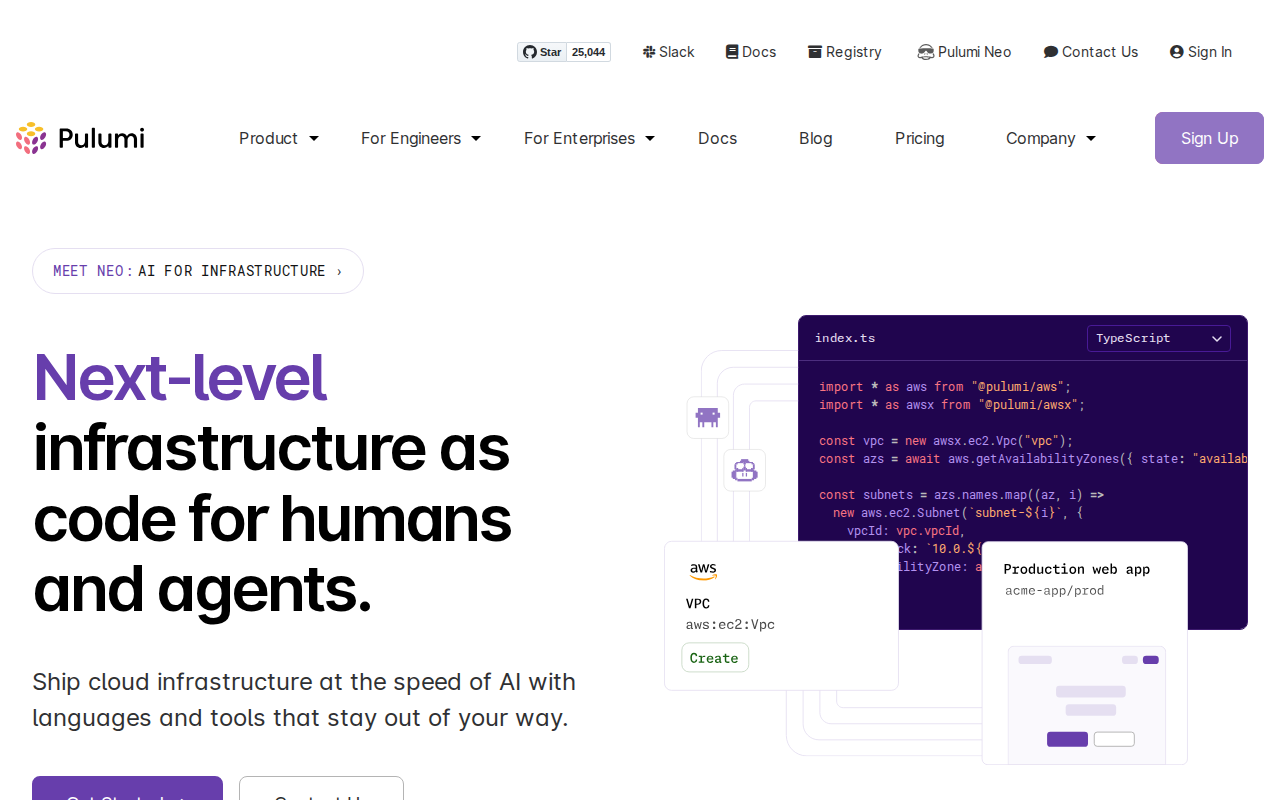
什么是 Pulumi
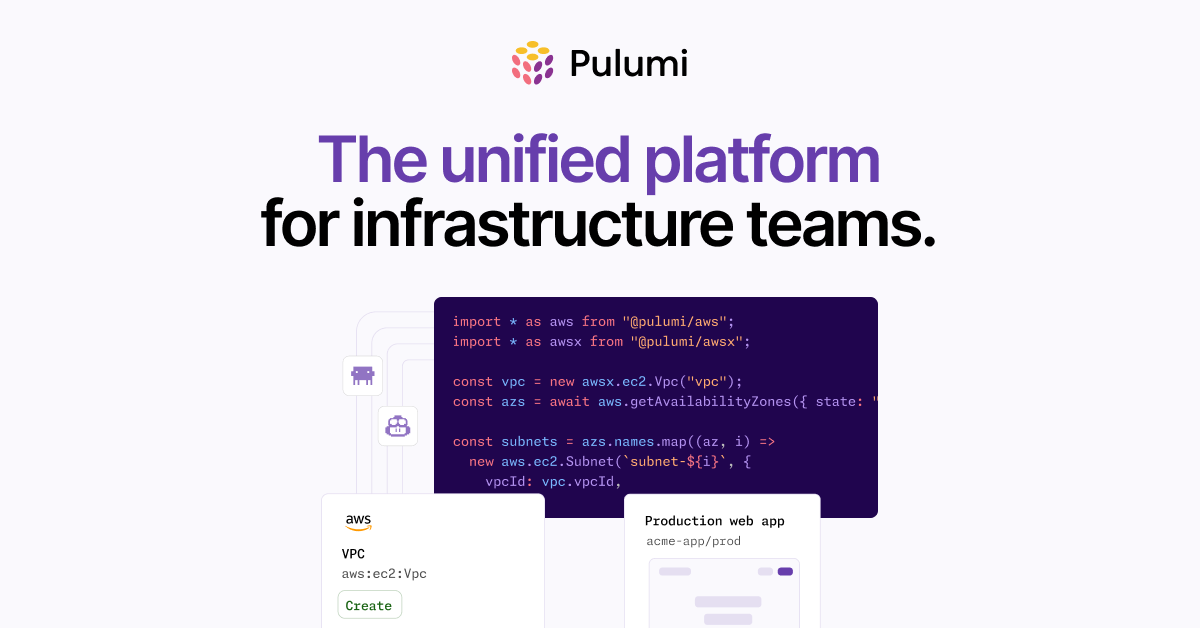
Pulumi is an Infrastructure as Code (IaC) platform that enables developers to define, deploy, and manage cloud infrastructure using general-purpose programming languages like TypeScript, Python, Go, C#, and Java. Unlike declarative DSLs like HCL (Terraform), Pulumi leverages the full power of standard IDEs, including static typing, unit testing, and package management. It supports over 100 cloud providers, including AWS, Azure, GCP, and Kubernetes. By treating infrastructure as software, teams can apply CI/CD best practices, such as code reviews and automated testing, directly to their cloud resources, significantly reducing configuration drift and deployment errors.
Pulumi 的核心功能
Multi-language SDK Support
Pulumi provides first-class support for TypeScript, Python, Go, C#, and Java. This allows developers to use the language they are already proficient in, rather than learning a proprietary DSL. By using standard language constructs like loops, conditionals, and classes, developers can create modular, reusable infrastructure components that are easier to maintain and test than static configuration files.
Unified Cloud Infrastructure
Pulumi offers a single interface to manage resources across AWS, Azure, GCP, Kubernetes, and over 100 other providers. It abstracts complex cloud APIs into strongly-typed objects, providing IDE autocompletion and type checking. This eliminates the need to context-switch between different vendor-specific tools, allowing for a unified workflow when managing hybrid or multi-cloud environments.
Integrated Testing Framework
Because Pulumi uses standard programming languages, you can use existing testing frameworks like Jest, Mocha, or PyTest to validate infrastructure. You can write unit tests to verify resource properties before deployment and integration tests to ensure the infrastructure behaves as expected. This 'shift-left' approach catches misconfigurations early, preventing costly outages and security vulnerabilities in production environments.
Policy as Code (CrossGuard)
Pulumi CrossGuard allows teams to enforce security and compliance policies programmatically. You can write policies in the same language as your infrastructure to prevent non-compliant resources—such as unencrypted S3 buckets or open security groups—from being deployed. These policies are evaluated during the 'pulumi preview' phase, providing immediate feedback to developers before any actual cloud resources are modified.
State Management and Orchestration
Pulumi manages the state of your infrastructure automatically, tracking the relationship between your code and the deployed cloud resources. It handles complex dependency graphs, ensuring resources are created, updated, or deleted in the correct order. The Pulumi Service backend provides a centralized source of truth, including audit logs, deployment history, and team-based access control for enterprise-grade infrastructure management.
如何使用 Pulumi
- Install the Pulumi CLI via npm, Homebrew, or the official installer script.,2. Run 'pulumi login' to authenticate with the Pulumi Service or a self-managed backend.,3. Execute 'pulumi new
Pulumi 的使用场景
Multi-Cloud Kubernetes Management
DevOps teams use Pulumi to deploy and manage Kubernetes clusters across multiple cloud providers simultaneously. By using a single codebase, they can standardize cluster configurations, ingress controllers, and service meshes, ensuring consistent deployment patterns regardless of the underlying cloud provider.
Serverless Application Deployment
Developers building event-driven architectures use Pulumi to define Lambda functions, API Gateways, and DynamoDB tables in the same project as their application code. This allows for atomic deployments where the infrastructure and the application code are versioned and deployed together.
Automated Compliance Enforcement
Security teams implement CrossGuard policies to ensure all infrastructure meets organizational standards. For example, they can automatically block any deployment that lacks mandatory resource tags or uses insecure instance types, ensuring compliance is baked into the CI/CD pipeline.
谁适合使用 Pulumi
DevOps Engineers
They need to manage complex, multi-cloud environments efficiently. Pulumi allows them to replace manual CLI scripts and brittle YAML files with robust, version-controlled code that integrates seamlessly into existing CI/CD pipelines.
Software Developers
They want to provision their own infrastructure without learning specialized DSLs. Pulumi enables them to use familiar programming languages and IDEs, reducing the friction between writing application code and deploying it to the cloud.
Cloud Architects
They require a scalable way to define reusable infrastructure patterns across an organization. Pulumi’s component model allows them to build internal libraries of 'golden' infrastructure templates that other teams can consume safely.
Pulumi 的价格方案
Free for individuals. Team plan starts at $7/user/month. Enterprise plans available with custom pricing for advanced security and SSO.