Atomic
An open-source, self-hosted knowledge graph for automated research synthesis.
Freemium
Support platforms
web
What is Atomic
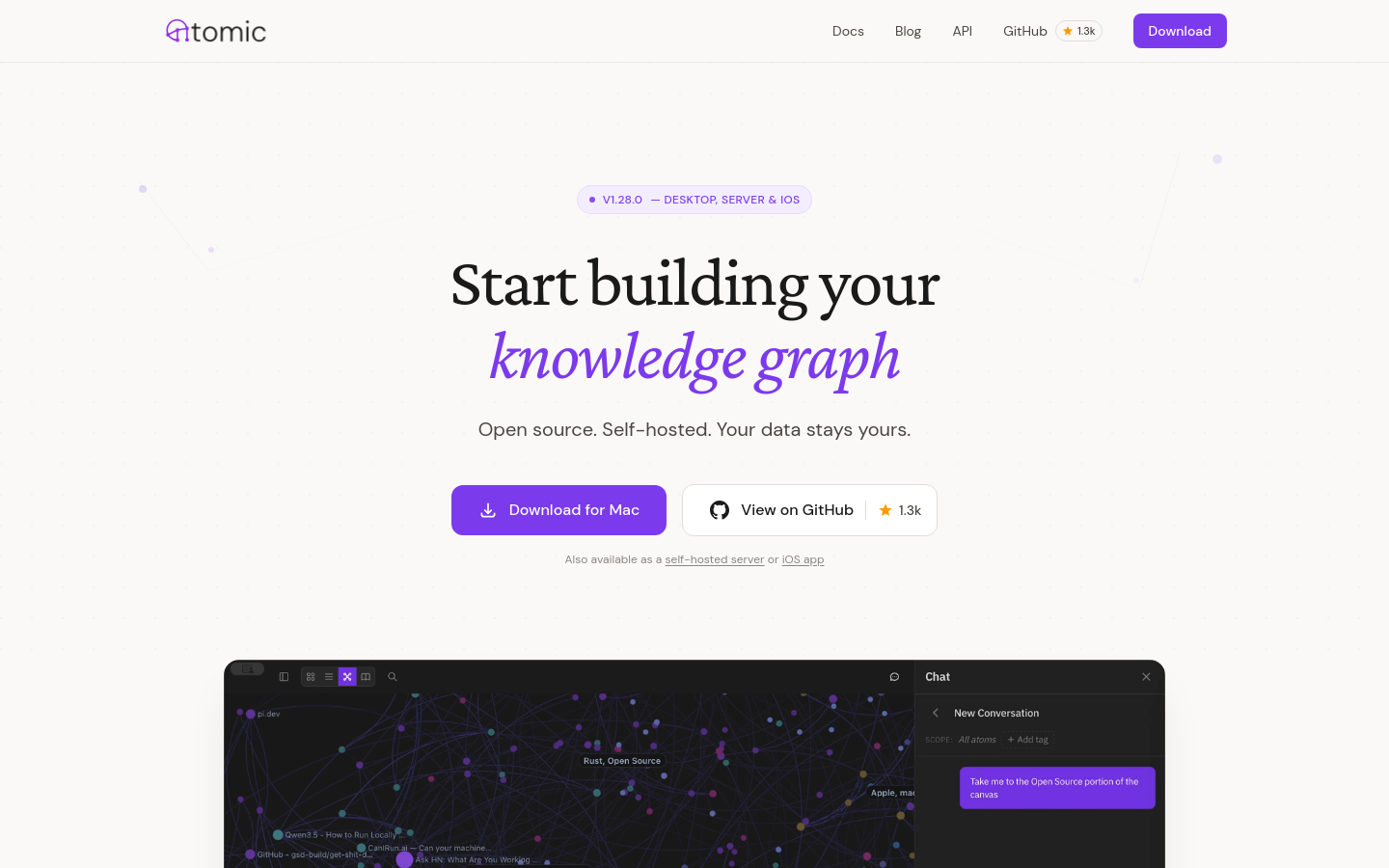
Atomic solves the common struggle of fragmented information by transforming disparate notes, web clips, and articles into a self-organizing knowledge graph. Designed for researchers and privacy-conscious professionals, this platform eliminates the manual overhead of folder management by using vector embeddings to automatically tag and link your content. Instead of burying your ideas in static files, you can visualize your entire library as a force-directed graph, allowing you to see how concepts cluster and relate to one another in real time. Beyond simple storage, the platform acts as an active research assistant. By leveraging semantic search and agentic chat, you can query your library based on meaning rather than exact keywords, receiving answers that cite your original sources to ensure accuracy. For those building long-form content, the system can synthesize research into wiki-style articles with inline citations. With its open-source, self-hosted architecture and MCP server support, Atomic integrates directly into your existing workflow, allowing AI tools like Claude or Cursor to access your personal knowledge base securely.
Atomic 's Core features
Semantic Search
Uses vector embeddings to surface related ideas based on conceptual meaning rather than exact keyword matches, ensuring you find relevant information even when terminology varies.
Wiki Synthesis
Automatically generates structured wiki articles from tagged content, providing synthesized summaries with inline citations that link directly back to your original source notes.
Spatial Canvas
Visualizes your knowledge as a force-directed graph where semantically related atoms cluster together, helping you explore the topology and hidden connections of your ideas.
Agentic Chat
An AI assistant that searches your notes mid-conversation, scoped to specific tags or your entire library, providing answers that cite your own data to prevent hallucinations.
MCP Integration
Provides an MCP server that allows AI clients like Claude or Cursor to directly access, search, read, and create atoms within your knowledge base, bridging the gap between your research and your tools.
How to use Atomic
- Capture your knowledge by writing markdown notes, saving web articles, or importing content via RSS feeds and browser extensions to create individual 'atoms' of information.
- Let the system automatically tag and embed your content, building a self-organizing taxonomy that removes the need for manual folder maintenance.
- Visualize your research on the spatial canvas, where semantically related ideas naturally cluster together in a force-directed graph for easier discovery.
- Use semantic search to find information by meaning, or engage in agentic chat to query your library with AI that provides answers backed by your own source citations.
- Generate structured wiki articles from specific tags to synthesize your research, ensuring every claim is linked back to your original source notes for verification.
- Connect your knowledge base to external tools like Claude or Cursor via the MCP server to search, read, and create new atoms directly within your active coding or writing workflow.
Use cases of Atomic
Research and Knowledge Synthesis
Researchers and writers can aggregate articles and notes to automatically generate synthesized wiki articles that track claims back to original sources, streamlining the writing process.
Personal Knowledge Management
Individuals can maintain a self-organizing library of information that grows and connects itself, significantly reducing the overhead of manual filing and folder maintenance.
AI-Assisted Workflow Integration
Power users can connect their personal knowledge base to AI coding or writing assistants, enabling the AI to reference their specific research during active tasks.
Who benefits from Atomic
Knowledge Workers and Researchers
Professionals who manage large volumes of information and need a system that automatically connects ideas and provides verifiable, AI-generated insights.
Privacy-Conscious Users
Users who prefer open-source, self-hosted solutions to ensure their data remains under their own control rather than stored on third-party cloud servers.
Pricing of Atomic
The software is open source and self-hosted; specific pricing tiers or subscription models are not disclosed.