Scale AI
Data labeling & AI model training
Paid
Support platforms
web
What is Scale AI
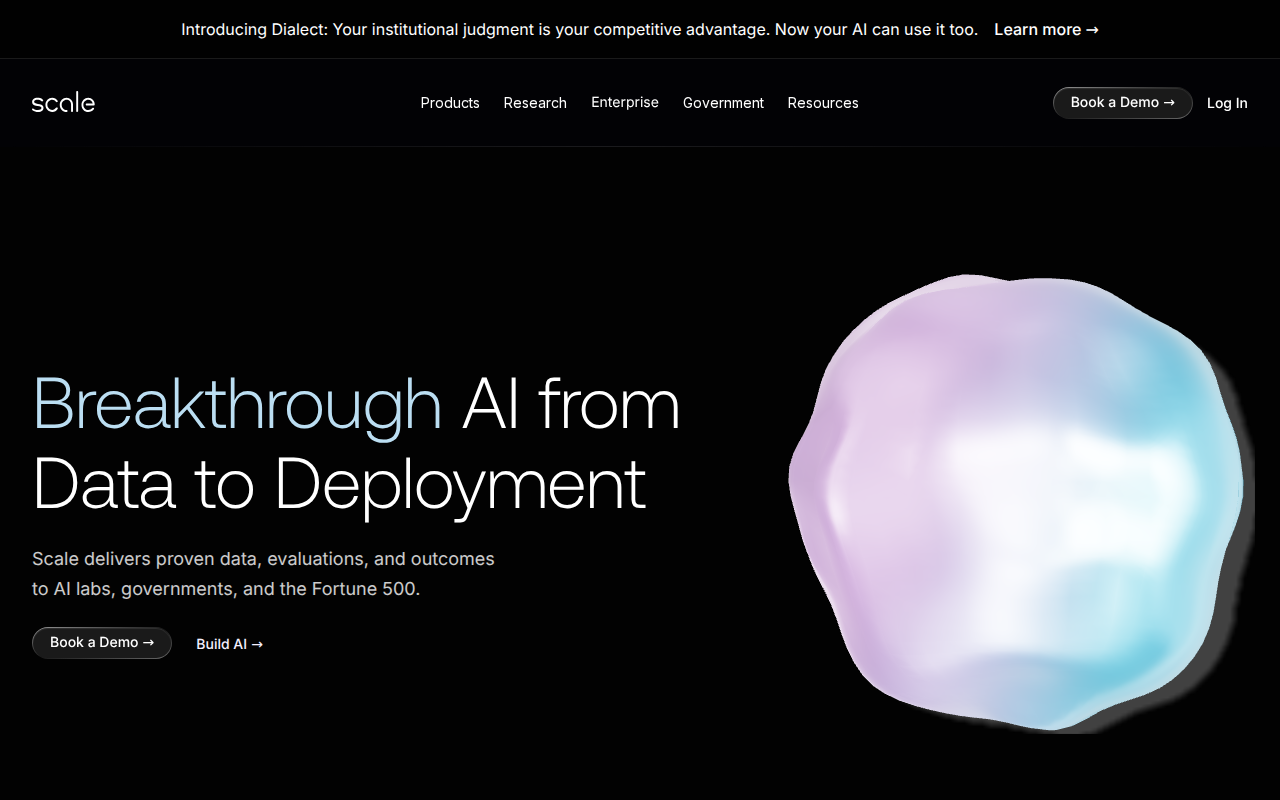
Scale AI provides a comprehensive platform for data labeling and AI model training. It offers a suite of tools and services designed to streamline the process of preparing high-quality training data, from image and video annotation to text and audio labeling. Scale AI differentiates itself through its focus on accuracy, scalability, and efficiency, leveraging a combination of human-in-the-loop workflows and advanced automation techniques. The platform supports various data types and model architectures, making it suitable for diverse AI applications. It utilizes a combination of human annotators and machine learning algorithms to ensure high-quality data. This is particularly beneficial for businesses and developers who need to train and deploy AI models quickly and accurately, especially in areas like autonomous vehicles, computer vision, and natural language processing.
Scale AI 's Core features
Data Annotation at Scale
Scale AI's platform allows for efficient data annotation, handling large datasets with ease. It supports various annotation types, including bounding boxes, semantic segmentation, and text labeling. The platform uses a combination of human annotators and automated tools to ensure high-quality data, with accuracy rates often exceeding 95% for complex tasks. This scalability is crucial for projects requiring vast amounts of labeled data for model training.
Human-in-the-Loop Workflows
Scale AI incorporates human-in-the-loop systems to improve data quality. Human annotators review and validate the outputs of automated labeling tools, correcting errors and ensuring accuracy. This hybrid approach combines the speed of automation with the precision of human judgment. This is particularly important for complex or nuanced data where automated systems may struggle, such as identifying subtle variations in images or understanding context in text.
Customizable Workflows
The platform offers customizable workflows to adapt to specific project requirements. Users can define custom labeling instructions, quality control processes, and annotation interfaces. This flexibility allows for tailoring the platform to meet the unique needs of different AI applications. For example, users can create specialized annotation tools for medical imaging or adapt workflows for specific industry standards.
Data Management and Versioning
Scale AI provides robust data management capabilities, including version control and dataset organization. Users can track changes to their datasets, revert to previous versions, and collaborate effectively with team members. This ensures data integrity and facilitates reproducibility of AI model training. The platform also supports data filtering and segmentation, allowing users to focus on specific subsets of their data.
API and Integrations
Scale AI offers a comprehensive API and integrates with popular cloud storage and AI model training platforms. This allows for seamless integration into existing workflows and automation of data labeling tasks. The API supports data upload, annotation retrieval, and project management. Integrations with platforms like AWS, Google Cloud, and Azure streamline data transfer and model deployment.
Model Training and Evaluation
Scale AI supports the training and evaluation of AI models using the labeled data generated on the platform. Users can track model performance metrics, such as accuracy, precision, and recall. The platform provides tools for visualizing model results and identifying areas for improvement. This end-to-end solution simplifies the entire AI development lifecycle, from data preparation to model deployment.
How to use Scale AI
- Create an account on the Scale AI platform and navigate to the 'Projects' section.,2. Define your project by specifying the data type (e.g., images, text, video) and labeling tasks required.,3. Upload your dataset or connect to your data source (e.g., cloud storage, API).,4. Configure labeling instructions and quality control measures to ensure accuracy.,5. Review and validate the labeled data through the platform's interface.,6. Export the labeled data in a format compatible with your AI model training framework (e.g., TensorFlow, PyTorch).
Use cases of Scale AI
Autonomous Vehicle Development
Engineers use Scale AI to label vast amounts of sensor data (images, lidar, radar) from vehicles to train perception models. They annotate objects like pedestrians, vehicles, and traffic signs, enabling the AI to accurately understand its environment. This leads to improved safety and reliability in autonomous driving systems.
Computer Vision for Retail
Retailers leverage Scale AI to label product images and videos for object detection and tracking. They train AI models to identify products on shelves, monitor customer behavior, and automate inventory management. This improves operational efficiency and enhances the customer experience.
Natural Language Processing (NLP)
Companies use Scale AI to annotate text data for sentiment analysis, named entity recognition, and text classification. They train NLP models to understand customer feedback, automate customer service, and improve content recommendation systems. This leads to better customer engagement and data-driven decision-making.
Medical Imaging Analysis
Medical professionals use Scale AI to annotate medical images (X-rays, MRIs, CT scans) for disease detection and diagnosis. They train AI models to identify anomalies and assist radiologists in their work. This improves diagnostic accuracy and speeds up the process of patient care.
Who benefits from Scale AI
AI Engineers and Data Scientists
AI engineers and data scientists benefit from Scale AI by streamlining the data labeling process, which is a critical bottleneck in AI model development. The platform's features enable them to focus on model design and experimentation rather than manual data annotation, accelerating their projects.
Autonomous Vehicle Companies
Companies developing autonomous vehicles rely on Scale AI to annotate massive datasets of sensor data. The platform's scalability and accuracy are essential for training perception models that enable self-driving capabilities. This helps them to improve the safety and reliability of their systems.
Computer Vision Startups
Computer vision startups use Scale AI to quickly label data for their specific applications, such as object detection, image recognition, and video analysis. The platform's customizable workflows and integrations allow them to efficiently build and deploy their AI-powered solutions.
Enterprises with AI Initiatives
Large enterprises with AI initiatives use Scale AI to manage and scale their data labeling efforts across various projects. The platform's collaboration features and data management tools enable them to efficiently coordinate data annotation teams and ensure data quality across their organization.
Pricing of Scale AI
Custom pricing based on project scope and data volume. Contact sales for a quote. Offers various plans tailored to different needs, from small projects to enterprise-level deployments.