Sim — Build AI Agents & Run Your Agentic Workforce
Build & Run AI Agent Workforces
Freemium
Support platforms
web
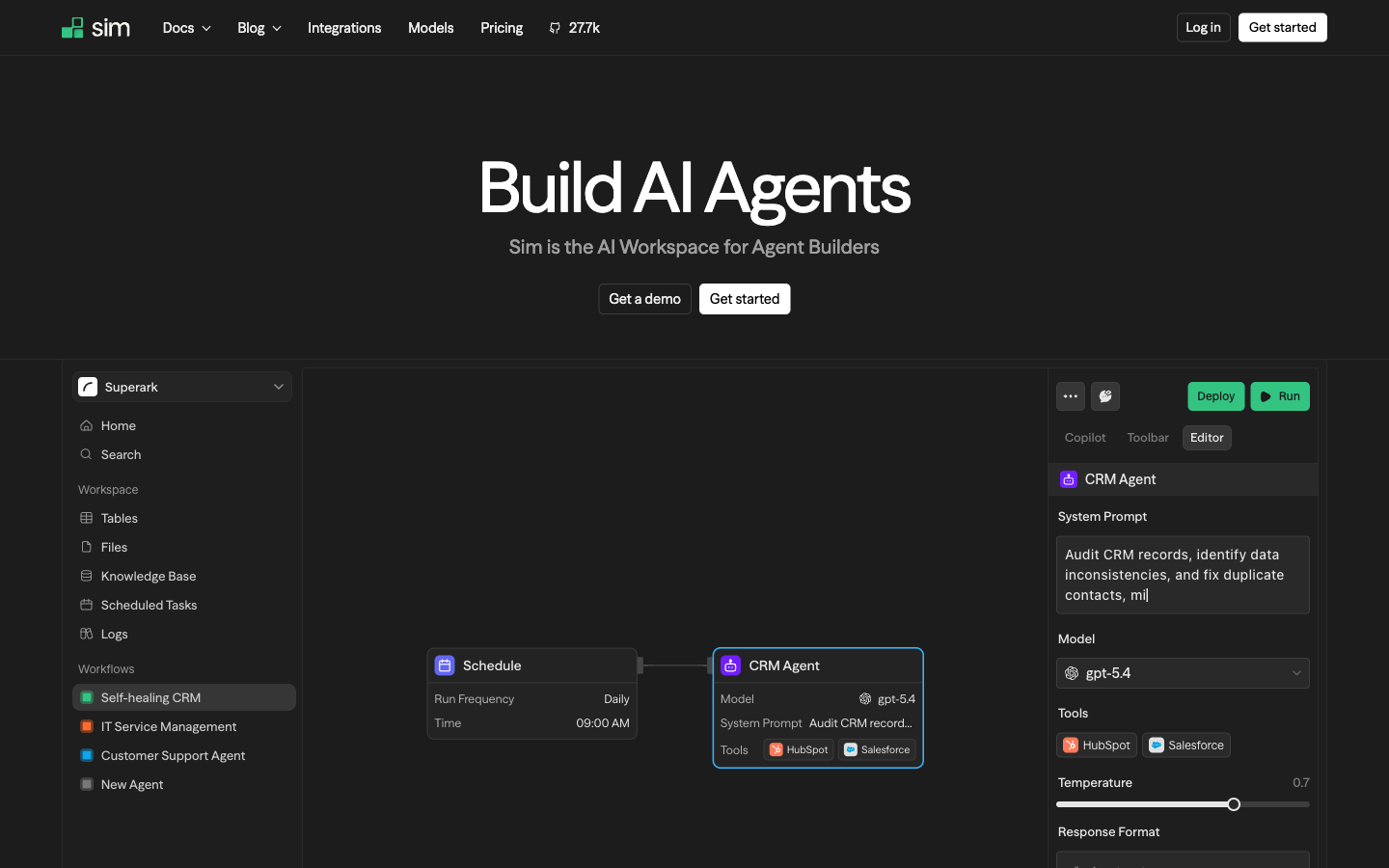
What is Sim — Build AI Agents & Run Your Agentic Workforce
Sim empowers users to build and deploy AI agents for automating complex tasks. It provides a platform to design, train, and manage agentic workflows, enabling businesses to create intelligent automation solutions. Unlike traditional automation tools, Sim focuses on agent-based systems that can reason and adapt. Key technologies include a visual workflow builder, integration with various LLMs, and robust monitoring capabilities. This platform is ideal for businesses looking to automate workflows, improve customer service, and streamline operations through intelligent agents. It's particularly beneficial for teams seeking to move beyond simple automation and embrace more sophisticated, autonomous systems.
Sim — Build AI Agents & Run Your Agentic Workforce 's Core features
Visual Workflow Builder
Sim offers a drag-and-drop interface for designing complex agent workflows. This allows users to create intricate automations without writing code, connecting various actions, LLM calls, and decision points. This visual approach reduces development time by up to 70% compared to traditional coding methods, making it accessible to non-technical users.
LLM Integration
Seamlessly integrates with leading LLMs like OpenAI's GPT models and Google's PaLM. This allows users to leverage the power of these models within their agents. Sim supports various LLM features, including prompt engineering, context management, and response parsing, enabling sophisticated AI interactions. Users can select from a variety of models and customize parameters such as temperature and top_p.
Agent Monitoring & Analytics
Provides real-time monitoring of agent performance, including metrics like task completion rate, error rates, and cost per task. The analytics dashboard offers insights into agent behavior, allowing users to identify bottlenecks and optimize workflows. Detailed logs and audit trails are available for debugging and compliance, with data visualization tools to track key performance indicators.
Multi-Agent Orchestration
Enables the creation of complex agentic systems where multiple agents collaborate to accomplish tasks. Agents can communicate and pass information between each other, allowing for sophisticated workflows that mimic human-like problem-solving. This feature supports parallel processing and task delegation, increasing overall efficiency and scalability.
Custom Tool Integration
Allows users to integrate custom tools and APIs into their agents' workflows. This enables agents to interact with external systems, databases, and services, expanding their capabilities beyond LLM interactions. The platform supports various integration methods, including webhooks, API calls, and custom code execution, providing flexibility for diverse use cases.
How to use Sim — Build AI Agents & Run Your Agentic Workforce
- Sign up for a Sim account and create a new workspace.,2. Access the visual workflow builder to design your AI agent's logic and actions.,3. Integrate with desired LLMs (e.g., OpenAI, Google) by providing API keys.,4. Configure agent behavior by setting up prompts, tools, and memory.,5. Deploy your agent and monitor its performance through the provided dashboard.,6. Iterate and refine your agent's performance based on real-time feedback and analytics.
Use cases of Sim — Build AI Agents & Run Your Agentic Workforce
Automated Customer Support
Customer support teams can build agents to handle common inquiries, route complex issues, and provide instant answers. The agent can access a knowledge base, understand customer intent, and resolve issues, freeing up human agents to focus on more complex problems. This improves response times and reduces operational costs.
Lead Generation & Qualification
Sales teams can deploy agents to identify and qualify leads by interacting with potential customers, gathering information, and assessing their needs. The agent can automatically schedule meetings, send follow-up emails, and update CRM systems, improving sales efficiency and conversion rates. This automates the initial stages of the sales funnel.
Data Extraction & Analysis
Data analysts can use agents to extract information from various sources, such as websites, documents, and databases. The agent can automatically clean, transform, and analyze data, generating reports and insights. This automates repetitive tasks and accelerates the data analysis process, allowing analysts to focus on strategic decision-making.
Workflow Automation
Businesses can automate complex workflows across departments, such as invoice processing, expense reporting, and HR onboarding. Agents can handle tasks like data entry, approvals, and notifications, reducing manual effort and improving accuracy. This streamlines operations and reduces the risk of errors.
Who benefits from Sim — Build AI Agents & Run Your Agentic Workforce
Automation Engineers
Automation engineers need Sim to build and deploy sophisticated AI agents that automate complex workflows. It simplifies the process of integrating LLMs and other tools, allowing them to create intelligent automation solutions without extensive coding.
Customer Support Managers
Customer support managers can use Sim to build AI agents that handle common customer inquiries, improving response times and reducing the workload on human agents. This leads to better customer satisfaction and lower operational costs.
Sales Operations Teams
Sales operations teams benefit from Sim by automating lead generation, qualification, and follow-up processes. This increases sales efficiency, improves conversion rates, and allows sales representatives to focus on closing deals.
Business Analysts
Business analysts can use Sim to automate data extraction, analysis, and reporting tasks. This helps them quickly gather insights from various data sources, improving decision-making and streamlining business processes.
Pricing of Sim — Build AI Agents & Run Your Agentic Workforce
Free plan available. Paid plans with increased usage limits and advanced features. Contact for custom enterprise pricing.