crates.io: Rust Package Registry
Rust Package Registry & Dependency Mgmt
Free
Support platforms
web
What is crates.io: Rust Package Registry
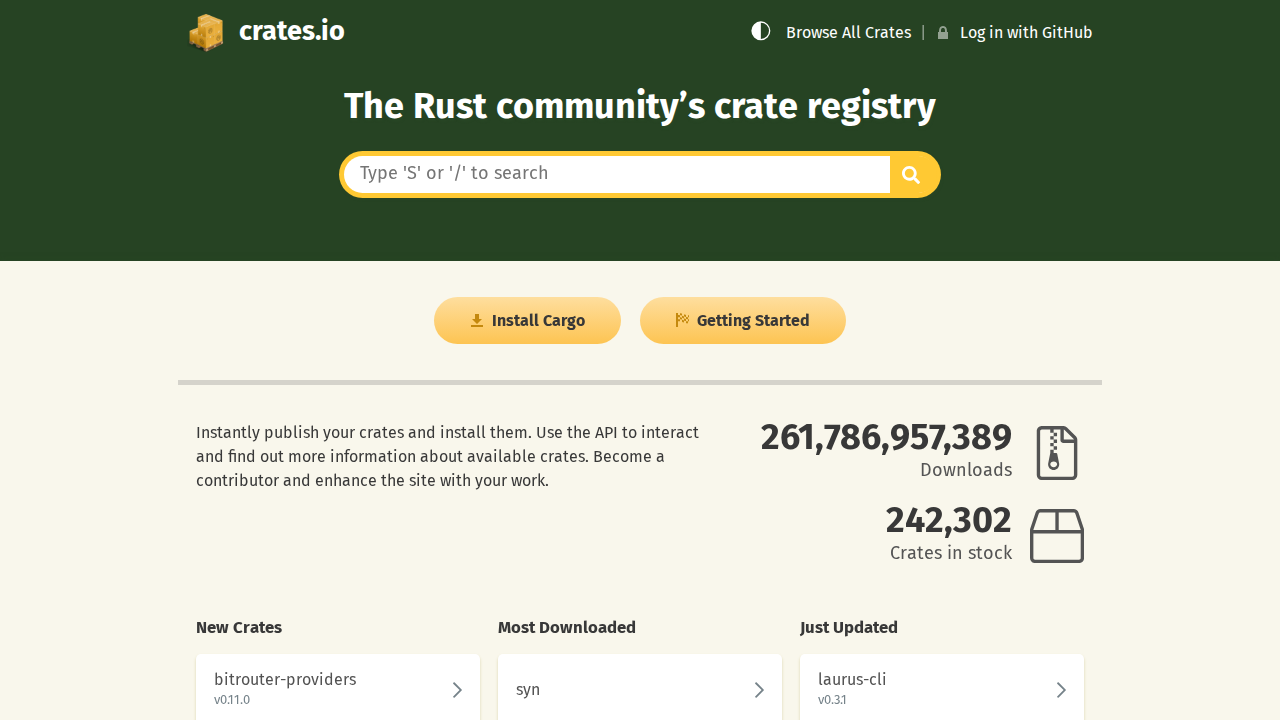
crates.io is the official package registry for the Rust programming language, serving as a central repository for Rust crates (packages). It enables developers to easily discover, share, and manage dependencies within their Rust projects. Unlike language-specific package managers like npm for JavaScript or pip for Python, crates.io is tightly integrated with Rust's build system (Cargo), ensuring seamless dependency resolution and build reproducibility. This integration simplifies dependency management, versioning, and publishing. It benefits Rust developers of all levels, from beginners to experienced professionals, by providing a reliable and efficient way to leverage the Rust ecosystem's vast library of reusable code.
crates.io: Rust Package Registry 's Core features
Centralized Package Repository
Provides a single, authoritative source for Rust crates, ensuring consistency and discoverability. This centralized approach simplifies dependency management compared to decentralized systems. Crates.io hosts over 100,000 crates, with millions of downloads per day, offering a vast ecosystem of reusable code for Rust developers. This reduces the need for developers to write code from scratch, saving time and effort.
Cargo Integration
Seamlessly integrates with Cargo, Rust's build system and package manager. This integration automates dependency resolution, versioning, and publishing. Cargo automatically downloads and compiles dependencies specified in the `Cargo.toml` file, ensuring that projects build consistently across different environments. This tight coupling streamlines the development workflow and reduces the risk of dependency-related issues.
Versioning and Dependency Management
Employs semantic versioning (SemVer) to manage crate versions and dependencies. This allows developers to specify compatible versions of dependencies, preventing breaking changes and ensuring project stability. Cargo's dependency resolution algorithm efficiently handles complex dependency graphs, minimizing conflicts and ensuring that all dependencies are met.
Crate Discovery and Search
Offers robust search functionality to help developers find the crates they need. Users can search by crate name, keyword, or author. Search results are ranked based on relevance, popularity (download count), and other factors. This makes it easy to find and evaluate crates for specific tasks, accelerating development and promoting code reuse.
Community-Driven Ecosystem
Fosters a vibrant community of Rust developers who contribute to the ecosystem by publishing and maintaining crates. This collaborative environment ensures a constant flow of new libraries and tools. The community also provides support, documentation, and examples, making it easier for developers to learn and use Rust and its associated crates.
Secure Package Distribution
Employs security measures to protect against malicious packages. Crates.io uses cryptographic signatures to verify the authenticity of published crates. This helps prevent supply chain attacks and ensures that developers can trust the code they are using. Regular security audits and vulnerability assessments are also performed to maintain a secure environment.
How to use crates.io: Rust Package Registry
- Navigate to crates.io using your web browser.,2. Search for a specific crate using the search bar at the top of the page (e.g., 'zoxide').,3. Click on the crate's name in the search results to view its details page.,4. Examine the crate's documentation, including its description, version history, and dependencies.,5. In your Rust project's
Cargo.tomlfile, add the crate as a dependency under the[dependencies]section, specifying the crate name and version (e.g.,zoxide = "0.9.0").,6. Runcargo buildorcargo runin your project's root directory to download and compile the crate's code, along with its dependencies.
Use cases of crates.io: Rust Package Registry
Building Command-Line Tools
Developers use crates.io to find and incorporate libraries for tasks like argument parsing (e.g., `clap`), terminal UI creation (e.g., `tui`), and file system operations. This allows them to quickly build robust and feature-rich command-line applications without writing all the code from scratch. For example, a developer could use `clap` to create a CLI with complex argument parsing in a few lines of code.
Developing Web Applications
Web developers leverage crates.io to integrate web frameworks (e.g., `rocket`, `actix-web`), database connectors, and other web-related libraries into their projects. This accelerates the development of web applications by providing pre-built components for common tasks such as routing, handling HTTP requests, and interacting with databases. For example, a developer can use `rocket` to quickly build a REST API.
Creating System-Level Utilities
System programmers utilize crates.io to access low-level system APIs, implement networking protocols, and interact with hardware. This allows them to build efficient and performant system-level tools and applications. For example, a developer could use crates like `tokio` for asynchronous programming and `libpnet` for network packet manipulation.
Developing Game Engines and Graphics Applications
Game developers and graphics programmers use crates.io to find libraries for graphics rendering (e.g., `gfx-rs`), game logic, and input handling. This enables them to create high-performance games and graphics applications. For example, a developer could use `ggez` to build a 2D game.
Who benefits from crates.io: Rust Package Registry
Rust Developers
Rust developers of all skill levels rely on crates.io to find, manage, and share dependencies within their projects. It simplifies the process of incorporating external libraries, accelerating development and promoting code reuse, which is crucial for building complex applications in Rust.
Open Source Contributors
Open-source developers use crates.io to publish their Rust libraries and tools, making them available to the wider community. This allows them to share their code, collaborate with others, and contribute to the growth of the Rust ecosystem. This is essential for the collaborative nature of open-source software.
Software Engineers
Software engineers use crates.io to build robust and efficient applications in various domains. They leverage the vast collection of crates to solve specific problems, reduce development time, and improve code quality. This is particularly important for projects where performance and safety are critical.
Pricing of crates.io: Rust Package Registry
Free and open-source (MIT License). Crates.io is free to use for publishing and downloading crates.