OpenSpec — A lightweight spec‑driven framework
Lightweight spec-driven framework
Free
Support platforms
web
What is OpenSpec — A lightweight spec‑driven framework
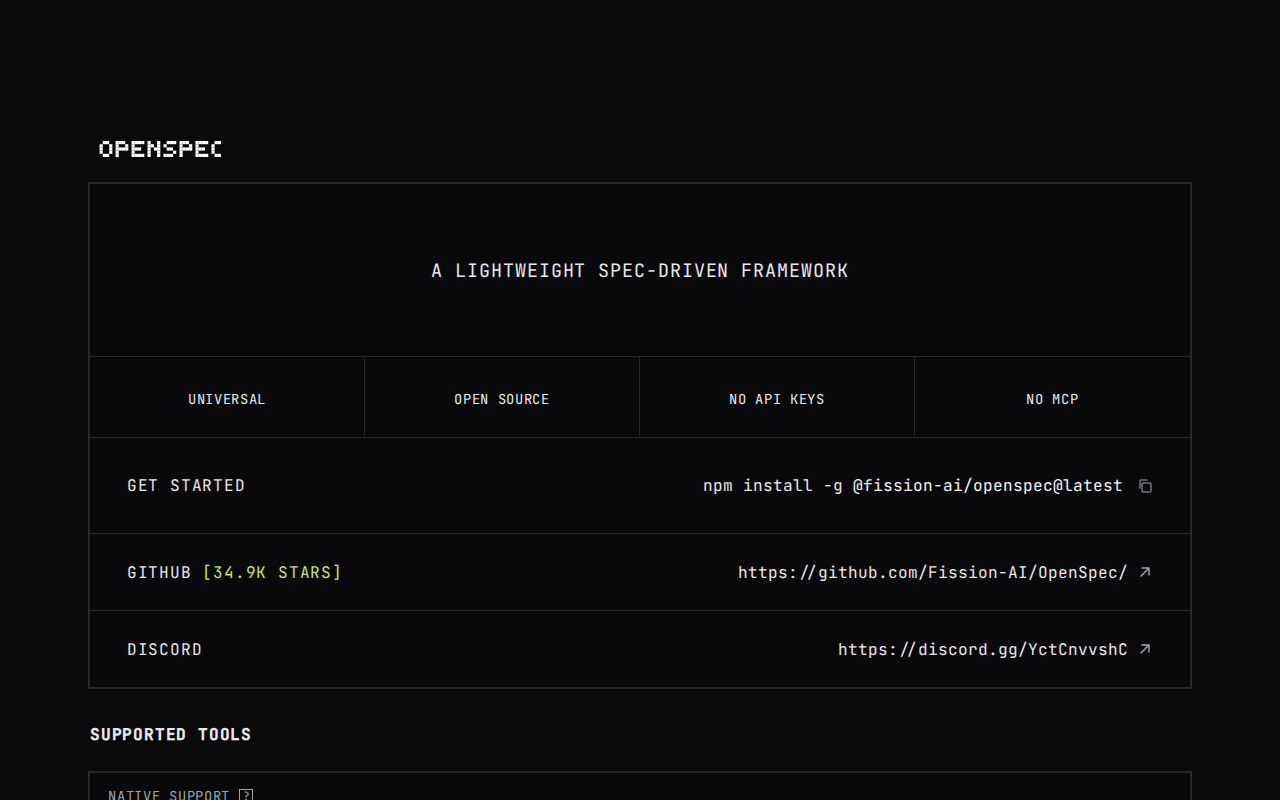
OpenSpec is a lightweight, open-source framework designed to streamline the development of AI-powered applications. It enables developers to build applications driven by specifications, promoting consistency and maintainability. Unlike frameworks that rely on complex configurations or proprietary APIs, OpenSpec offers a simplified approach with no API keys and native support for various AI tools. This framework excels in providing a universal, spec-driven environment, making it ideal for developers and teams looking to build robust and scalable AI applications with ease. OpenSpec's focus on simplicity and open-source principles sets it apart from alternatives, offering a more accessible and collaborative approach to AI development.
OpenSpec — A lightweight spec‑driven framework 's Core features
Spec-Driven Development
OpenSpec uses specifications as the core of your application. This approach ensures consistency and maintainability by defining the expected behavior and interactions of your AI tools. This contrasts with ad-hoc development, reducing errors and improving collaboration. Specifications are written in a declarative format, making them easy to understand and modify, leading to faster development cycles and fewer bugs.
Universal Open Source
OpenSpec is completely open-source, promoting transparency and community contributions. This means no vendor lock-in and the ability to customize the framework to your specific needs. The open-source nature fosters a collaborative environment, allowing developers to share knowledge and contribute to the project's evolution. This also ensures long-term viability and reduces reliance on proprietary solutions.
Native Tool Integrations
OpenSpec provides native support for a wide range of AI tools, including Claude, Code Cursor, and GitHub Copilot. These integrations offer custom slash commands and streamlined workflows. This built-in support reduces the need for custom integrations, saving developers time and effort. The native integrations ensure compatibility and optimal performance with the supported tools.
No API Keys Required
OpenSpec eliminates the need for API keys, simplifying the development and deployment process. This reduces the complexity associated with managing and securing API keys, making it easier to get started and scale your applications. This also removes potential costs associated with API key usage and simplifies the development workflow.
Lightweight Framework
OpenSpec is designed to be lightweight, ensuring efficient resource utilization and fast performance. This is particularly beneficial for serverless deployments and applications with strict latency requirements. The lightweight nature contributes to faster startup times and reduced operational costs, making it ideal for scalable AI applications.
How to use OpenSpec — A lightweight spec‑driven framework
- Install the OpenSpec CLI globally using npm:
npm install -g @fission-ai/openspec@latest.,2. Initialize a new OpenSpec project in your desired directory.,3. Define your specifications using OpenSpec's declarative syntax.,4. Integrate OpenSpec with your preferred AI tools, leveraging native support where available.,5. Build and test your application, ensuring it aligns with the defined specifications.,6. Deploy your application, utilizing OpenSpec's lightweight nature for efficient resource usage.
Use cases of OpenSpec — A lightweight spec‑driven framework
AI-Powered Code Generation
Developers can use OpenSpec to build applications that leverage AI for code generation. They define specifications for the desired code, and OpenSpec integrates with tools like GitHub Copilot to generate the code based on those specifications. This accelerates development and reduces the time spent on repetitive coding tasks.
Automated Content Creation
Content creators can use OpenSpec to automate the creation of various content formats. By defining specifications for articles, social media posts, or marketing copy, they can leverage AI tools to generate content that meets their specific requirements. This streamlines the content creation process and improves efficiency.
Chatbot Development
Businesses can use OpenSpec to build and deploy chatbots with ease. They can define the conversational flows and desired responses using specifications, and OpenSpec integrates with tools to create intelligent and responsive chatbots. This improves customer service and automates interactions.
Data Analysis and Reporting
Data analysts can use OpenSpec to automate data analysis and reporting tasks. They can define specifications for data processing, analysis, and report generation, and OpenSpec integrates with AI tools to automate these processes. This reduces manual effort and improves the accuracy of insights.
Who benefits from OpenSpec — A lightweight spec‑driven framework
AI Developers
AI developers benefit from OpenSpec's spec-driven approach, which simplifies the development process and ensures consistency. It helps them build robust and scalable AI applications with ease, reducing development time and improving code quality. The framework's lightweight nature and native tool integrations are particularly valuable.
Software Engineers
Software engineers can leverage OpenSpec to integrate AI capabilities into their existing applications. The framework's open-source nature and ease of use enable them to quickly add AI-powered features without extensive training or complex configurations. This allows them to enhance their products with AI.
Data Scientists
Data scientists can use OpenSpec to streamline their workflows and automate data-related tasks. The framework's ability to integrate with various AI tools and its focus on specifications enable them to build data-driven applications more efficiently. This improves the speed and accuracy of their analyses.
Pricing of OpenSpec — A lightweight spec‑driven framework
Open Source (MIT License). Free to use and modify.