Haystack
Open-Source AI Framework
Freemium
Support platforms
web
What is Haystack
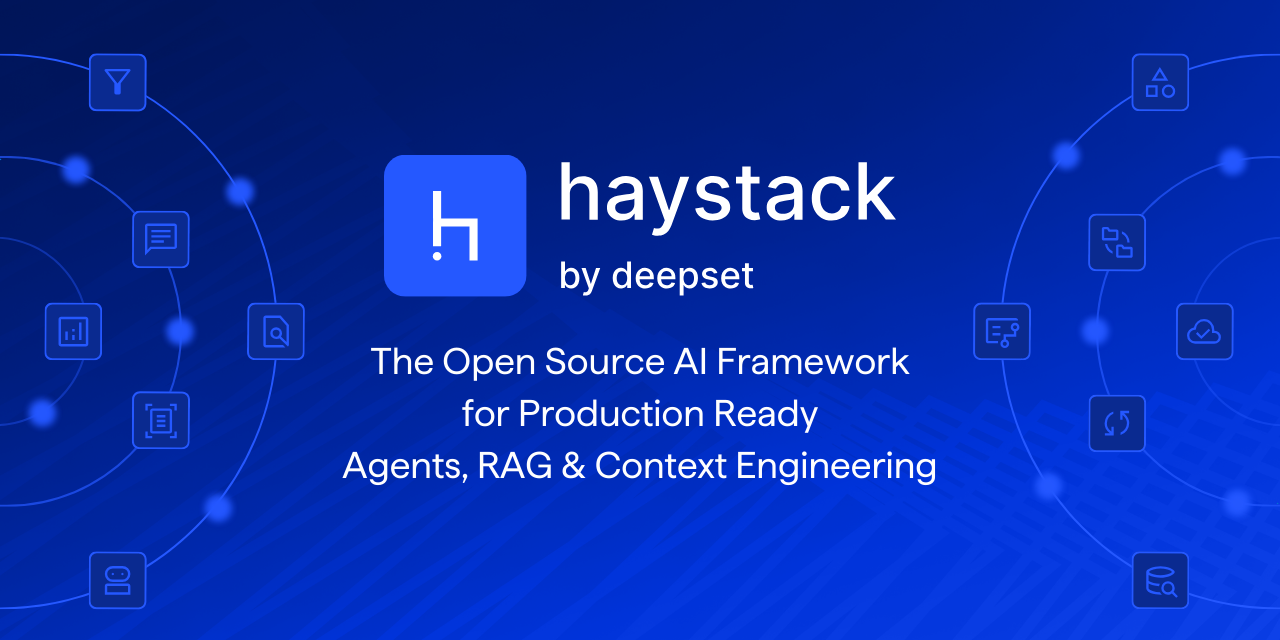
Haystack is an open-source framework designed for building production-ready AI agents, Retrieval-Augmented Generation (RAG) systems, and facilitating advanced context engineering. It provides a modular and flexible architecture, enabling developers to orchestrate every step of their AI workflows, from data retrieval and reasoning to memory management and tool utilization. Unlike proprietary solutions, Haystack offers full visibility into the decision-making processes of AI agents, allowing for inspection, debugging, and optimization. It supports seamless integration with a wide range of AI tools and services, including OpenAI, Anthropic, Mistral, Hugging Face, and various vector databases, avoiding vendor lock-in. Haystack's composable building blocks accelerate the transition from prototype to production. This makes it ideal for developers and data scientists seeking to build transparent, scalable, and customizable AI applications.
Haystack 's Core features
Modular and Flexible Architecture
Haystack's modular design allows developers to select and combine components based on their specific needs. This flexibility enables the creation of custom AI workflows, from simple question-answering systems to complex agentic applications. Components are easily swapped out, allowing for experimentation with different retrieval strategies, readers, and generators. This modularity promotes code reusability and simplifies maintenance.
Production-Ready Components
Haystack provides pre-built, optimized components for common AI tasks, such as document retrieval, question answering, and text generation. These components are designed for scalability and performance, enabling developers to build production-ready systems without extensive manual optimization. For example, the framework includes optimized implementations for various retrieval methods, including BM25 and dense vector search, with support for different vector database backends.
Context Engineering Capabilities
Haystack offers tools for advanced context engineering, allowing developers to refine and optimize the information provided to language models. This includes features like query rewriting, document filtering, and context aggregation. By carefully crafting the context, developers can improve the accuracy and relevance of AI-generated responses. For instance, Haystack supports the use of Jinja2 templates for dynamic system prompts in Agents, enabling greater control over the model's behavior.
Seamless Integrations
Haystack integrates with a wide range of AI tools and services, including popular language models, vector databases, and cloud platforms. This allows developers to easily incorporate Haystack into their existing workflows and leverage the best-in-class solutions. The framework supports integrations with OpenAI, Anthropic, Mistral, Hugging Face, Weaviate, Pinecone, and Elasticsearch, among others, minimizing vendor lock-in.
Agentic AI Support
Haystack provides a robust framework for building and deploying AI agents. It allows developers to orchestrate complex workflows involving multiple steps, such as information retrieval, tool use, and decision-making. The framework supports features like memory management and planning, enabling the creation of sophisticated agents that can interact with the world and solve complex problems. This includes support for LLMRanker for high-quality context.
How to use Haystack
- Install Haystack using pip:
pip install haystack-ai.,2. Choose your preferred document store (e.g., Elasticsearch, Weaviate) and install the relevant integration:pip install haystack-ai[elasticsearch].,3. Configure your document store connection details in your Python script.,4. Load your data into the document store using Haystack's data ingestion pipelines.,5. Define your retrieval strategy, such as using dense or sparse retrievers.,6. Build your RAG pipeline by connecting the retriever, reader (e.g., a question answering model), and generator (e.g., a language model).
Use cases of Haystack
Building RAG Applications
Data scientists can use Haystack to build Retrieval-Augmented Generation (RAG) systems that provide accurate and up-to-date answers to user queries. They can ingest documents, build retrieval pipelines, and connect them to language models to generate responses. For example, a legal firm could use Haystack to build a RAG system that answers questions about legal documents.
Creating AI-Powered Chatbots
Developers can leverage Haystack to create intelligent chatbots that can answer questions, provide information, and automate tasks. They can integrate Haystack with various messaging platforms and use its components to handle natural language understanding, context retrieval, and response generation. A customer service team could use Haystack to build a chatbot to answer common customer inquiries.
Developing Knowledge Management Systems
Organizations can use Haystack to build knowledge management systems that allow users to easily search and retrieve information from a large corpus of documents. They can use Haystack's retrieval and ranking capabilities to improve search accuracy and relevance. For example, a company could use Haystack to build an internal knowledge base for employees.
Building AI Agents for Automation
Developers can use Haystack to create AI agents that automate complex tasks, such as data analysis, report generation, and process automation. They can use Haystack's agentic capabilities to orchestrate workflows involving multiple steps and tools. A financial analyst could use Haystack to build an agent that automatically generates financial reports.
Who benefits from Haystack
AI Engineers and Researchers
AI engineers and researchers benefit from Haystack's modular architecture, which allows them to experiment with different components and build custom AI workflows. They can leverage Haystack's pre-built components and integrations to accelerate their research and development efforts, focusing on innovation rather than infrastructure.
Data Scientists
Data scientists can use Haystack to build production-ready AI applications, such as RAG systems and chatbots. They can leverage Haystack's tools for data ingestion, retrieval, and generation to create accurate and reliable solutions. Haystack simplifies the process of deploying and managing AI models in real-world scenarios.
Software Developers
Software developers can integrate Haystack into their applications to add AI-powered features, such as natural language understanding and question answering. They can leverage Haystack's APIs and integrations to build intelligent applications without needing to build AI infrastructure from scratch. This allows for rapid prototyping and deployment.
Pricing of Haystack
Haystack is open-source (Apache 2.0 License). Haystack Enterprise offers a free trial and a platform with custom pricing. Contact for details.