Langfuse
LLM Observability & Debugging
Freemium
Support platforms
web
What is Langfuse
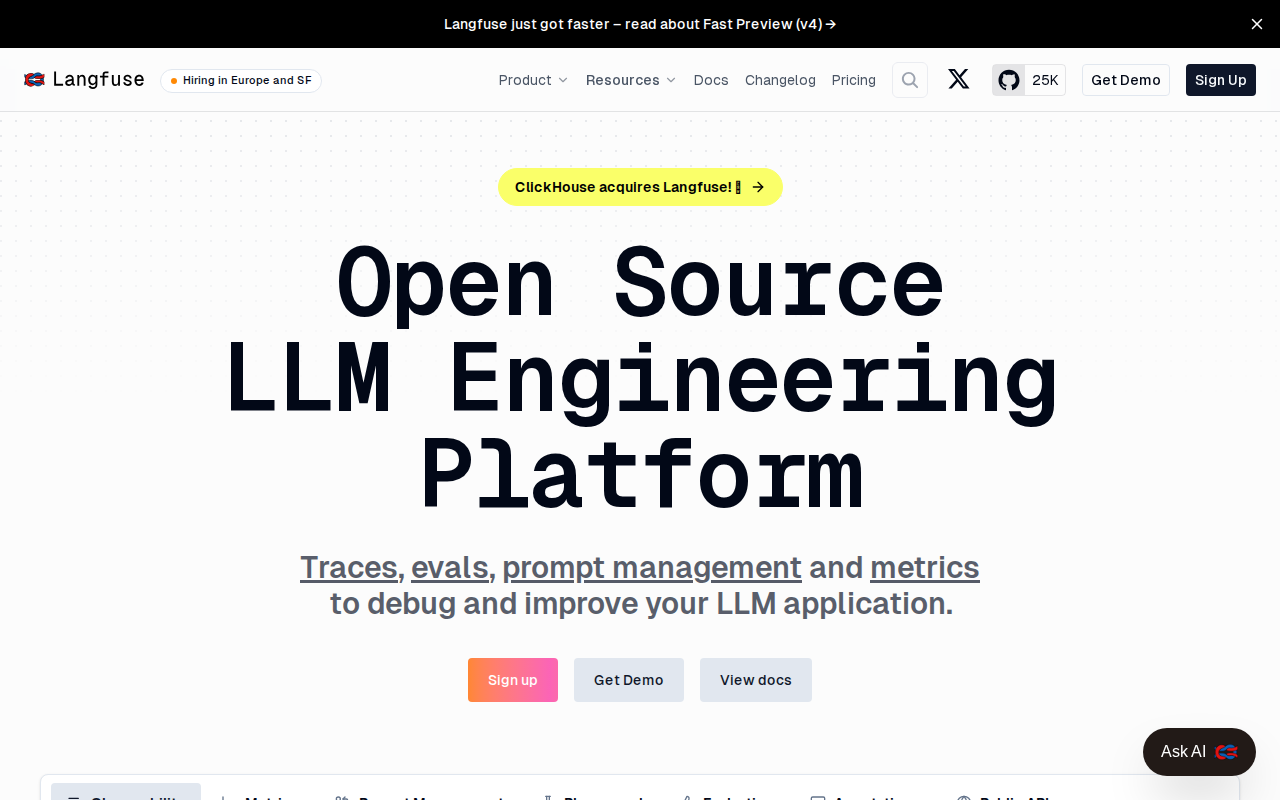
Langfuse is an open-source platform designed for comprehensive observability, prompt management, and evaluation of LLM applications. It provides a centralized hub for tracing LLM interactions, managing prompts, and rigorously evaluating model performance through metrics. Unlike basic logging tools, Langfuse offers deep insights into LLM behavior, enabling developers to debug issues, optimize prompts, and track key performance indicators (KPIs) such as cost, latency, and accuracy. Its unique value lies in its end-to-end approach, integrating tracing, prompt versioning, and evaluation in a single platform. This allows for streamlined workflows and data-driven decision-making. Langfuse is built for AI engineers and developers who need to build, monitor, and improve LLM-powered applications. It helps them understand and refine their LLM integrations, leading to better user experiences and more efficient resource utilization.
Langfuse 's Core features
LLM Tracing & Observability
Provides detailed traces of all LLM interactions, including inputs, outputs, and metadata. This allows developers to understand the complete lifecycle of each LLM call, identify errors, and pinpoint performance bottlenecks. Traces include timing data, token counts, and cost metrics, enabling comprehensive monitoring and debugging. This is superior to basic logging, offering a structured view of LLM behavior.
Prompt Management & Versioning
Offers robust prompt management capabilities, allowing users to create, version, and deploy prompts efficiently. This feature supports A/B testing of different prompts, enabling data-driven optimization. Users can track prompt performance over time and easily revert to previous versions. This is crucial for maintaining consistency and improving the quality of LLM outputs, reducing the need for manual prompt management.
Evaluation Metrics & Datasets
Enables the creation of custom evaluation metrics and the use of datasets to assess LLM performance. Users can define metrics relevant to their specific use cases, such as accuracy, relevance, and coherence. The platform supports automated evaluation runs and provides detailed reports on model performance. This allows for continuous improvement and ensures the reliability of LLM applications, unlike manual evaluation processes.
Interactive Playground
Offers an interactive playground to experiment with prompts and LLMs directly within the Langfuse interface. This allows developers to quickly test and refine prompts without needing to deploy code. The playground provides real-time feedback on prompt performance and includes features like prompt versioning and evaluation integration. This accelerates the development cycle and makes prompt optimization more efficient.
SDKs and Integrations
Provides SDKs for popular programming languages (Python, JavaScript, etc.) and integrations with leading LLM providers and platforms. This simplifies the process of integrating Langfuse into existing projects. The SDKs automatically capture essential data, and the integrations streamline the setup process. This ensures compatibility and ease of use for developers across various environments.
How to use Langfuse
- Sign up for a Langfuse account and create a project.,2. Install the Langfuse SDK for your preferred programming language (e.g., Python, JavaScript).,3. Instrument your LLM calls by wrapping them with Langfuse's tracing functions; this automatically captures inputs, outputs, and metadata.,4. Define and manage your prompts within the Langfuse platform, versioning them for easy A/B testing and rollback.,5. Set up evaluation metrics and datasets to assess your LLM's performance on key tasks.,6. Analyze traces, prompt versions, and evaluation results within the Langfuse dashboard to identify areas for improvement and optimize your LLM applications.
Use cases of Langfuse
Debugging LLM Applications
AI engineers use Langfuse to trace and analyze LLM calls, identifying errors and performance issues in their applications. They can examine detailed traces to understand why an LLM is producing unexpected outputs, quickly pinpointing the root cause and resolving it, leading to faster debugging cycles.
Prompt Optimization
Developers leverage Langfuse to A/B test different prompts, comparing their performance based on defined metrics. They can iterate on prompts, track their impact on key performance indicators (KPIs), and identify the most effective prompts for their specific use cases, improving the quality of LLM outputs.
LLM Cost Management
Teams utilize Langfuse to monitor the cost of LLM calls, tracking token usage and associated expenses. They can identify inefficient prompts or models that are driving up costs. This enables them to optimize their LLM usage, reducing expenses and improving the ROI of their AI investments.
Performance Monitoring
Product managers use Langfuse to monitor the performance of their LLM-powered features in production. They track metrics like latency, accuracy, and error rates to ensure a high-quality user experience. This allows them to proactively address issues and maintain the reliability of their applications.
Who benefits from Langfuse
AI Engineers
AI engineers need Langfuse to debug, monitor, and optimize their LLM-based applications. It provides the tools necessary to understand the inner workings of LLMs, identify performance bottlenecks, and improve the overall quality of their AI solutions.
Software Developers
Developers benefit from Langfuse by gaining insights into their LLM integrations, enabling them to build more robust and reliable applications. They can easily trace LLM calls, manage prompts, and evaluate performance, leading to faster development cycles.
Product Managers
Product managers use Langfuse to monitor the performance of LLM-powered features in production. They can track key metrics, identify areas for improvement, and ensure a high-quality user experience, leading to better product outcomes.
Pricing of Langfuse
Open Source (MIT). Cloud hosted: Free tier, paid plans available with increased request limits and features. Enterprise options available.